

Emerald Pages
◆
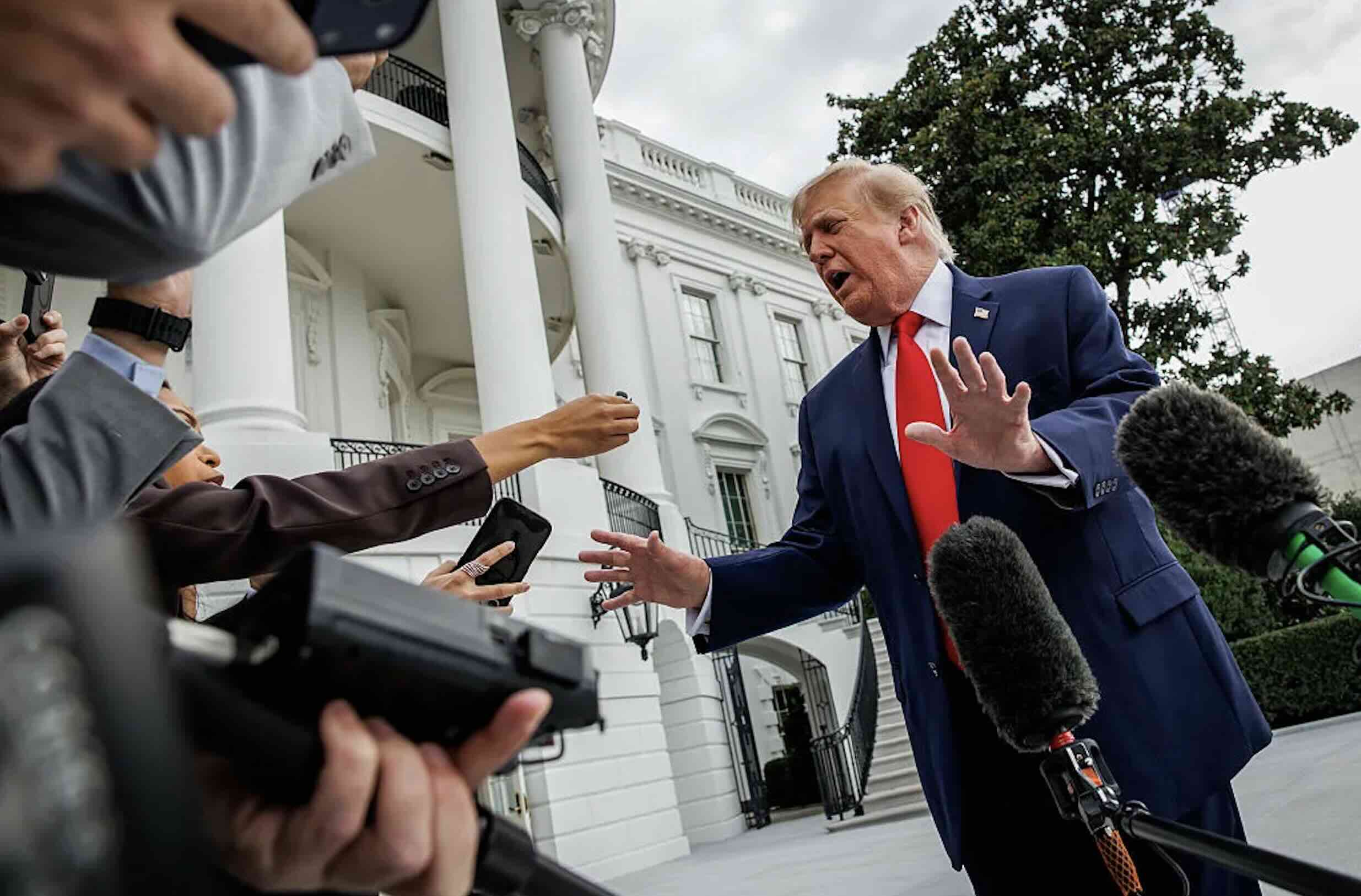
Photo: Reuters
President Donald Trump has repeatedly threatened to bomb Iran's power plants and critical infrastructure as coercive leverage in the ongoing Strait of Hormuz standoff. While the administration frames these threats as a final "deal-maker" to force Tehran's surrender, a growing consensus of economists, energy analysts, and financial institutions warns that executing this plan would not just punish Iran—it would trigger a self-inflicted economic catastrophe for the United States.
The current 2026 conflict has already cost American households over $100 billion. A full-scale strike on Iran's electrical grid, coupled with Iran's vowed asymmetric retaliation against regional energy infrastructure, would transform this slow bleed into a catastrophic hemorrhage, risking a severe stagflationary recession and sending global oil prices spiraling toward $200 a barrel.
The threat is not theoretical. According to reports from outlets like BBC News, President Trump has stated on social media and in interviews that the U.S. would target Iranian power plants and bridges—including locations near or in Tehran—in response to attacks on commercial vessels in the vital waterway. Reporting by Axios noted that U.S. officials indicated strikes on Iranian energy and infrastructure targets are seriously considered as a pressure tactic to force Iran's compliance in ceasefire or nuclear talks, though final orders often fluctuate with the president's shifting rhetoric and rolling deadlines.
The core danger lies in the interconnected nature of global oil markets. While the U.S. imports very little crude directly from the Persian Gulf, oil is a globally traded commodity. Destroying Iran's power grid would likely trigger severe asymmetric retaliation from Tehran, which has explicitly stated that if its infrastructure is destroyed, it will use drone and missile networks to target major oil extraction and processing plants in neighboring Gulf states, vital water desalination facilities in Saudi Arabia, Kuwait, and the UAE, and global maritime channels in the Strait of Hormuz and the Red Sea.
The Chokepoint Cascade: From $120 to $200 Oil
Over 20 million barrels of oil pass through the Strait of Hormuz daily. If Iran's Revolutionary Guards make good on their threat to permanently block the Strait in response to a grid strike, it could send global crude prices surging from their current conflict range of $90–$120 per barrel to a devastating $150–$200 per barrel.
- Global Crude Oil: Projected to spike to $150–$200/barrel if regional infrastructure is permanently taken offline.
- U.S. Gas Prices: Forecast to surge past $5.50–$6.00 per gallon nationally as supply chains contract.
- Regional Production Loss: Permanent multi-million barrel shortages if Gulf desalination or extraction nodes are struck.
- Recession Risk: A full infrastructure war shifts the U.S. economy from slower growth into a severe stagflationary recession.
For the U.S., this translates directly into a domestic inflation bomb. Fuel costs, already driving annual consumer inflation to a three-year peak, would skyrocket. Gasoline prices—already hovering near $4.10 to $4.47 a gallon—would shatter records. Diesel, a critical input for nearly every sector of the economy, has already hit a staggering $6.27 to $6.50 a gallon. A total infrastructure war would push these figures into uncharted territory.
The Center for Strategic and International Studies (CSIS) and U.S. cybersecurity officials have also warned that Iran views asymmetric cyberattacks as its strongest weapon against the West. IRGC generals have explicitly threatened to target the highly fragmented and vulnerable U.S. electrical grid and financial digital infrastructure in response to any attacks on Tehran's infrastructure. This adds a second front to the economic war—one that could disrupt everything from banking to hospital operations on American soil.
The "Interest Rate Penalty" and the Stagflation Trap
Because war-driven energy costs have fueled broader consumer inflation, the Federal Reserve has kept borrowing costs elevated rather than cutting them. The Center for American Progress estimates this extra interest penalty drains capital straight out of the economy. To combat further war-driven inflation, interest rates would remain elevated or climb even higher. According to analysis by Moody's Analytics, higher borrowing costs are projected to drain an extra $4.6 billion from U.S. households, $12.7 billion from non-financial businesses, and $30.8 billion from the government this year alone.
This creates a scenario economists call "stagflation"—a rare and damaging mix of a shrinking economy paired with rapidly rising prices. The Fed would be trapped: lowering interest rates to stimulate growth would accelerate inflation, while raising rates to cool inflation would crush economic growth. Because a massive energy war would send inflation to multi-decade highs, the Fed would likely be forced to keep interest rates highly elevated despite a crashing job market, leaving the economy stuck in a prolonged downturn with no easy policy escape.
The per-household cost is already staggering. Analysts estimate the current total cost of the war has reached roughly $1,100 per American household when factoring in defense spending and broader price increases for groceries, energy, and airfare. A full infrastructure war would multiply this figure several times over. Direct military spending alone—the Pentagon has spent roughly $29 billion to $38 billion on unbudgeted direct military operations and munitions—would balloon further as the conflict expands.
The Collapse of Consumer Spending
Consumer spending drives roughly 70% of the U.S. economy. When regular households are forced to spend hundreds of extra dollars a month on war-inflated necessities like $6.00-a-gallon gasoline, grocery bills, and winter heating—Northeast households relying on heating oil are already projected to pay $2,279 this winter, a $548 increase over last year—they immediately stop spending money on discretionary items.
The result is a collapse in retail, hospitality, travel, and entertainment sectors, triggering widespread business failures and layoffs. The "interest rate penalty" further compounds the pain by making mortgages, auto loans, and credit card debt more expensive. The World Food Programme already estimates that 45 million people are facing acute hunger due to the ongoing conflict—a figure that would rise dramatically if the power grid is destroyed, halting the processing, refrigeration, and distribution of food supplies across the region.
The Humanitarian Catastrophe Inside Iran
The economic fallout for Americans would be matched—and in some ways exceeded—by a humanitarian catastrophe inside Iran. Human rights organizations and international observers warn that completely disabling Iran's electrical grid would put millions of civilian lives at acute risk. The country's 92 million citizens depend on electric pumps to draw water from groundwater wells and operate desalination networks. A complete blackout would instantly cut off drinking water and cripple sewage systems, creating a major crisis of disease and dehydration.
Public health emergencies would follow immediately. Losing power would disable hospital emergency rooms, render medical equipment useless, and break the cold chains needed to preserve vaccines and medication. The World Food Programme's estimate of 45 million people facing acute hunger would become a full-scale famine as food processing and distribution systems collapse.
Legal scholars and historians point to the 1991 Persian Gulf War as a warning. When the U.S. destroyed Iraq's electrical grid, the immediate bombing casualties were outnumbered tenfold by subsequent civilian deaths. The resulting collapse of water treatment facilities led to massive cholera outbreaks and a documented 46,900 excess deaths among Iraqi children under the age of five alone. United Nations and Amnesty International officials have repeatedly stated that carrying out these infrastructure threats would likely constitute a civilian war crime under the Geneva Convention, which strictly bans attacks that cause "excessive incidental civilian harm."
The Strategic Backfire
The irony is that the very act meant to force Iran's surrender—destroying their power grid—would likely entrench the regime, unite the Iranian public in anti-American sentiment, and devastate the American economy. It is a strategic backfire of historic proportions.
Intelligence and defense experts argue that because Iran's operational military assets rely largely on independent diesel generators and jet fuel, destroying civilian power plants would paralyze society while leaving Iran's underground missile capabilities largely intact. The military returns would be diminishing, while the humanitarian and economic costs would be catastrophic.
Critics, including members of Congress, warn that inflicting "unthinkable horrors" on 92 million civilians will backfire. Rather than forcing a rebellion, a humanitarian catastrophe would likely unite the Iranian public in deep anti-American sentiment, validating the regime's propaganda and strengthening their resolve to fight to the end.
This is not a hypothetical concern. Recent polling by CNN shows that roughly 76% of Americans feel the ongoing war is not worth the immense economic and human costs, complicating Trump's political calculations. The administration's own reluctance to permanently destroy expensive civilian infrastructure—acknowledging it might ultimately require costly post-conflict reconstruction—reveals an awareness that the strategy is self-defeating.
A Recession of Choice
The economic fallout would not be a side effect of the war; it would be the primary theater of conflict. Iran's strategy is explicitly designed to exploit America's economic vulnerability. By targeting the global energy chokepoint and regional infrastructure, Tehran aims to make the war too politically, financially, and morally costly for the United States to continue.
As IEA head Fatih Birol has warned, the ongoing crisis presents a threat worse than the combined oil shocks of the 1970s. Economists point to the 1973 OPEC oil embargo and the 1979 Iranian Revolution as exact historical blueprints for this risk. In both instances, Middle East geopolitical conflicts abruptly cut global oil supplies, crude prices doubled or tripled in a matter of weeks, and the U.S. economy immediately plunged into deep, painful recessions characterized by long gas lines, skyrocketing unemployment, and double-digit inflation that took nearly a decade to fully correct.
A full infrastructure war would shift the U.S. economy from a period of slower growth into a severe stagflationary recession, with global economic damage that international mediators warn could become "unbearable." The ultimate risk is a stagflationary cycle: soaring daily operational costs for regular citizens paired with a forced slowdown in domestic business output.
The White House has repeatedly issued ultimatums but then paused or extended deadlines to give international mediators room to negotiate an off-ramp. That caution is warranted. The decision facing Trump is not simply whether to strike Iran—it is whether to accept the near-certain economic devastation that would follow. The answer, from an economic standpoint, is clear: the price of this escalation is far higher than any potential gain. It is a recession of choice, and one that the United States cannot afford.
No Ads. By Us. For Us.
This article was made possible by readers like you. We hope it inspired you to support Emerald Book, so we can continue producing content like this.
We will never show you ads, sell your data, or require a subscription to consume our content. Your gift helps us keep the truth accessible.
Click the Support button to give a gift of any amount today.
Thank you for making this work possible.