

Emerald Pages
◆
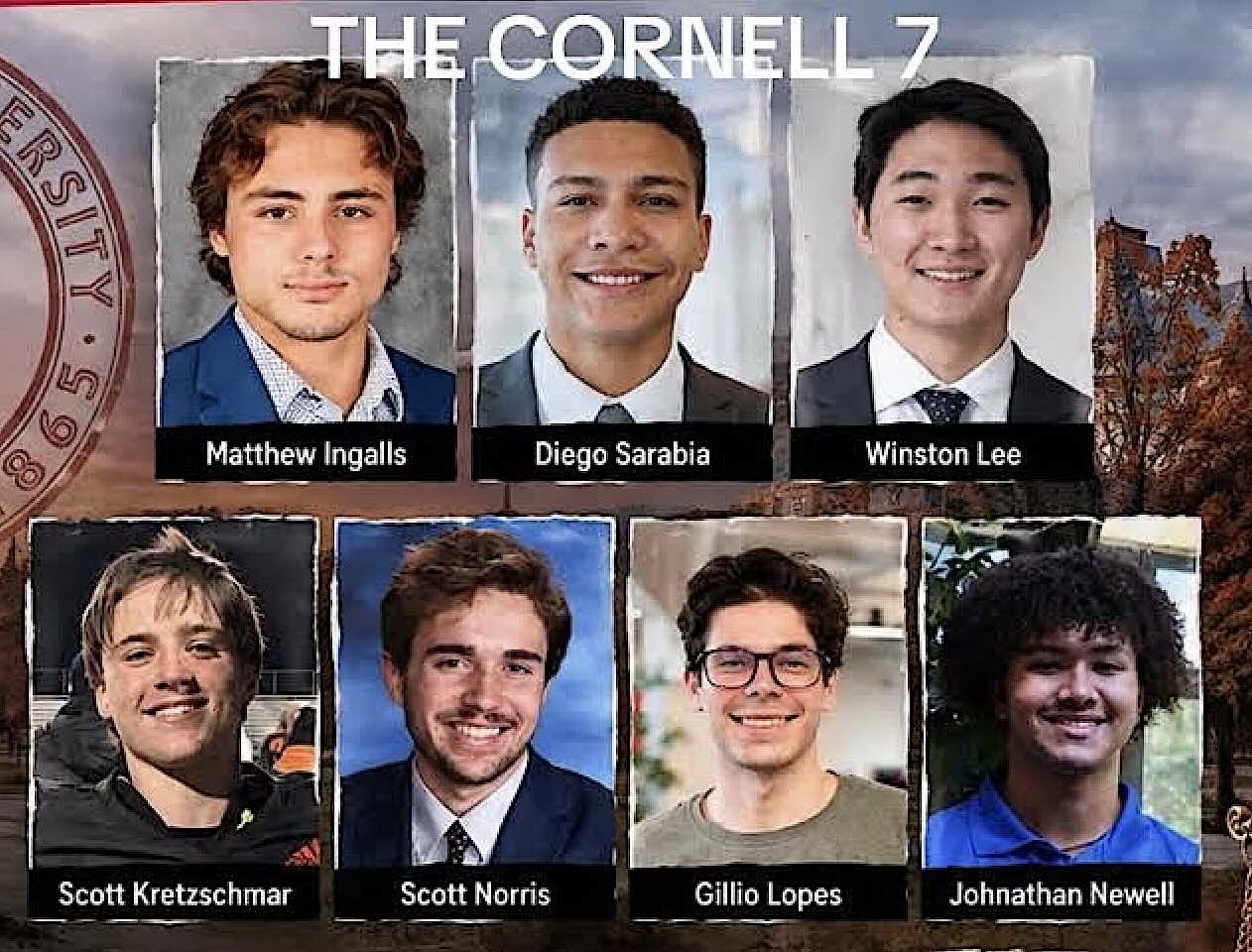
Photo: @boopterjay | TikTok
When a 20-year-old Cornell student reported that she had been drugged and sexually assaulted over seven hours at the Chi Phi fraternity house in October 2024, the case did not immediately become a criminal investigation. Instead, it became an internal student conduct matter—a “code of conduct violation”—handled entirely behind closed doors by Cornell University.
That quiet, administrative classification would have remained hidden from public view were it not for one thing: The Cornell Daily Sun, the university’s independent student newspaper, which refused to let the story stay buried.
The case now known as the “Cornell 7” centers on a civil lawsuit filed on September 16, 2026, by the survivor, identified in court documents as Jane Doe. The 101-page complaint alleges that seven fraternity members—Matthew Ingalls, Johnathan Newell, Winston Lee, Gillio Lopes, Diego Sarabia, Scott Norris, and Scott Kretzschmar—drugged and gang-raped her at the Chi Phi house. The lawsuit includes screenshots of a Snapchat group chat in which members allegedly alerted others that she was in a room and invited them to join.
The “Code of Conduct” Shield
Cornell’s decision to treat the allegation as a code of conduct violation rather than a criminal matter is at the heart of the public outrage. Under this internal disciplinary framework, the case was heard by a panel of faculty, staff, and students—not a judge or jury. The burden of proof was “preponderance of the evidence,” meaning the panel only needed to decide whether it was “more likely than not” that the assault occurred. The maximum punishment available was expulsion or suspension.
The university conducted a multi-day Title IX hearing in May 2025. According to Cornell Vice President for University Relations Kyle Kimball, the panel issued “a range of sanctions, which included expulsions and suspensions.” The local Chi Phi chapter was permanently barred from campus in 2024. But because the proceedings were classified as internal student disciplinary records, they were shielded from public disclosure by the federal Family Educational Rights and Privacy Act (FERPA).
- Private panels, not courts: The case was heard by university faculty and staff, not a criminal court.
- Lower burden of proof: Internal hearings use a “more likely than not” standard, not “beyond a reasonable doubt.”
- Administrative punishments only: The maximum penalty was expulsion—no jail time, no criminal record.
- FERPA shield: Federal privacy law prevented Cornell from publicly naming who was punished or revealing the details.
To the university, this was a closed case. To the survivor and her legal team, it was an injustice buried in confidential files.
The Student Newspaper That Broke the Silence
The turning point came on September 21, 2026, when The Cornell Daily Sun published a viral editorial titled “Cornell won’t, we will.” Led by Editor-in-Chief Sophia Dasser, the student newspaper pulled the names of the seven accused men directly from the public civil court docket—something Cornell was legally prohibited from doing under FERPA.
As an independent student publication, The Daily Sun is not bound by the same federal privacy laws that constrain the university. Once the civil lawsuit was filed, the complaint became a matter of public record. The student journalists used their First Amendment rights to expose the details, including the Snapchat group chat logs and the multi-hour timeline of the alleged assault.
The editorial board argued that Cornell’s quiet, internal discipline was entirely insufficient for an alleged gang rape. They accused the university of protecting the reputations of the accused—allowing some to remain on sports rosters or transition into corporate jobs without public accountability.
The Fallout: Criminal Investigation Reopened
The student newspaper’s reporting ignited a firestorm. Major national outlets—CNN, ABC News, NBC News, The New York Times, The Guardian—picked up the story. Public outcry intensified. And on September 28, 2026, Tompkins County District Attorney Matthew Van Houten announced that his office was officially reopening the criminal investigation.
In his statement, Van Houten explicitly acknowledged that “the community outrage stemming from the… news and social media coverage” forced his office to revisit the case and present evidence to a grand jury. The DA had initially declined to press charges in late 2024, citing the victim’s original sworn statement, which he said described the drug use and sexual conduct as “voluntary, conscious, and consensual.” Her attorney, Thomas Giuffra, disputes that characterization, arguing that campus police failed to use trauma-informed interview techniques and overlooked the Snapchat evidence.
The Ithaca Police Department also released a statement noting they were “disturbed” by the allegations but had been left completely in the dark by Cornell University Police in 2024. They only learned about the alleged gang rape through recent news reports.
An Institutional Failure
The Cornell case has become a national flashpoint in the debate over how universities handle campus sexual violence. By classifying an alleged gang rape as a “code of conduct violation,” Cornell effectively shielded the accused from public and criminal accountability for nearly two years.
Cornell has fiercely disputed the narrative that it trivialized the assault. The university stated that it permanently barred the Chi Phi chapter, conducted a thorough Title IX hearing, and issued expulsions and suspensions. It also denied that writing essays was ever used as a sole consequence for the assault, calling that a “false narrative.”
But the university also acknowledged that federal privacy law prevented it from publicly naming who was punished or detailing individual sanctions. That legal constraint, combined with the DA’s initial decision not to press charges, kept the case out of the public eye until the student newspaper forced it into the open.
The grand jury review is expected to take about 45 days. A senior prosecutor has been assigned to prepare the criminal case, which will include the civil complaint details, the digital evidence, and Jane Doe’s testimony.
What Comes Next
The reopened criminal investigation is now moving forward, but the case has already exposed deep questions about institutional accountability. Cornell’s internal Title IX process, its reliance on FERPA, and its decision to treat the allegation as a code of conduct violation all contributed to a two-year delay in criminal scrutiny.
Meanwhile, the defendants’ lawyers have begun issuing statements denying liability. Scott Kretzschmar’s attorney, Jeremy Saland, issued a flat denial, stating his client did not touch or sexually assault the plaintiff. Scott Norris acknowledged sending messages in the Snapchat group but said he was not present when any misconduct occurred. Other defendants have retained counsel and are pointing to the 2024 police findings.
The case has also sparked corporate fallout. Wells Fargo terminated an employment contract with one of the named defendants after the student newspaper published their names.
But perhaps the most enduring lesson is this: it took a student-run newspaper—not the university, not the local police, not the district attorney—to force an alleged gang rape out of the shadows of a confidential code of conduct file and into the light of the criminal justice system.
No Ads. By Us. For Us.
This article was made possible by readers like you. We hope it inspired you to support Emerald Book, so we can continue producing content like this.
We will never show you ads, sell your data, or require a subscription to consume our content. Your gift helps us keep the truth accessible.
Click the Support button to give a gift of any amount today.
Thank you for making this work possible.