

Emerald Pages
◆
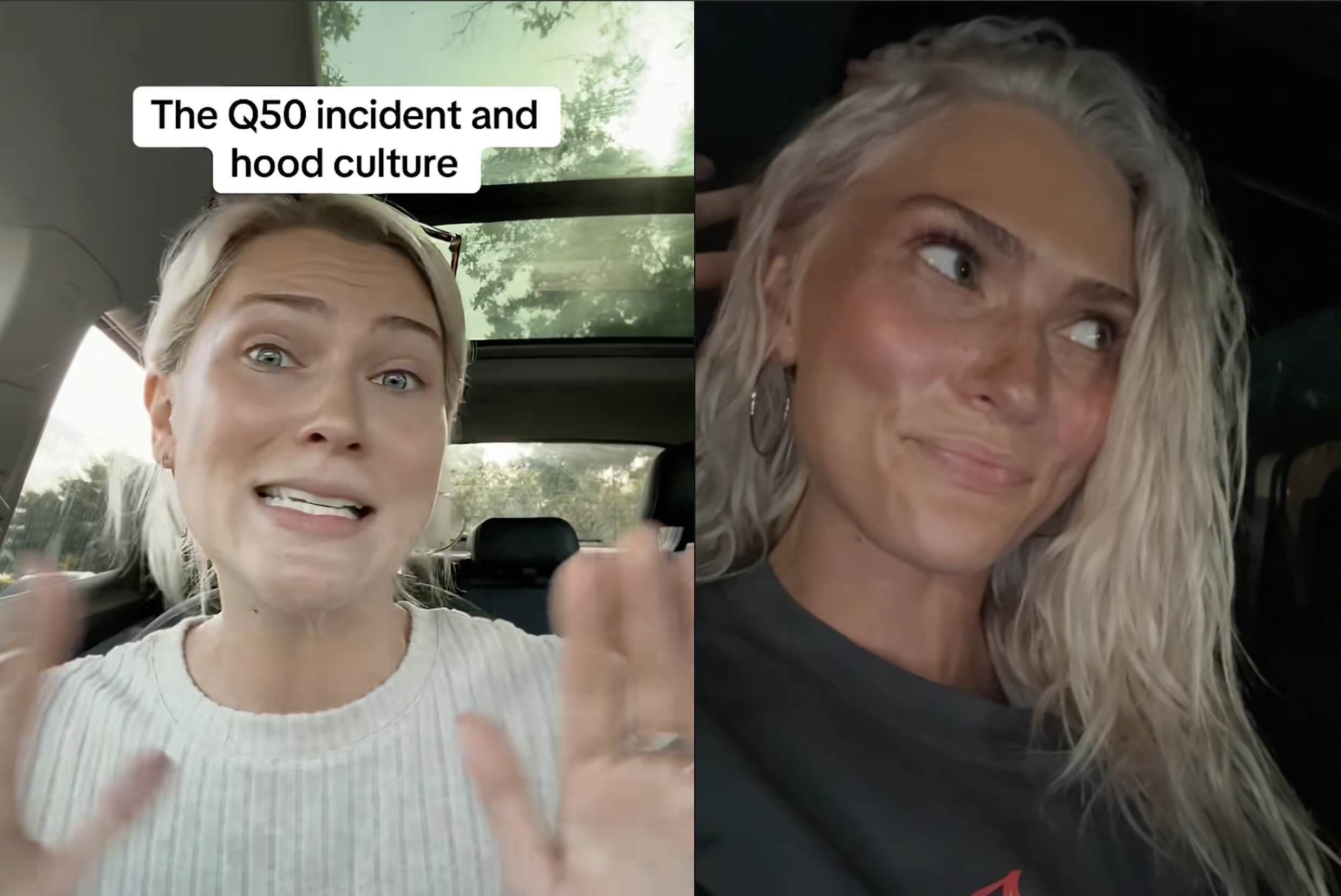
Photo: @nolablest2020 | Instagram
The video that launched a thousand stitches, critiques, and collective groans was, on its surface, unremarkable. A woman sits in her car, a suburban setting visible through the windows, and proceeds to deliver a passionate, unironic critique of modern street violence. She questions why conflicts can no longer be settled with a "fair one"—a one-on-one fistfight—instead of drive-by shootings. She speaks with the confidence of an insider, using the word "we" to describe a community she is not a part of, offering a paternalistic prescription for how an entire demographic should handle its internal conflicts.
This is Brooke (@nolablest2020), a white content creator from Sanford, Florida, whose typical fare includes co-parenting chronicles and Home Depot dates. In this now-viral video, she stepped out of her lane and into the digital arena of "hood culture," attempting to arbitrate the rules of engagement for active street conflicts in Chicago and beyond. The result was not a thoughtful commentary, but a textbook example of internet cultural tourism—a phenomenon where outsiders consume a community's trauma as entertainment and then mistake their algorithmic education for lived experience. The audacity to speak on "hood culture" from a place of total detachment is not just cringeworthy; it is the modern face of a very old, very racist tradition.
The sheer racism of Brooke's video is not an undercurrent; it is the engine driving her entire commentary. It manifests in three distinct ways: the minstrel performance, the white savior complex, and the weaponization of dehumanization for algorithmic gain. She didn't just speak on the topic; she put on a forced, exaggerated "blaccandese" accent, a form of digital blackface that black creators immediately identified as minstrelsy. She used heavy slang that does not appear in her everyday videos, a caricatured performance of Black speech patterns used to mock and lecture Black people. Her use of "we" and her scolding tone adopted the historical, deeply racist trope of the white observer looking down on a minority community and treating them like unruly children who need to be taught basic manners.
The Blind Leading the Blind
The irony of Brooke's self-appointed role as a cultural analyst is compounded by her source material. She got almost all of her information from Trap Lore Ross, a British YouTuber who is, famously, a white guy from the UK making highly detailed, hours-long "true crime" style documentaries about American hip-hop and street wars. The chain of detachment is staggering: a suburban white woman in Florida watching a white British YouTuber, and then taking to TikTok to lecture actual Black people in Chicago on how they should be conducting their street politics. It is a game of telephone where the final message is delivered with unearned authority.
This creates a bizarre, multi-layered cycle of digital detachment. Trap Lore Ross is an outsider himself. He does a massive amount of research, but he is analyzing American systemic poverty, redlining, and generational street wars like a true-crime enthusiast analyzing an old mystery. He is packaging real-life trauma into highly edited, digestible "entertainment." When people like Brooke consume those videos, they start using the vocabulary, the theories, and the breakdowns of a British YouTuber as their factual blueprint for how urban America works. The information passes through a digital filter before reaching the viewer, stripping away the humanity of the neighborhood and training people to view real human beings as "characters" in a seasonal drill music storyline rather than actual people surviving in specific socio-economic conditions.
- The Illusion of Proximity: Through algorithms, outsiders consume endless hours of localized subculture content. This creates a false sense of familiarity, leading them to feel like active participants rather than anonymous viewers.
- The "True Crime" Detachment: Consuming street culture through documentary channels encourages outsiders to treat real-life systemic issues, poverty, and gang wars as if they are episodes of a fictional television show.
- Algorithmic Echo Chambers: When an outsider comments on a culture and uses terms like "our community," they are often living in an echo chamber of other internet commentators who also lack real-world experience.
The Monolith Myth and the Erasure of a People
Perhaps the most damaging aspect of this phenomenon is the way it conflates race with a specific socio-economic environment. The vast majority of Black Americans do not live in the hood. Black people live in suburban neighborhoods, rural areas, upscale communities, and towns all across the country. They span every social class, profession, and lifestyle imaginable. When an outsider watches drill rap documentaries and assumes they are learning about "Black culture" or "urban culture" as a whole, they are turning a massively diverse population into a monolith. They mistake a highly specific, localized street subculture for the universal Black experience, completely erasing the millions of Black families who live in the exact same kind of suburbs Brooke lives in.
This is the core mechanism of systemic stereotyping: taking a small, sensationalized subculture and weaponizing it to define an entire race of people. When commentators like Brooke look at inner-city street violence and call it "Black culture" or "hood culture," they are engaging in a deeply harmful form of reductionism. White individuals are almost always granted the privilege of being judged as individuals. If a white person commits a crime, it is treated as a personal choice or a mental health issue. But when a Black person from an underfunded area is involved in violence, outsiders immediately label it a failure of "Black culture" or "hood culture," applying the actions of a few to millions of innocent people.
Furthermore, this framing completely flattens a complex, vibrant community down to nothing but a caricature of violence. The overwhelming majority of people living in inner-city neighborhoods have absolutely nothing to do with crime or gun violence. They are regular families, working professionals, students, and elders who are simply navigating their daily lives, working hard, and trying to thrive. By hyper-focusing only on the small fraction of people involved in street politics, creators like Brooke actively erase the normal, everyday reality of millions of residents. They miss the deep-rooted community and family structures, the neighbors looking out for each other, the block parties, the creativity and innovation that are the birthplace of global trends in music, fashion, and art.
And then there is the hypocrisy of her "culture" diagnosis. Gun violence is a widespread American crisis, not an isolated cultural trait of the hood. Statistically, the vast majority of gun violence and mass shootings across the United States are committed by white individuals outside of the hood, yet people like Brooke selectively ignore that broader reality to hyper-fixate on urban areas. When a horrific mass shooting happens in a predominantly white suburb, the media and public discourse treat it as an isolated tragedy caused by a single, deeply disturbed individual. The broader suburban lifestyle, parenting, or neighborhood values are never put on trial. Conversely, when violence happens in inner-city neighborhoods, outsiders immediately weaponize it to judge the entire community. This double standard is the very foundation upon which Brooke's video was built.
Culture is Lived, Not Watched
The most fundamental flaw in Brooke's entire argument—and the entire genre of internet cultural tourism—is the belief that culture can be learned from a screen. Culture is lived reality, not digital content. You cannot download a culture, study it on a screen, or understand it from a distance. Lived experience and face-to-face community interaction are the only ways to truly know a culture. When people live in a specific environment, their culture is shaped by real-world nuances, survival mechanisms, community bonds, and systemic pressures that an outsider can never truly grasp from a YouTube documentary.
The vast majority of Americans—regardless of their race or background—have never lived in the hood. It represents a highly specific, localized socio-economic environment, not the standard American experience. Because they lack that direct, day-to-day experience, millions of people are outsourcing their understanding of American inner-city life to a white guy from the UK who reads internet forums and stitches together YouTube documentaries. This is the ultimate death of nuance. It trains people to view real human beings as "characters" in a seasonal drill music storyline rather than actual people surviving in specific socio-economic conditions.
By treating a deeply complex, lived culture as a subject she could just "study" via YouTube and then speak on authoritatively, Brooke completely erased the boundary between a spectator and a participant. She was trying to intellectualize and critique a daily existence she has never had to navigate. She confused being a highly entertained spectator with being a qualified cultural analyst. And in doing so, she exposed the ugly truth of the modern internet: it has become a marketplace for ancient racial biases, packaged and monetized for a suburban audience that mistakes its algorithmic feed for an accurate representation of reality.
The internet's reaction was a mix of intense mockery, stitch videos correcting her on how street politics actually work, and debates over why an outside creator felt comfortable analyzing the culture so intimately. But beyond the jokes and the stitches, there is a profound sadness. A community was reduced to a spectacle. A culture was flattened into a caricature. And a white woman in Florida was given a platform to lecture Black people on how to be "gangster" enough for her standards. That is the audacity. That is the racism. And that is the internet we have built.
No Ads. By Us. For Us.
This article was made possible by readers like you. We hope it inspired you to support Emerald Book, so we can continue producing content like this.
We will never show you ads, sell your data, or require a subscription to consume our content. Your gift helps us keep the truth accessible.
Click the Support button to give a gift of any amount today.
Thank you for making this work possible.