

Emerald Pages
◆
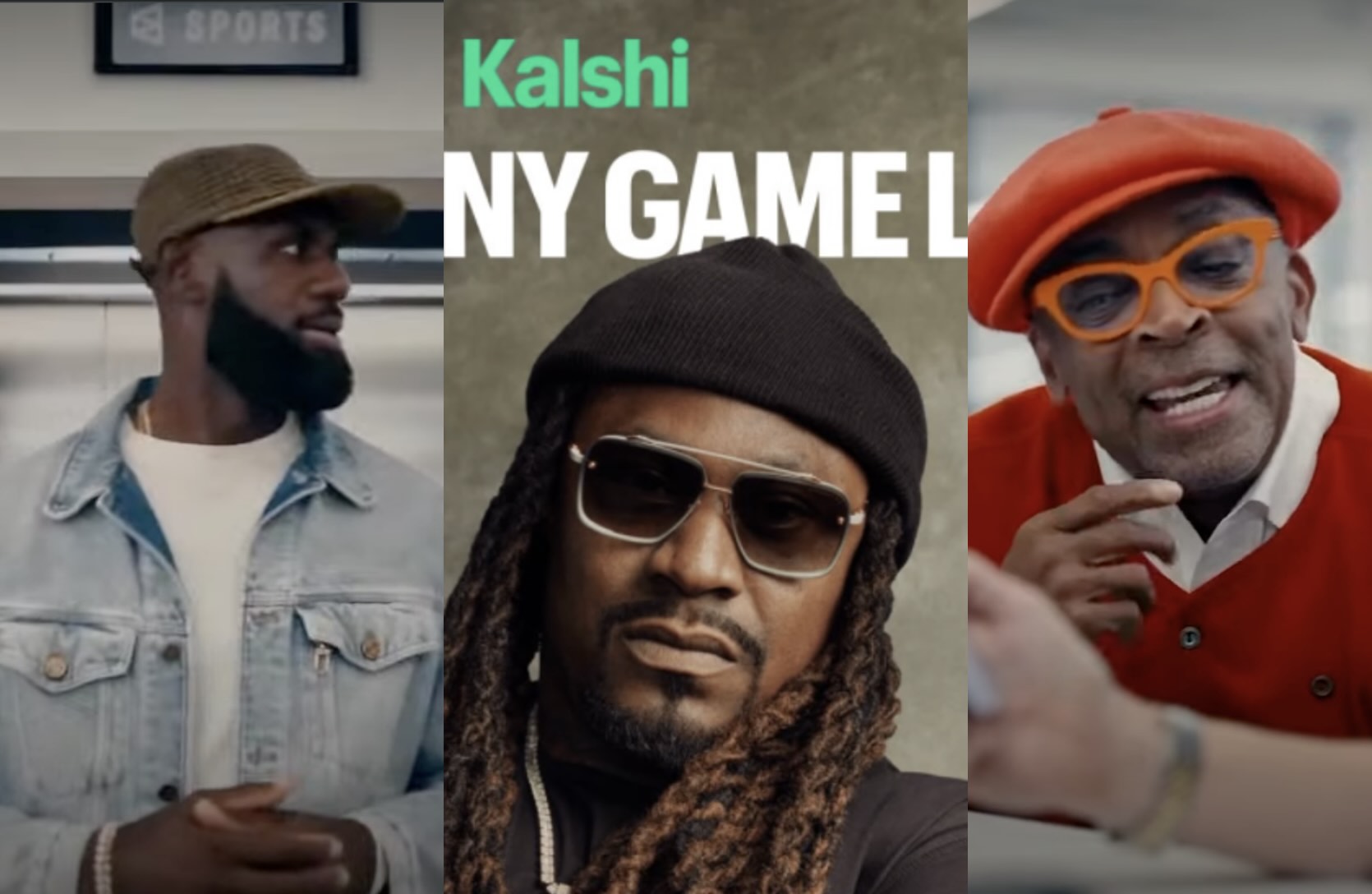
LeBron (left), Marshawn Lynch (center), Spike Lee (right) | Photo: Emerald Book Image
The face of modern gambling isn't a smoky casino or a shady backroom. It is LeBron James smiling on your television screen, a $15 million check in hand, telling you that predicting the outcome of a basketball game is a sophisticated financial move.
Prediction markets have exploded into the mainstream, fueled by a $250 million marketing blitz that has transformed the digital and television landscape. But beneath the glossy production value and the Wall Street jargon lies a grim reality: these platforms are zero-sum wagering systems where the vast majority of users lose their money. To achieve this, they have deployed a calculated strategy that leverages the trust and cultural cache of Black superstars to target the most vulnerable demographic: young men.
Buying Credibility: The Record Payouts
The industry's playbook is explicit. To erase the stigma of gambling and rebrand their apps as "financial trading platforms," prediction markets are paying unprecedented sums to Black cultural icons. They are purchases of cultural validation.
Polymarket, now valued at over $21 billion, has anchored its entire strategy around LeBron James. The platform is paying the NBA legend a staggering $15 million per year—the largest known individual endorsement deal in prediction market history, and nearly four times more than his actual veteran minimum NBA contract with the Philadelphia 76ers. He is joined by director Spike Lee and NFL icons like Richard Sherman and Reggie Bush, figures chosen specifically for their association with high-level intellectual sports culture and authenticity.
But the payouts are not equal. Reporting from Front Office Sports indicates that while LeBron commands $15 million annually, other legendary sports icons featured alongside him in the same Polymarket campaign—such as Derek Jeter and Eli Manning—are signed to significantly smaller deals. The industry views LeBron as the premium asset, valuing his cultural reach far above traditional sports metrics.
Kalshi has countered by recruiting Marshawn Lynch, whose "Beast Mode" persona is deployed to make event-contract trading feel approachable and cool. Industry data places Lynch's typical brand partnership value at $500,000 to $3 million per year, covering the stylized Fast & Furious-themed commercials and social amplification. Kalshi also brought in Giannis Antetokounmpo—not with a cash fee, but with an actual equity stake in the company, cementing a long-term financial relationship. Secondary stars who appear in these cinematic spots, like Spike Lee, typically command $250,000 to $1 million+ for a single commercial feature.
This strategy isn't accidental. It is a deliberate move to capture the attention of young men, particularly within the Black community, by framing high-risk speculation as a form of "financial literacy" or "getting a bag." The ads mimic Wall Street, using terms like "contracts" and "portfolios" instead of "bets" and "wagers," creating a dangerous illusion that this is a reliable path to wealth. The presence of figures like Reggie Bush at a chalkboard or Richard Sherman discussing analytics reinforces the message: you aren't a gambler, you're a sharp investor.
The Underground Pipeline
The spending doesn't stop at the top. Below the LeBron-tier contracts, an underground influencer pipeline quietly funnels money to smaller Black creators, meme pages, and sports "clipper" accounts who post betting content without disclosure.
Internal leaks exposed that a Polymarket marketing executive distributed over $2.5 million via a personal PayPal account to hundreds of micro-influencers and content creators. Smaller sports and meme creators are reportedly paid steady retainers of $2,000 to $3,000 a month just to casually post screenshots of winning bets or talk about the platform's odds—often without labeling the content as sponsored, in violation of FTC disclosure rules.
This is the sneakiest layer of the marketing blitz. When a young man scrolls past a viral NBA highlight with a Polymarket odds screenshot layered on top, he thinks he's seeing an organic fan post. In reality, it is a paid placement engineered to normalize betting as just another part of watching sports.
The Statistical Drain: A Transfer of Wealth
While the celebrities get richer, the users get poorer. The mathematical reality of prediction markets is brutal. Because these markets are zero-sum—for you to profit a dollar, someone else must lose a dollar—the majority of retail players are doomed to fail. Data shows that over 80% to 90% of casual retail users lose money over time.
This is not a fair fight. Young men, lured by clipper videos and meme accounts, are trading against high-frequency algorithmic bots and institutional whales. The "spread" on every trade acts as a micro-tax, slowly draining account balances with every click, even when a user thinks they are breaking even.
- The 90% Loss Rate: Academic tracking shows between 85% and 92% of casual users lose money within a year.
- The Wealth Gap: The top 1% of traders (algorithmic bots) extract the vast majority of profits, leaving everyday users with the losses.
- The Mental Health Toll: Gambling helplines report a 34% surge in calls from men aged 18-25, driven by the "near-miss" dopamine loops designed into these apps.
The wealth being drained from young men isn't just disappearing into the ether; it is being funneled directly into the marketing budgets that created this cycle. The $15 million check paid to LeBron James is funded by the net losses of the millions of users who downloaded the app because they saw him holding it.
The Backlash: "Selling Out" vs. the Bag
These campaigns have not gone unchallenged. Fans on social media have reacted with a mix of fatigue and disappointment, criticizing LeBron James and other athletes for promoting platforms that carry significant financial risk. The praise for "securing the bag" has been matched by accusations of "selling out."
More seriously, financial literacy advocates and media analysts point out that betting companies rely on Black celebrities precisely because of their massive crossover appeal—and that this disproportionately hooks younger Black men into addictive platforms under the guise of "financial empowerment" or "investing." The concern is not abstract: prediction markets carry significant financial risk, and the demographic being targeted is the least equipped to absorb losses.
The vetting failures have compounded the problem. An investigation revealed that Kalshi was unknowingly funding an anonymous "affiliate" marketing account on X that was heavily promoting their betting lines right next to deeply anti-Black and offensive posts. The rush to pay anyone with a following has created a pipeline where brand safety is an afterthought.
The Hustle Culture Trap
The industry has weaponized "hustle culture." By linking their apps to narratives of economic empowerment, they convince young men that betting on the outcome of an election or a football game is a productive side hustle. The use of Black celebrities makes this pitch even more effective, lending a veneer of community trust to a product that systematically transfers wealth out of that community.
Advocates warn that this is a predatory dynamic. The platforms are not paying these icons out of generosity; they are buying the attention of their followers. When you see Spike Lee or Marshawn Lynch casually using these platforms, it bypasses the natural skepticism one should have for high-stakes speculation. It makes the app feel like a lifestyle accessory rather than a financial risk.
Ultimately, the numbers tell a clear story. Prediction markets are spending hundreds of millions to acquire users because the "churn and burn" model requires a constant influx of fresh money. They need young men to download the app, deposit their savings, and lose it to the bots. The celebrity faces are just the bait. The drain is the business model.
As these platforms continue their land-grab, the true cost will be measured not in TV ratings, but in the depleted savings accounts and rising debt of a generation targeted by a sophisticated, well-funded marketing machine.
No Ads. By Us. For Us.
This article was made possible by readers like you. We hope it inspired you to support Emerald Book, so we can continue producing content like this.
We will never show you ads, sell your data, or require a subscription to consume our content. Your gift helps us keep the truth accessible.
Click the Support button to give a gift of any amount today.
Thank you for making this work possible.