

Emerald Pages
◆
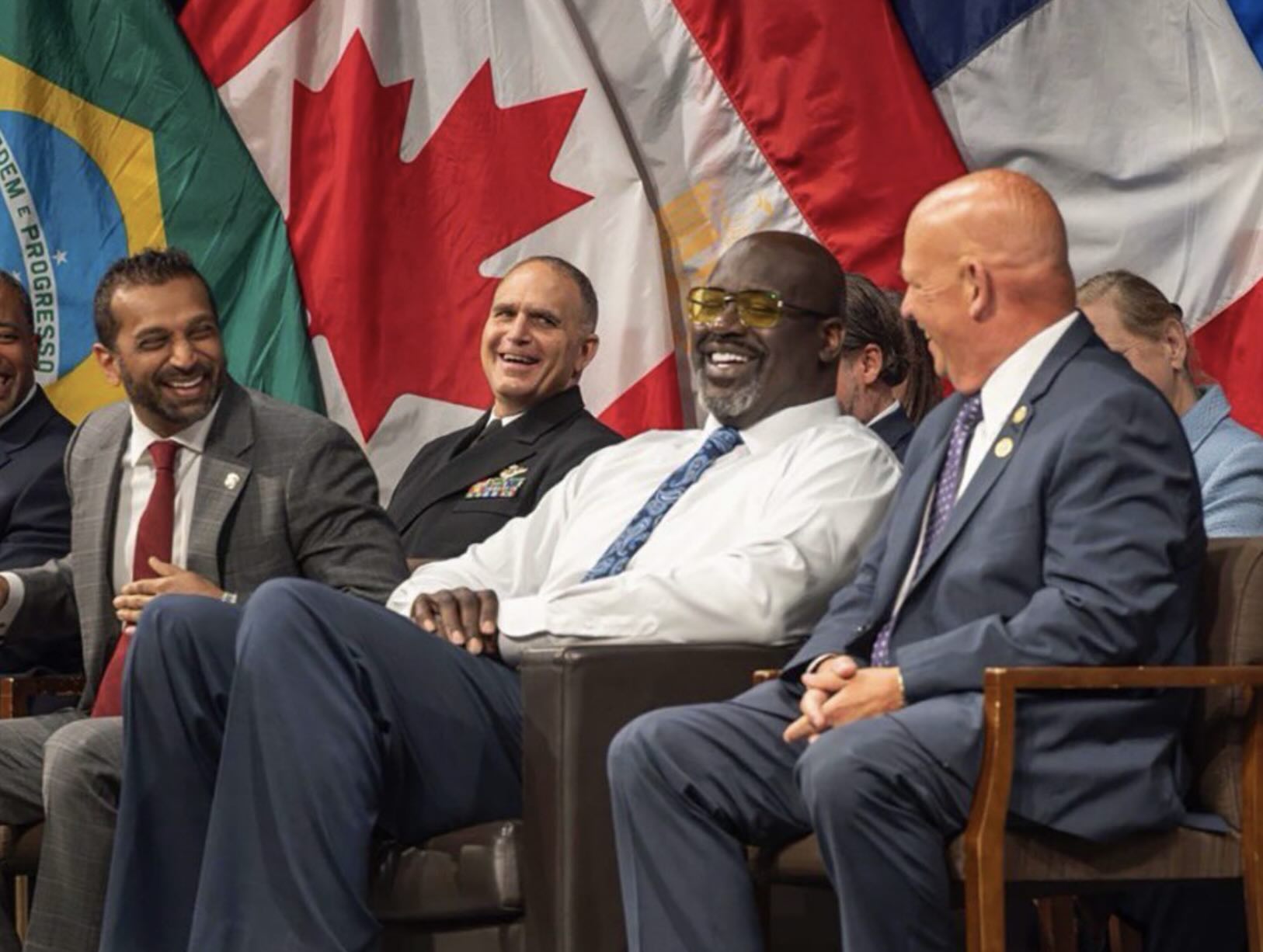
Photo: ABC News | Instagram
When Shaquille O'Neal stood beside FBI Director Kash Patel on September 17, 2026, accepting an honorary Special Agent title at the FBI National Academy's Session 299 graduation in Quantico, Virginia, the image was jarring to many Black Americans. But for those who had been paying attention, it wasn't surprising. It was the inevitable conclusion of a career-long pattern: Shaq has consistently chosen the blue line over the Black community.
The ceremony itself was lighthearted—Shaq joked that his 7'1" frame would make undercover work impossible and playfully told his fellow "agents," "If you see Charles Barkley, arrest him." Patel commended him as "one of the best supporters of law enforcement in the country." But beneath the laughter and the ceremonial badge lies a deeper truth that Black civil rights advocates have long understood: Shaq's loyalty has never been to the communities that raised him, but to the institutions that police them.
To understand why this moment matters, one must trace the full arc of Shaquille O'Neal's relationship with law enforcement—and his consistent refusal to use his platform for systemic change.
A Career Built on Institutional Partnership
Shaq's law enforcement resume is not incidental. It is extensive, deliberate, and deeply personal. Unlike celebrities who accept honorary badges as photo opportunities, Shaq actually went through real police training. He has served as a reserve officer for the Port of Los Angeles, Miami Beach, and Doral, Florida. In 2016, he was sworn in as an honorary deputy in Clayton County, Georgia. Late last year, he was named community relations chief for the Henry County Police Department in Georgia. And this isn't even his first federal recognition—back in 2005, he was named an honorary U.S. Deputy Marshal.
Shaq has repeatedly stated that he preferred to actually learn the law enforcement profession rather than simply take empty, symbolic positions. His interest, he says, was shaped by his stepfather, Phillip Harrison, a career U.S. Army Sergeant who taught him from an early age to deeply respect law enforcement officers.
But respect for individual officers—many of whom are Black and serve their communities honorably—is fundamentally different from alignment with the institution of policing itself. And Shaq's critics argue that he has never understood, or chosen to ignore, the distinction.
The Systemic Reform Gap
The Black community's relationship with law enforcement is not a matter of politeness or personal rapport. It is a matter of life and death, of qualified immunity and legal accountability, of budgets and power. For decades, civil rights leaders have argued that true progress requires changing laws, altering police accountability structures, and tackling systemic racism directly.
Shaq's approach has been the opposite. He believes that if officers and local kids know each other by name, play basketball together, and interact positively, it will naturally reduce conflict and misconduct. His charity work—funding schools, building basketball courts, giving away shoes and meals—is undeniably generous. But it operates entirely outside the political and legal systems that produce inequitable outcomes.
- Charity is temporary relief. It relies on the ongoing willingness and wealth of a benefactor. If Shaq stops giving, the support vanishes.
- Justice is permanent restructuring. It embeds equity into policy, ensuring protections and resources are legally mandated for everyone.
- Spectacle philanthropy creates an illusion of progress. It suggests the existing system is fundamentally fine and just needs generous individuals to make it work.
By choosing a path that prioritizes immediate, high-visibility gestures while aligning closely with institutions like the FBI, Shaq's strategy delivers undeniable short-term comfort to a select few while leaving the larger collective vulnerable to the very systems he chooses to celebrate.
The Kash Patel Problem
The controversy surrounding Shaq's honorary FBI title isn't just about the bureau as an abstract institution. It's about Kash Patel specifically. Under Patel's leadership, the FBI has faced severe backlash from civil rights organizations including the NAACP and The Leadership Conference on Civil and Human Rights. Critics point to staffing reductions, the dropping of federal discrimination cases, and the FBI's decision to sever long-standing partnerships with hate-monitoring groups like the Southern Poverty Law Center.
Advocacy groups have recently filed lawsuits against Patel and other administration officials to challenge what they describe as voter intimidation efforts targeting communities of color. For many Black Americans, accepting an award from this FBI—smiling alongside this director—was not a neutral act. It was a political statement.
Shaq's defenders argue that his partnership with law enforcement has historically remained separate from partisan politics. But for critics, this defense misses the point. When an individual chooses to validate, praise, and accept awards from the leadership of an institution rather than challenging its systemic flaws, they are functionally aligning themselves with that institution—whether they intend to or not.
The Classism That Reveals Everything
If any doubt remained about where Shaq's true alignment lies, his response to criticism settled it. Following the ceremony, a Black content creator named Matthew Chappelle (known online as "OG Matt") posted a video criticizing Shaq. Chappelle made clear that the issue wasn't just Shaq's general support for police, but specifically his decision to accept the honor from Kash Patel.
Shaq discovered the video and went directly into the comment section to fire back, mocking the creator's financial status and living situation:
"U don't have to like me I don't like u. U don't have a real job' u live in your moms house why should anybody listen to you. All this for clicks and u still broke."
He didn't stop there, adding, "I hear you broke boy" and telling Chappelle, "You're a follower I'm a leader. Get a real job and maybe we will believe. Your page sucks."
This exchange crystallized everything. Rather than addressing the actual political and civil rights critiques regarding Kash Patel's FBI, Shaq defaulted to wealth shaming. Critics pointed out that having a massive bank account doesn't automatically make someone right, and using his wealth status to punch down at an everyday creator only proved the point that he is disconnected from the realities of regular people.
More fundamentally, it exposed the classism at the heart of Shaq's approach. When a multi-millionaire public figure uses "broke" or "living with your mom" as an insult to silence a critic, they are weaponizing the very economic inequalities that systemic change is meant to fix. It suggests that a person's right to speak, critique power, or have an opinion on their own community is tied directly to their bank account. If only wealthy people are allowed to have a voice, then the systems that protect the wealthy will never be challenged or restructured.
A Contrast in Values
Shaq's refusal to push for systemic change stands out even more when compared to peers who have chosen to tackle the structures themselves:
- LeBron James: While also doing immense charitable work, James has actively funded voting rights organizations to fight systemic voter suppression targeting Black communities.
- Colin Kaepernick: Sacrificed his NFL career to protest systemic police brutality directly, later launching the Know Your Rights Camp to advance systemic liberation and legal education for youth.
- WNBA Players: The entire league dedicated seasons to structural social justice initiatives, actively campaigning for specific federal legislation like the George Floyd Justice in Policing Act.
These athletes understand that their platform is not just for personal brand-building or feel-good charity. It is a tool for political change. Shaq has consistently rejected that responsibility.
Not a Leader
Shaquille O'Neal is not a political or ideological leader for the Black community. He has explicitly stated that he is "not an activist." He prefers direct, individual charity over systemic or political organizing. His immense personal generosity is deeply valued by many. But his political associations and pro-police stances remain a point of ongoing debate—and for many, a source of deep disappointment.
The honorary FBI title wasn't an anomaly. It was a confirmation. For decades, Shaq has chosen to work within the existing system rather than challenging it. He has chosen to celebrate the institutions that police Black communities rather than demand their transformation. And when challenged, he has chosen to weaponize his wealth rather than engage with the legitimate concerns of the people he claims to serve.
True alignment with a marginalized community requires solidarity with their struggles, an acknowledgment of systemic failures, and a willingness to listen to everyday people. Shaq has demonstrated, time and time again, that his alignment lies elsewhere—with the institutions, the badges, and the power they represent.
The blue line, it turns out, has always come before the baseline.
No Ads. By Us. For Us.
This article was made possible by readers like you. We hope it inspired you to support Emerald Book, so we can continue producing content like this.
We will never show you ads, sell your data, or require a subscription to consume our content. Your gift helps us keep the truth accessible.
Click the Support button to give a gift of any amount today.
Thank you for making this work possible.