

Emerald Pages
◆
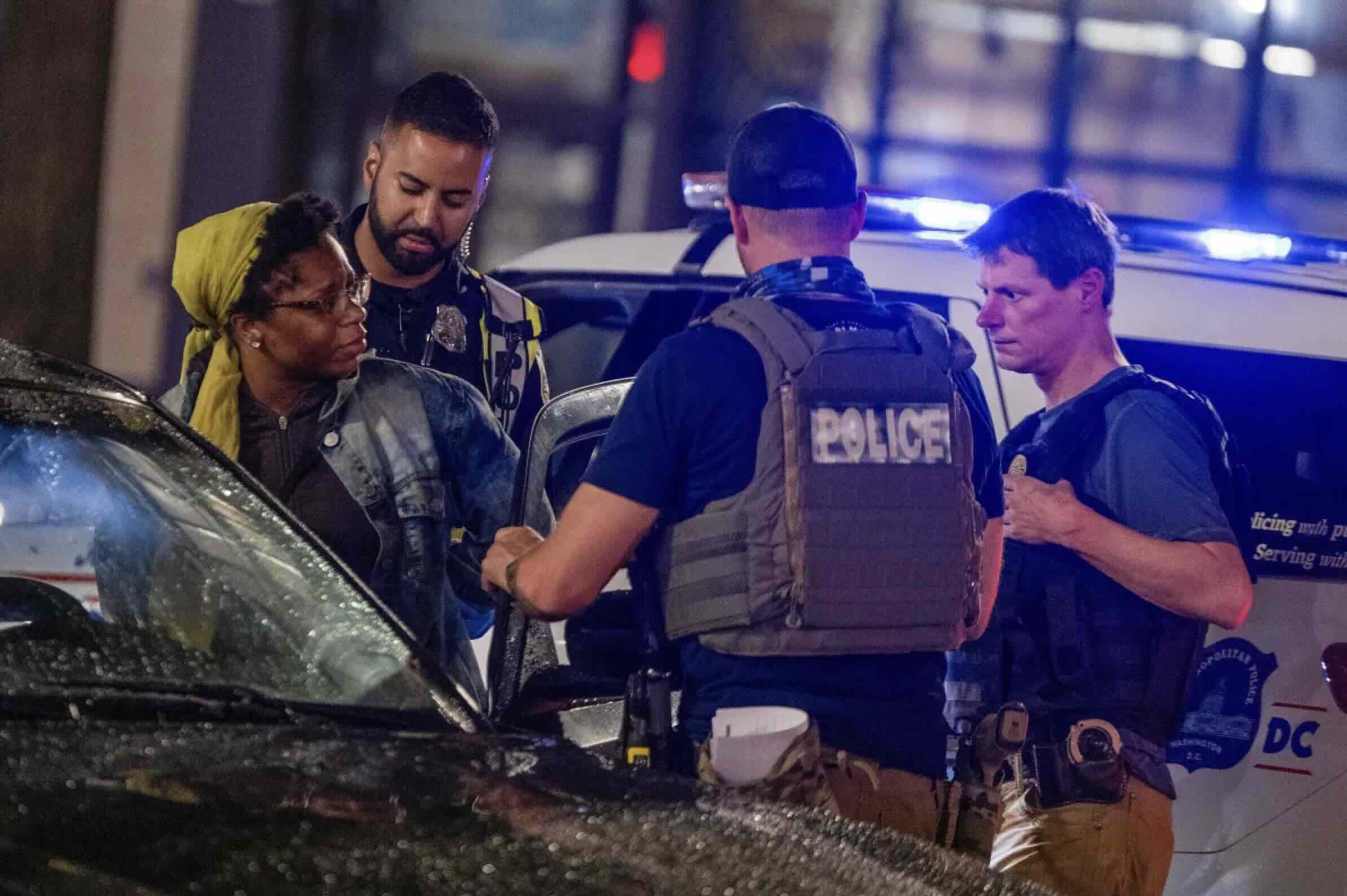
Photo: Getty Images
For residents of Wards 7 and 8 in Washington, D.C., the sound of an unmarked Chevy Malibu screeching to a halt is not just a nuisance—it is the sound of a hunt beginning. The "jump-out" squad, a specialized unit of the Metropolitan Police Department (MPD), has become the defining symbol of a policing strategy that critics say treats Black neighborhoods as occupied territory. While the city frames these tactics as "crime suppression," the lived experience of those on the ground is one of predatory containment, where the mechanics of a police stop behaviorally mimic the hunting of prey.
This is not a metaphor for the community. It is a structural reality supported by extensive empirical data. According to a 2019 audit mandated by the D.C. Council, the Narcotics and Special Investigations Division (NSID) recorded 100% of its use-of-force incidents against Black individuals within a six-month window. Out of 2,871 recorded stops, 2,035 resulted in arrests, and 91% of those arrested were Black. When a specialized unit uses force exclusively against one demographic and arrests almost everyone they stop, the line between public safety and racial targeting dissolves.
The roots of this dynamic stretch back centuries. Before the formal establishment of a modernized police force, early constables and members of the D.C. Auxiliary Guard were frequently accused in abolitionist literature of being "negro hunters" or "man-hunters." American policing has deep roots in early slave patrols, which were civic duties legally tasked with tracking down escaping slaves, enforcing curfews, and preventing gatherings. In Washington, D.C., early municipal police and watchmen actively enforced strict slave codes against the city's Black population until slavery was abolished in the District in 1862.
The primary tactic, the "jump-out," involves plainclothes officers in unmarked vehicles abruptly speeding up, slamming on brakes, and swarming individuals on sidewalks or porches. Officers, often in tactical vests, demand to see waistbands, ordering citizens to lift shirts. The justification for these stops is frequently a "pretext"—minor infractions like a window-tint violation or the standard movement of someone adjusting their clothing upon seeing an unmarked car. These stops are not precise; they are a broad net cast over Black neighborhoods.
The Data Behind the "Hunt"
The comparison to a hunt is supported by the stark disparity between stops and actual crime prevention. Over a two-year evaluation period analyzed by the ACLU of the District of Columbia, D.C. police conducted over 136,000 warrantless stops—averaging one stop every 10 minutes. Yet, only about 1% of those stops resulted in the seizure of a gun. The overwhelming majority of those stopped were innocent Black men, caught in a system that treats their existence as suspicious.
- 100% of use-of-force incidents by specialized units were against Black people.
- 91% of arrests made by these units were of Black individuals.
- 87% of all stops were of Black residents, despite making up only about 40-44% of the city's population.
- 1% of over 136,000 warrantless stops resulted in a gun seizure.
- Black individuals account for over 70% of all police stops and 94% of use-of-force incidents by the MPD overall.
The geographic concentration of these tactics is undeniable. Wards 7 and 8, primarily Black communities east of the Anacostia River, bear the absolute brunt. While affluent, predominantly white wards in Northwest D.C. see search rates of just 4% during police stops, the Sixth and Seventh Police Districts—covering Wards 7 and 8—regularly see between 20% and 35% of all stops escalate to full physical searches. The city's political leadership justifies this geographic concentration by pointing to the fact that Wards 7 and 8 suffer from a disproportionate share of the city's gun violence. However, for the innocent majority living east of the river, this creates a reality where their entire geographic region is policed like an active containment zone.
Legal Challenges and Constitutional Violations
Legal challenges have further exposed the unconstitutional nature of these tactics. In federal class-action lawsuits like Crudup v. District of Columbia, court documents revealed a pattern where groups of 4 to 6 armed officers would surround a Black individual, using overwhelming numbers to intimidate suspects into "consenting" to searches they had no legal right to perform. Court data outlines that the Gun Recovery Unit (GRU) regularly used minor infractions—such as a suspected window-tint violation—as a "pretext" to execute an aggressive, proactive stop and vehicle tear-down.
In one landmark case, an officer aggressively probed a Black resident's sensitive body parts on a public street, handcuffing and violating him even after the resident flinched and verbally protested. Instead of a limited pat-down for weapons, the officer subjected him to a humiliating, public, and unconstitutional body search. Community members frequently testified before the D.C. Council that GRU and NSID officers subjected them to full stop-and-frisk pat downs without any legal justification. The city has quietly settled many of these cases out of court, burying systemic evidence behind legal agreements and preventing massive public trials that would draw national attention.
The Cycle of Rebranding
When public pressure or lawsuits force the MPD to disband a unit, the department historically does not dismantle the underlying behavior. Instead, it rebrands. The controversial Gun Recovery Unit (GRU) is a prime example; after intense scrutiny, its elements were re-absorbed into the "Violent Crime Impact Team." Civil rights watchdogs note that the unmarked cars and aggressive jump-outs continue under new names, fracturing public awareness. Whenever public pressure or the D.C. Council forced the MPD to ban or disband a "jump-out" squad or a specific vice unit, the department would routinely re-emerge the exact same tactics under a different name—shifting personnel from "Vice Units" to "Crime Suppression Teams," the "Robbery Enforcement Program," and eventually the "Gun Recovery Unit."
This tactical shuffling fractures public awareness; by the time the community organizes against one specific acronym, the department has already shifted those same officers into a newly named initiative. The bureaucratic "shell game" ensures that the behavior persists even as the branding changes.
The "Jump Out Boys"
The internal culture of these units has also been exposed. Officers from a specialized unit were caught wearing custom-made shirts featuring an authoritarian cross and the letters "JO" (short for "Jump Out") alongside the unit's aggressive catchphrase, "Let me see that waistband." The department was forced to suspend officers over the imagery, which communities viewed as a literal admission that they treated Black neighborhoods as hunting grounds. For the community, this was not a harmless inside joke—it was evidence of a mindset that viewed their neighborhoods as prey.
Furthermore, an explosive internal affairs probe revealed that high-ranking police leadership was manipulating and downgrading violent crime data to make these aggressive strategies look more successful than they were. D.C.'s Interim Police Chief Jeffery Carroll handed out termination and disciplinary papers to over a dozen top MPD officials involved in altering the city's crime statistics. Federal prosecutors, the Department of Justice, and the House Oversight Committee launched sweeping investigations into allegations that MPD leadership systematically manipulated and downgraded violent crime statistics to make the city appear safer than it actually was.
The Abolition Debate
For local activists, abolitionist groups, and heavily impacted communities, everything the government has done—renaming units, changing shirts, passing data-tracking laws, or shifting oversight—feels like a superficial cosmetic fix that avoids the actual core of the problem. From the perspective of grassroots organizers, the city's actions represent a cycle of reform that protects the institution of policing rather than the citizens.
The political reality in D.C. is that the elected government operates on a philosophy of reform and regulation, not dismantling. They view the police force as an absolute necessity for public safety, especially during spikes in violent crime, and believe the solution is better training, body cameras, and stricter laws. But because D.C. is the federal capital and not a state, the political threshold for actually dismantling or defunding a police force is legally and structurally blocked. Any local attempt to significantly defund the Metropolitan Police Department is immediately met with a federal veto or direct congressional intervention, as seen with federal bills overriding local D.C. police accountability laws.
For the people who feel like they are living in a targeted zone, any response short of entirely dismantling these specialized, aggressive units is viewed as a systemic failure to stop the "hunt."
The Lived Experience
The perspective that these tactics constitute an active, systemic hunt is a powerful conclusion shared by many residents, civil rights attorneys, and community organizers who look at the compounding weight of the data, the body camera footage, and the historical continuity. From a strict legal and institutional standpoint, the city and federal governments frame these actions differently—as aggressive, data-driven "crime suppression" targeted specifically at neighborhoods experiencing high rates of gun violence. They argue the intent is to seize illegal weapons and lower homicide rates, not to target a demographic.
However, for the communities living under this reality, the distinction between "crime suppression" and an active hunt is non-existent. When the practical execution of a policy relies on swarming unmarked vehicles, mass pretextual stops, and the systemic violation of civil liberties almost exclusively within Black neighborhoods, the lived experience matches the definition of being hunted.
The debate ultimately centers on this fundamental divide: whether these tactics are an unfortunate but necessary tool for public safety, or an unconstitutional, predatory system of racial containment. The data—100% of use-of-force incidents against Black people by specialized units, 91% of arrests, and a 1% gun recovery rate from over 136,000 stops—suggests that whatever the stated intent, the outcome is a system that treats Black residents of Washington, D.C., not as citizens to be protected, but as a population to be tracked, contained, and controlled.
No Ads. By Us. For Us.
This article was made possible by readers like you. We hope it inspired you to support Emerald Book, so we can continue producing content like this.
We will never show you ads, sell your data, or require a subscription to consume our content. Your gift helps us keep the truth accessible.
Click the Support button to give a gift of any amount today.
Thank you for making this work possible.