

Emerald Pages
◆
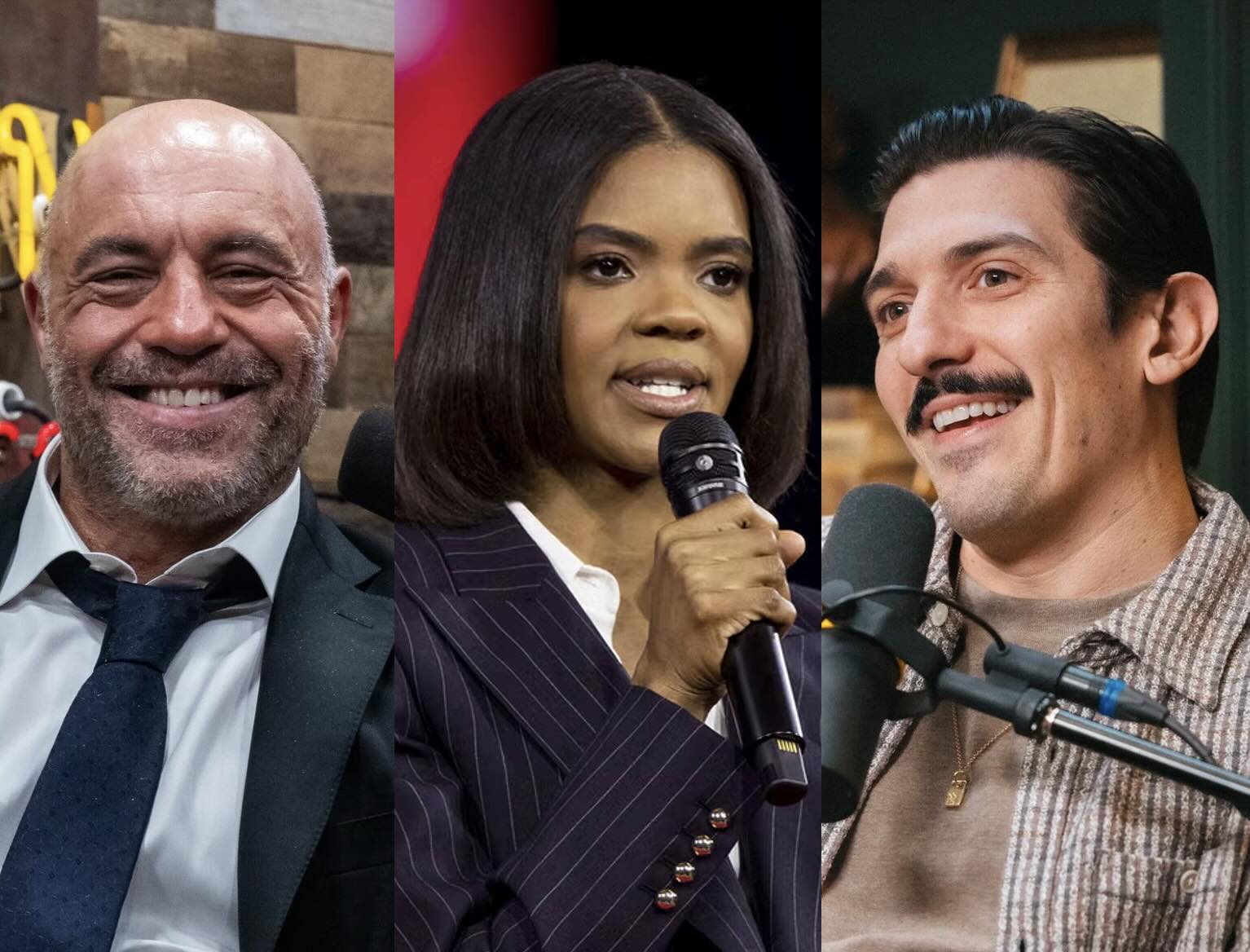
Joe Rogan (left), Candace Owens (center), and Andrew Schulz (right) | Photo: Emerald Book Image
Joe Rogan called Donald Trump's supporters "f***ing nuts" and "rabid" during a September 16, 2026 episode of The Joe Rogan Experience. The comment, made while defending country star Jelly Roll against online backlash, has ignited a firestorm of criticism and accusations of staggering hypocrisy.
For critics, the irony is almost too thick to cut. Rogan formally endorsed Trump on November 4, 2024—literally hours before polls opened. Now, less than two years later, he's expressing shock that the movement he boosted has turned out to be exactly what political analysts warned it was all along: a cult of personality defined by uncritical, "rabid" loyalty.
But Rogan is far from alone. Candace Owens and Andrew Schulz—two other influential podcasters who helped amplify Trump's message—are experiencing their own versions of political buyer's remorse. They wanted the cultural power of being kingmakers. They didn't want the responsibility that followed.
Rogan's comments are particularly striking given his admission that he has been left-wing his whole life and his frustration that the administration's pledge to "drain the swamp" has "not been ideal." The problem, critics argue, is that you can't spend years boosting a candidate, endorse him at the eleventh hour, and then act surprised when his most devoted followers behave exactly as they always have.
The Collective Realization
The pattern is repeating across the podcast ecosystem. These hosts built massive audiences by treating politics like content—rebellious, anti-establishment, and entertaining. They projected their own libertarian fantasies onto a candidate who was openly promising mass deportations, aggressive foreign policy, and expansive executive power. They dismissed his most radical proposals as mere "trolling."
Now that the fantasy has collided with reality, they're scrambling to distance themselves from the movement they helped manufacture.
- Joe Rogan: Endorsed Trump hours before Election Day 2024, now calls his base "f***ing nuts" and "rabid" while blasting the administration's promises as a "total dud."
- Candace Owens: Once one of the most prominent Black conservative voices, Owens has aggressively broken from the administration on her podcast Candace. She has called Trump a "chronic disappointment," blasted his foreign policy, and even publicly called for his removal under the 25th Amendment.
- Andrew Schulz: The Flagrant podcast host leaned heavily into promoting Trump as the ultimate anti-establishment disrupter. Now he's expressed "major reservations" and called the administration's handling of the Epstein files "insulting to our intelligence."
The breaking points are consistent: foreign policy escalations (particularly the June 2025 strikes on Iran), the administration's refusal to release the Epstein files, and the graphic reality of aggressive immigration enforcement.
The Blind Spots Critics Warned About
Political analysts and journalists had been screaming warnings for years. They pointed to the 34 felony counts, the federal court ruling finding Trump liable for sexual abuse and defamation, the string of corporate bankruptcies, and the well-documented history of stiffing working-class contractors.
The podcasters ignored all of it. They framed the legal system as corrupt, dismissing the convictions as a "coordinated deep-state hit job." They laughed off the sexual abuse ruling as old news. They promoted the Apprentice-era myth of Trump as a brilliant billionaire who could magically fix the economy.
As critics now point out, the podcasters didn't uncover some hidden secret. They are simply catching up to the exact warnings that everyday voters had been making from the very beginning.
The Pot Calling the Kettle Black
The question many are asking is simple: How can these podcasters be shocked by the "rabid" loyalty of Trump supporters when they themselves were the most rabid supporters of all?
Rogan endorsed Trump hours before polls opened. Owens built her entire brand on being one of the loudest MAGA voices in media—she wore the hats, attended the events, and told her audience that Trump was the only answer. Schulz leaned heavily into promoting Trump as the ultimate anti-establishment disrupter, telling his millions of listeners that he was the candidate who would finally break the system.
They weren't just sympathetic commentators. They were the base. They were the ones amplifying the message, dismissing the warnings, and attacking anyone who dared to question the movement. They were the ones calling critics "deep state shills" and laughing off the criminal convictions, the sexual abuse liability, and the bankruptcies as nothing more than political hits.
Now they want to act surprised that the movement they built is exactly what it always was.
The MAGA base's fierce, uncritical devotion has been a hallmark of Trump's political identity for nearly a decade. Anyone paying attention knew how they treated anyone who stepped out of line. They primary challenged anyone who disagreed. They threatened election officials. They stormed the Capitol on January 6, 2021. Rogan, Owens, and Schulz were right there cheering it on—or at minimum, staying silent while their audiences celebrated.
They wanted the cultural influence of being political disrupters without the burden of the outcomes. They wanted the massive engagement that came with tapping into a populist wave without accepting that they were the ones who built that wave. They wanted to be the voice of a revolution without acknowledging that revolutions have consequences—and those consequences don't disappear just because you've changed your mind.
The pot is calling the kettle black. But in this case, the pot and the kettle are the same thing. Rogan, Owens, and Schulz aren't observers of the MAGA movement. They are the MAGA movement. And the "f***ing nuts" supporters they now criticize are the very people they spent years cultivating, encouraging, and profiting from.
The Fantasy vs. The Reality
At the heart of this disillusionment is a fundamental misunderstanding of what politics actually is. These podcasters treated a presidential election like a movie where they could customize the main character to fit their personal anti-establishment narrative. They constructed a version of Donald Trump that simply didn't exist.
They fantasized that Trump was a small-government libertarian who would dismantle federal agencies and leave people alone. They ignored his entire record of utilizing massive executive power. They viewed him as an "anti-woke" cultural icon fighting the same battles they fight on their comedy stages, forgetting he was running to command the most powerful military and surveillance state on Earth.
Now that the fantasy has ended and the actual policy execution has begun, these internet personalities are waking up to a reality that everyday voters saw from the very beginning. They learned the hard way that when someone tells you exactly what they plan to do, you should probably believe them.
The Audience Backlash
What makes this situation even more precarious is that their audiences are starting to push back. The same listeners who cheered them on during the election are now questioning why their favorite hosts are suddenly turning on the movement they helped build.
Rogan's audience is diverse, spanning the political spectrum from disaffected liberals to anti-establishment conservatives. But even he is facing criticism from both sides. Some on the left are mocking him for his naivety. Some on the right are accusing him of betrayal. The common thread is that these podcasters are now caught in a trap of their own making. When you endorse a candidate and that candidate wins, you become part of the establishment. You become responsible for the outcomes.
The Lessons No One Learned
The most damning critique of this entire saga is that none of it was unpredictable. Every single issue these podcasters are now upset about was publicly telegraphed during the campaign.
Trump didn't hide his plans for mass deportations. The June 2025 strikes on Iran? He had been hawkish on Iran for years, dating back to ordering the killing of Qasem Soleimani. The Epstein files? The administration's backing away from transparency was entirely consistent with his history. The "drain the swamp" promise? Anyone who watched his first term knew the swamp doesn't get drained—it gets restocked with loyalists.
The question now is whether this wave of buyer's remorse will have any lasting impact. Will these podcasters actually change their behavior, or will they simply recalibrate their messaging to maintain their audiences?
Some analysts suggest the damage is already done. The 2024 election was decided, in part, by the massive reach of these alternative media platforms. Young men, in particular, were heavily influenced by the "manosphere" podcast ecosystem. Now that the consequences are becoming clear, there's a reckoning happening—but whether it leads to meaningful accountability remains to be seen.
For Rogan, the path forward is unclear. He insists he's just a comedian and commentator. But when you have the largest podcast in the world and you use it to endorse a presidential candidate, you can't simply retreat to the "I'm just a comedian" defense when things go wrong.
Ultimately, these podcasters wanted the cultural power of being political kingmakers without the burden of accountability. They treated politics as pure entertainment. Now that the real-world consequences are directly impacting their audiences—and their fans are beginning to push back—they are desperately trying to retroactively separate themselves from the outcomes they directly helped manufacture.
Whether their audiences will forgive them, or whether they'll be held accountable for their role in electing a president whose policies they now criticize, is a question only time will answer. But one thing is certain: the pot calling the kettle black has never been quite this ironic.
No Ads. By Us. For Us.
This article was made possible by readers like you. We hope it inspired you to support Emerald Book, so we can continue producing content like this.
We will never show you ads, sell your data, or require a subscription to consume our content. Your gift helps us keep the truth accessible.
Click the Support button to give a gift of any amount today.
Thank you for making this work possible.