

Emerald Pages
◆
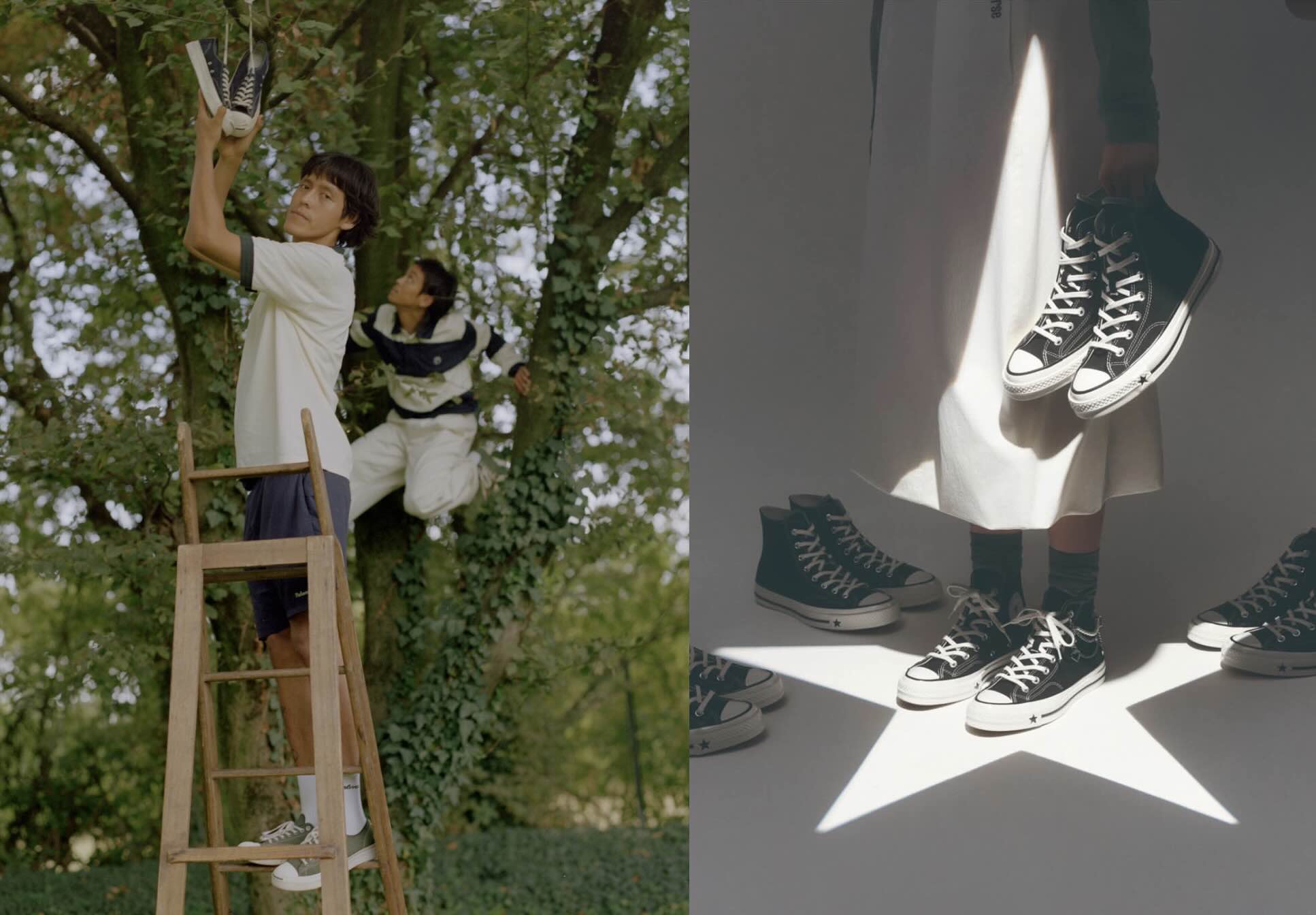
Photo: Converse | Chuck 70 X campaign
Let us be clear from the outset: a multi-billion dollar American corporation with endless resources, layers of approval, and a global marketing apparatus either knew exactly what it was doing, or it is so breathtakingly incompetent that it has no business selling sneakers to anyone. Neither option is acceptable. Both are an insult to Black people.
The image in question, part of the "Stars Align With KARINA" campaign for the Chuck 70 X sneaker, shows K-pop star Karina in a flowing cream skirt, standing on a star-shaped spotlight, holding black high-top Converse sneakers by their laces. The lighting tapers the white fabric into a sharp triangle. The shoes dangle beneath it like a body from a noose. The visual is not subtle. It is not a stretch. It is a complete, unmistakable tableau of racial terror that anyone with even a cursory knowledge of American history would recognize instantly.
Actress Yvette Nicole Brown saw it immediately. "That's a lynching, yes? ... AND a Klan robe," she wrote. Photographers and composition experts pointed out that even if the star-shadow effect was accidental, anyone trained in lighting and framing should have flagged the silhouette before publication. Social media users on Threads and TikTok exploded with anger. Calls to boycott Converse grew overnight.
Converse issued a statement to The Washington Post and WWD: "We're sorry. We understand why this image is deeply upsetting and recognize that we got this wrong. We removed it from our channels and are working to remove it everywhere it appeared. This should not have happened, and we will do better."
Notice what they did not do. They did not post that apology to their main Instagram or TikTok grids — the very platforms where millions of Black consumers follow them. They did not hold a press conference. They did not announce leadership changes, internal reviews, or any structural reforms that would prevent this from happening again. They quietly emailed the statement to reporters and waited for the news cycle to move on. That silence is deafening. It tells us exactly how much Black pain is worth to Converse: a few sentences in a press email, and not a word more.
A Brand on Life Support
To understand why this feels less like a mistake and more like a calculated play, you have to look at the financial reality Converse is facing. This is not a healthy brand making a careless creative choice. This is a desperate brand making a dangerous one.
Converse revenue has plummeted 31% to 32% year-over-year. Nike, its parent company, has been preparing massive layoffs and restructuring at Converse headquarters. The brand that once defined American cool — the Chuck Taylor All-Star — has lost its grip on youth culture, streetwear, and sneaker relevancy. Nike Inc. itself is trading at a 12-year low, was recently removed from the S&P 100, and has lost roughly 78% of its value since its 2021 peak.
The Chuck 70 X was supposed to be the comeback. The Hail Mary. The product that proved Converse could still be edgy, relevant, and culturally connected. Instead, they chose to make the launch about something else entirely.
- Converse revenue has dropped 31–32% year-over-year
- Nike has prepared mass layoffs and restructuring at Converse
- Nike Inc. was removed from the S&P 100 and is trading at a 12-year low
- Nike has lost roughly 78% of its value since its 2021 peak
- The brand has been losing cultural relevance for years
Two Ads, Two Hanging Motifs, One Brand
If the KKK and lynching image were the only problem, Converse might have been able to hide behind the "star shadow" explanation. But it was not the only problem. At the exact same time, Converse released a second campaign with Copenhagen brand Palmes. That ad features a person standing on a ladder next to a tree, slinging sneakers over a branch.
Two campaigns. Two hanging motifs. Two separate creative teams. One brand. The "accident" narrative collapses under the weight of that coincidence. What are the odds that two separate campaigns, produced by two separate teams, would both inadvertently evoke lynching imagery within the same product launch window? At some point, coincidence stops being a plausible defense and starts looking like a pattern.
The preponderance of evidence — the dangling shoes, the obscured arm that makes them float like a hanging body, the white triangular hood, the second ad with a tree and a ladder — suggests something far worse than a mistake. It suggests that either no one in the approval chain cared enough to notice, or someone noticed and decided the controversy was worth more than Black dignity.
The "We Didn't Know" Excuse Is an Insult
Converse would have you believe this was a tragic oversight by an international creative team unfamiliar with American racial history. But Converse is an American company. Based in Boston, Massachusetts. Its parent company, Nike, is based in Oregon. The corporate headquarters that approved this campaign for global distribution is American. The executives who signed off on pushing this image to Western social media feeds are American. The brand assurance teams, legal clearances, and localization vetting processes that every global campaign must pass through are American.
The "we didn't know" excuse requires you to believe that not a single person in a multi-billion dollar corporate pipeline — from the creative team in South Korea to the global brand managers at Converse HQ to the marketing executives at Nike — looked at this image and saw what the entire internet saw within minutes of its release.
That level of negligence is not an excuse. It is an indictment. And it is an insult to every Black consumer who has ever bought a pair of Chuck Taylors, who has ever believed that Converse was a brand for them. The message is clear: your history, your trauma, your pain — none of it matters enough for us to pay attention.
This Is Not an Isolated Incident
This is not an isolated incident. It is part of a long, exhausting pattern of major brands using Black trauma as a marketing tool. Gucci's blackface sweater. Balenciaga's disturbing teddy bear campaigns. Target's hair care layout and halloween constume controversies. American Eagle's recent ad campaigns. The list goes on.
Each time, the brand issues an apology. Each time, they claim it was an accident. Each time, they pull the image and promise to "do better." And each time, the cycle repeats because the outrage generates engagement, and engagement generates revenue.
Cultural commentators and activists point out that if Converse or Nike had a diverse oversight committee checking global rollouts, a Black executive or employee would have flagged the unmistakable KKK and lynching visual instantly. The fact that no one stopped it means either Converse did not care enough to check, or they intentionally let it slide because they knew the controversy would generate massive viral buzz.
Both possibilities are damning. And both should make every Black consumer think twice before spending another dollar on a Converse product.
The Real Question
The real question is not whether this specific image was intentional. The real question is why this keeps happening. Why do global brands with unlimited resources and endless approval pipelines keep producing imagery that mimics racial terror? Why do their apologies always sound the same? Why do they always pull the image, say the magic words, and move on without any meaningful accountability?
The answer is uncomfortable but simple: because it works. Because the outrage generates more attention than a standard ad campaign ever could. Because the brand gets to play the role of the contrite corporate citizen while reaping the benefits of viral engagement. Because Black trauma is treated as an acceptable risk in creative design — or as a highly effective tool to manipulate the media for views.
Converse is a dying brand. Their revenue is collapsing. Their cultural relevance is fading. Their parent company is in freefall. They needed attention. They got it. And they got it by playing in Black people's faces.
When a brand is this desperate, and when the imagery is this precise, and when the apology is this quiet, the distinction between "accident" and "intent" starts to feel less like a legal defense and more like a convenient fiction. And Black people deserve better than to be a dying brand's last resort.
No Ads. By Us. For Us.
This article was made possible by readers like you. We hope it inspired you to support Emerald Book, so we can continue producing content like this.
We will never show you ads, sell your data, or require a subscription to consume our content. Your gift helps us keep the truth accessible.
Click the Support button to give a gift of any amount today.
Thank you for making this work possible.