

Emerald Pages
◆
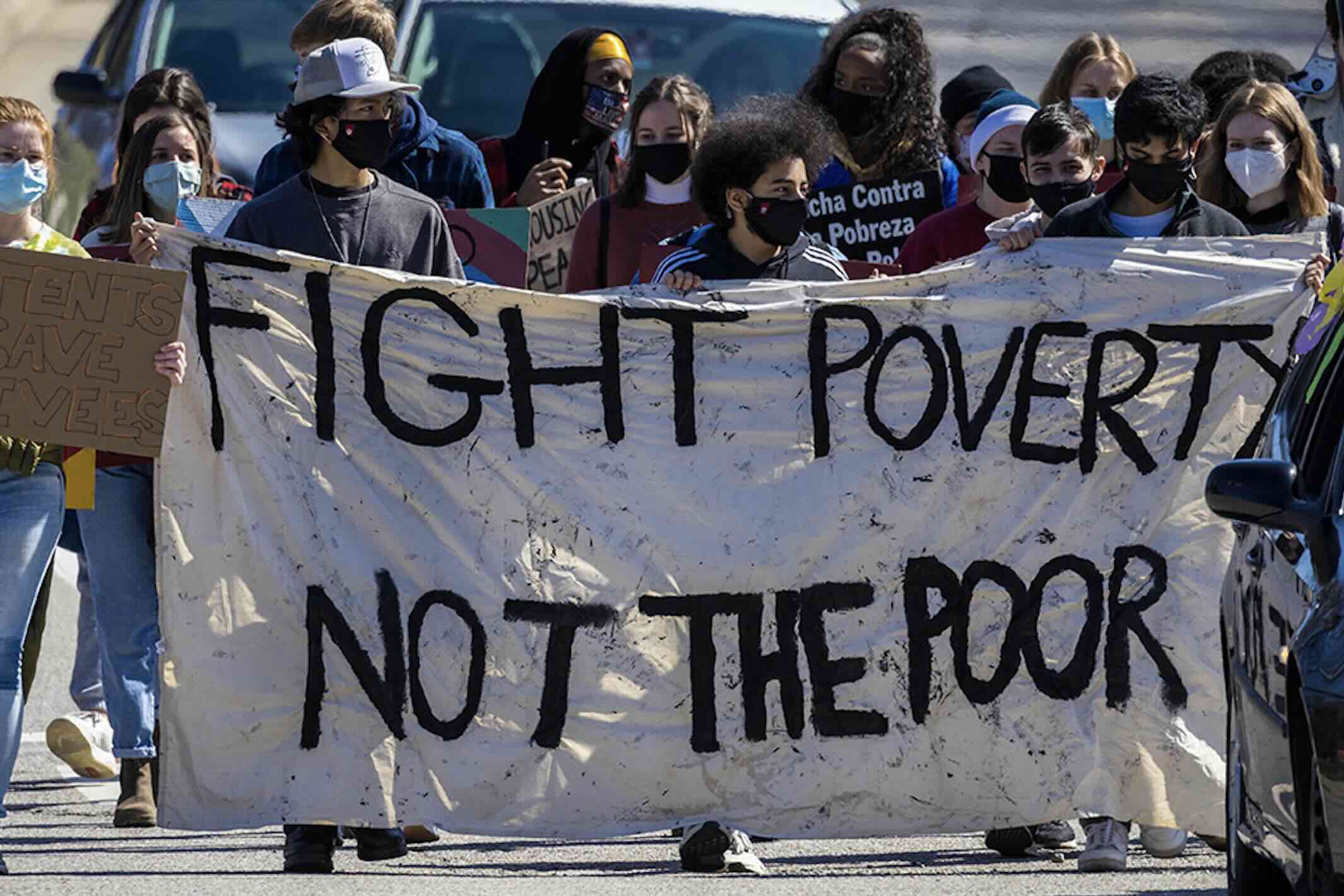
Photo: Getty Images
There are more than eight thousand registered charities and nonprofits in the United States explicitly classified under poverty alleviation, with tens of thousands more working indirectly on housing, food insecurity, workforce development, and advocacy. The human services sector generates between $216 billion and $350 billion in annual revenue. Tens of millions of Americans volunteer their time. Donors give billions. And yet, poverty persists.
Most people assume the problem is a shortage of money. But the math tells a different story. Economists estimate it would take roughly $170 billion to $177 billion a year in direct cash transfers to bring every single poor American family up to the federal poverty line. That amount is significantly less than the $216 billion to $350 billion already flowing through the nonprofit sector. We are already spending enough to solve poverty.
The Middle-Man Economy
What the United States has built is not a poverty eradication system. It is a poverty management system. It operates through what might be called the "nonprofit buffer"—a multi-billion-dollar layer of organizations placed deliberately between wealth and poverty.
Instead of routing public money directly to a poor person's bank account, society passes it through a chain of vetted, supervised organizations. This arrangement serves a specific set of cultural, political, and economic functions that have almost nothing to do with actually lifting people out of poverty.
The nonprofit buffer solves a major political dilemma. It allows society to prevent a visible humanitarian crisis—mass starvation, families sleeping on the streets—without violating the deep cultural taboo against giving out "free money." The government can say it isn't handing out welfare; it is funding a prestigious community organization. Donors can say they are funding a specific, structured program that teaches responsibility. The recipient gets help, but it is delivered in a restricted format—a soup kitchen meal, a shelter bed, or a food box—that satisfies the cultural requirement for supervision. This is not an accident. It is a design feature.
Consider the financial reality of the sector. According to data from Candid and the Urban Institute, fifty-nine percent of U.S. nonprofits have annual budgets under $50,000. Most operate on volunteers and donated space with almost no overhead. Ninety-seven percent have budgets under $5 million, meaning the vast majority are tiny, hyper-local operations. Major charities like Feeding America dedicate ninety-eight percent of expenses directly to programs, with minimal administrative costs. The entire sector employs ten percent of the U.S. workforce, making it the third-largest employment sector behind manufacturing and retail.
The money isn't being wasted in any traditional sense. It is being spent on the logistics of survival: warehouses, trucks, caseworkers, shelter beds, and food distribution networks. These are real services that keep millions of people alive. But they do not solve poverty. They subsidize it.
The Government's Hidden Role
When people think of nonprofits, they usually assume the money comes from billionaires, everyday donors, and corporate charity drives. In reality, the financial structure is entirely different. Up to sixty to eighty percent of human services revenue does not come from private donations. It comes from government grants and fee-for-service contracts. Federal, state, and local governments essentially hire nonprofits as subcontractors to run housing programs, manage Medicaid clinics, and distribute food aid on behalf of taxpayers.
Instead of building government facilities, agencies pay existing local nonprofits to administer public programs. When a homeless shelter operates, a massive chunk of its budget is often government money paid to the shelter to manage beds on the city's behalf. The government relies on this arrangement. It is not built to run thousands of local homeless shelters, domestic violence clinics, or food distribution networks. By treating nonprofits as private subcontractors, federal and state agencies can fund these services without having to hire thousands of public employees, buy real estate, or manage local operations directly. It is a way to run a public safety net while keeping the actual size of the government footprint looking smaller.
The Unspoken Conflict of Interest
Here is the reality that no one in the nonprofit sector wants to admit. If a nonprofit's stated goal is to eliminate hunger in its city, and it actually succeeds, that organization has effectively put itself out of business. It would have to fire its staff. The executive director would lose their job. The board would dissolve.
Organizations are hardwired for self-preservation. So they naturally shift from eliminating the problem to managing the problem. It is much safer to find funding to feed ten thousand people again next year than it is to build a system where those ten thousand people never need you again. This is not a conspiracy. It is institutional inertia. But it is also why the system perpetuates itself regardless of its stated mission.
What Happens If Poverty Actually Gets Fixed?
The question that exposes the entire charade is this: What would happen if a nonprofit network actually succeeded in eradicating poverty?
If every single person had a guaranteed, stable financial baseline, the entire low-wage labor market would collapse overnight. Fast-food chains, agricultural fields, gig-economy apps, warehouse fulfillment centers, and retail stores rely entirely on a desperate workforce that has to accept twelve to fifteen dollars an hour just to survive. If people were no longer desperate, companies would be forced to drastically raise wages and offer excellent benefits to attract workers. This would cause massive corporate pushback and a middle-to-upper-class freakout over rising prices for fast food, groceries, deliveries, and services.
The political backlash would be immediate and severe. This is precisely why several state legislatures have passed laws explicitly banning cities from running guaranteed income pilots.
The Cultural Trap
In the United States, the primary obstacle to giving people direct cash isn't financial math. It is a deeply ingrained set of cultural values that makes the concept highly controversial. If a politician proposed a pure, national "no-strings-attached" cash program, it wouldn't just face pushback; it would spark a massive ideological battle.
Dating back to its founding, mainstream American culture has been heavily influenced by the idea that a person's worth and survival should be directly tied to their labor. Wealth should be earned through hard work. Giving out cash with "no strings attached" violates this core narrative. Opponents argue that giving people guaranteed money creates a "disincentive to work," leading to a society of dependency. Even if economic data shows most people continue working, the fear of rewarding perceived laziness is an incredibly powerful cultural force.
There is also a widespread cultural assumption in the U.S. that people are poor because of poor personal choices, rather than systemic failures. Because of this "trust gap," society feels more comfortable giving a low-income person a voucher that can only buy food or a physical bed in a shelter. Handing over raw cash triggers a cultural anxiety that the money will be "wasted" on non-essentials or luxury items, despite tracking data showing that recipients overwhelmingly spend it on baseline survival needs like rent and medicine.
Because of this exact cultural resistance, policymakers who want to use cash have learned they cannot call it "welfare" or a "handout." Instead, they have to rebrand it to fit American values. When the government permanently expanded the Child Tax Credit, it was essentially a direct cash transfer sent straight to parents' bank accounts. But because it was framed as a tax cut for working families, it bypassed the cultural stigma and achieved overwhelming bipartisan public support.
Universal Basic Income polling shows that Americans are highly split. However, support spikes significantly when the cash is framed not as "aid for the poor," but as compensation for workers displaced by automation and technology. Ultimately, this is why the eight thousand plus nonprofit system persists. It serves as a culturally acceptable compromise: it provides a safety net so people don't starve, but it satisfies the cultural demand that the aid remains supervised, restricted, and program-based.
The Illusion of Progress
By funding eight thousand nonprofits to the tune of hundreds of billions of dollars, society gets to feel a collective sense of charity and effort. It gives the appearance of a war on poverty, while ensuring the underlying economic system remains completely untouched.
Major sociologists and political scientists call this "the illusion of progress." The system keeps poor people just stable enough so they don't riot or starve on the evening news. It keeps them just desperate enough to keep showing up for low-wage jobs. It allows the wealthy and middle class to feel generous without actually redistributing power or wealth. And it creates a massive employment sector for college-educated professionals to manage the safety net.
The persistence of poverty in America is not a failure of resources. It is not a failure of charity. It is a deliberate choice to fund the management of poverty rather than the eradication of poverty.
No Ads. By Us. For Us.
This article was made possible by readers like you. We hope it inspired you to support Emerald Book, so we can continue producing content like this.
We will never show you ads, sell your data, or require a subscription to consume our content. Your gift helps us keep the truth accessible.
Click the Support button to give a gift of any amount today.
Thank you for making this work possible.