

Emerald Pages
◆
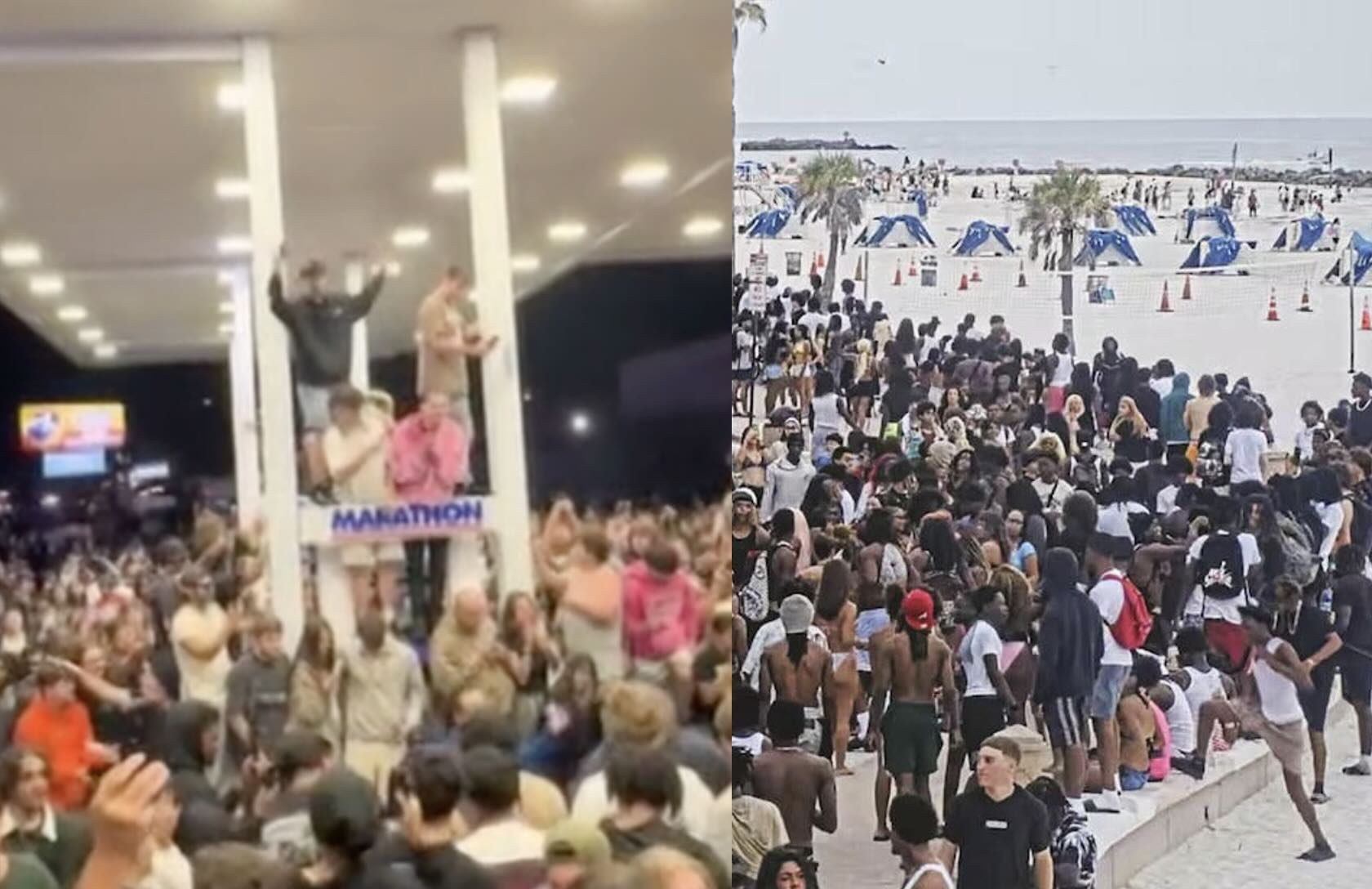
Photo: Florida Politics | WBIR
According to the U.S. Census Bureau, there are roughly 21 million white teenagers in the United States compared to about 5 million Black teenagers. That means white youth outnumber Black youth by a factor of more than four to one.
Given this demographic reality, it is statistically impossible for the phenomenon of large, social media-fueled youth gatherings—dubbed "teen takeovers"—to be a predominantly Black issue. Yet, if you were to turn on your local news or scroll through your social media feed, you would be forgiven for believing that these events are a one-race crisis.
The discrepancy between the data and the coverage is not a coincidence. It is the result of a systemic bias in local journalism, an over-reliance on police sources, and a commercial incentive to broadcast fear over facts. We will dissect the media's racialized narrative, using data, historical context, and comparative examples to show that the "teen takeover" panic is a manufactured story that masks a much older, more ordinary tale: bored teenagers looking for a place to exist.
The media frame hinges on a few key pillars: geography, language, and the economics of outrage. By understanding these pillars, we can identify the real issue: a generation of young people who have been stripped of safe, public spaces to simply be together.
The Contradiction
Let’s start with the numbers. The narrative that "teen takeovers" are an inner-city, Black phenomenon falls apart under the slightest scrutiny. The 2026 Poynter Institute analysis of "teen takeover" coverage found that 84% of stories relied almost exclusively on law enforcement and government sources, which in turn disproportionately police urban centers with large minority populations. This creates a feedback loop: police presence generates arrests and footage, which generates news stories, which reinforces the public perception that the problem is solely "urban."
This selective coverage also ignores the reality of the gatherings themselves. Legal scholars monitoring these events in cities like Washington D.C. have noted that while 1,000 teenagers might show up, the arrest rate hovers around 2 to 8 individuals per event. This means 99.5% of the attendees are breaking no laws—they are simply loitering, talking, and being teenagers in a place where adults don't want them.
When we look at the data on juvenile crime, the picture becomes even clearer. According to the The Sentencing Project, total juvenile arrests have declined by more than 75% since their peak in 1994. The current generation is statistically safer and less criminal than their parents' generation. The panic is a result of visibility, not an increase in danger.
- The 4-to-1 Ratio: White youth outnumber Black youth by over 400%. Simple math dictates that if social media coordination is a youth-wide activity, there are more white gatherings taking place.
- The 0.5% Rule: In crowds of thousands, the number of kids actually arrested for violence or vandalism is a fraction of a percent—around 0.5%.
- Declining Crime Rates: Juvenile violent crime arrests have dropped by 71% from their 1994 peak, contradicting the media narrative of a youth crime wave.
The "Project X" Blind Spot
If the media wanted to find footage of white teenagers engaging in mass property destruction and chaotic social media-driven violence, they wouldn't have to look far. Suburban and affluent white youth have been organizing "takeovers" under different names for decades.
The clearest example of this double standard is the phenomenon of the "Project X" parties, named after the 2012 found-footage film. In cities like Austin, Texas, and across suburban Florida, affluent teens routinely use social media to drop location pins for vacant mansions or Airbnbs, drawing hundreds of kids. These events often result in hundreds of thousands of dollars in property damage, theft, and massive neighborhood disruptions. Yet, in the media, these are framed as "trashed rentals" or "bad decisions" by individuals, not as a "gang" or "takeover" of a community.
The Gilbert Goons and the Irvine E-Bike Assaults
The case of the "Gilbert Goons" in Arizona shatters the media's urban narrative entirely. This was a group of predominantly white, upper-middle-class teenagers from one of the safest cities in America. They used Snapchat to coordinate brutal, "blitz-style" assaults with brass knuckles, recording the beatings for social media clout. Their activities went largely unchecked by police for over a year, culminating in the tragic fatal beating of 16-year-old Preston Lord in October 2023.
Similarly, in March 2026, a group of five white teenagers on e-bikes in Irvine, California, chased down and assaulted a Black UC Irvine student, hurling racial slurs and ramming him with their bikes. These are not "urban" crimes; they are suburban, affluent, and white.
Despite fitting the profile of social media-fueled group violence, these stories were framed as local true-crime anomalies rather than a sweeping "teen takeover" crisis. The media's framing didn't blame the demographic; it blamed the individual perpetrators.
The Split-Vocabulary Double Standard
The most blatant example of this racialized framing comes from the language news outlets choose to deploy. In one documented instance, a local news station—WBIR—reported on a large gathering of white teenagers and explicitly labeled it a "large gathering." Yet, when covering events involving Black teenagers in the same region, the same type of outlet deployed the term "teen takeover." This split-vocabulary tactic is not an accident; it is a systemic pattern in journalism.
When a news organization reports on the same state or region but alters its wording based on the race of the participants, it follows a predictable template. The White Demographic Filter uses neutral, clinical language like "large gathering" or "unruly party." This framing treats the teenagers as individuals making mistakes or blowing off steam, with no criminal connotation. The Black Demographic Filter deploys aggressive, militarized language like "teen takeover" or "chaos," shifting the entire context from a social event to a hostile invasion. This language suggests a coordinated, malicious attempt to seize public territory, sending an immediate signal to the audience that heavy policing and mass crackdowns are justified.
Local news networks rely on automated scripts, wire reports, and police press releases. If a suburban police department releases a statement about a "large gathering of juveniles," the station copies that exact headline. If an urban department releases a statement warning parents about "teen takeovers," the station copies that headline instead. But the choice of which press release to amplify is itself a bias. Furthermore, local news stations are commercial businesses trying to appeal to their primary viewer base; they are far less likely to label a crowd of white kids as a "dangerous mob" because those kids look like their main audience or their advertisers' children.
The double standard has become so glaring that major media institutions are finally calling it out. The Poynter Institute explicitly issued reporting guidelines warning journalists to stop using sensationalized words like "takeover," "swarm," and "chaos" specifically because they are disproportionately used to describe Black youth while white youth are given the grace of neutral language.
The Economics of Fear
Why does this double standard persist? It is a business decision. Major news organizations are commercial enterprises. Decades of media research show that imagery of minority youth engaged in public disorder taps into historical, deeply ingrained societal anxieties that older, suburban audiences find emotionally triggering—which drives clicks, views, and ultimately, ad revenue.
A video of a Black teenager jumping on a car in a city center triggers an immediate emotional response of fear and outrage. A video of a white teenager doing the exact same thing at a college tailgate is often processed by audiences as "reckless partying" or a harmless prank. The news industry sells the version that generates the most profit.
The truth is that teenagers across all racial and economic lines are using the same technology to fulfill the same basic human need: socialization. The real crisis is the lack of safe, accessible spaces for them to do so. By focusing on racialized narratives of chaos, the media avoids asking the hard questions about why our cities have failed young people, and instead gives politicians a reason to impose curfews and crackdowns that further alienate them.
The algebra of this issue is simple. The denominator is all teenagers. The numerator in the media's fear-driven equation is based on race and geography. When you redo the math by looking at the actual demographics of the country and the arrest statistics, the fabricated nature of the "teen takeover" panic is exposed. It is a story designed to sell fear, not to report facts.
No Ads. By Us. For Us.
This article was made possible by readers like you. We hope it inspired you to support Emerald Book, so we can continue producing content like this.
We will never show you ads, sell your data, or require a subscription to consume our content. Your gift helps us keep the truth accessible.
Click the Support button to give a gift of any amount today.
Thank you for making this work possible.