

Emerald Pages
◆
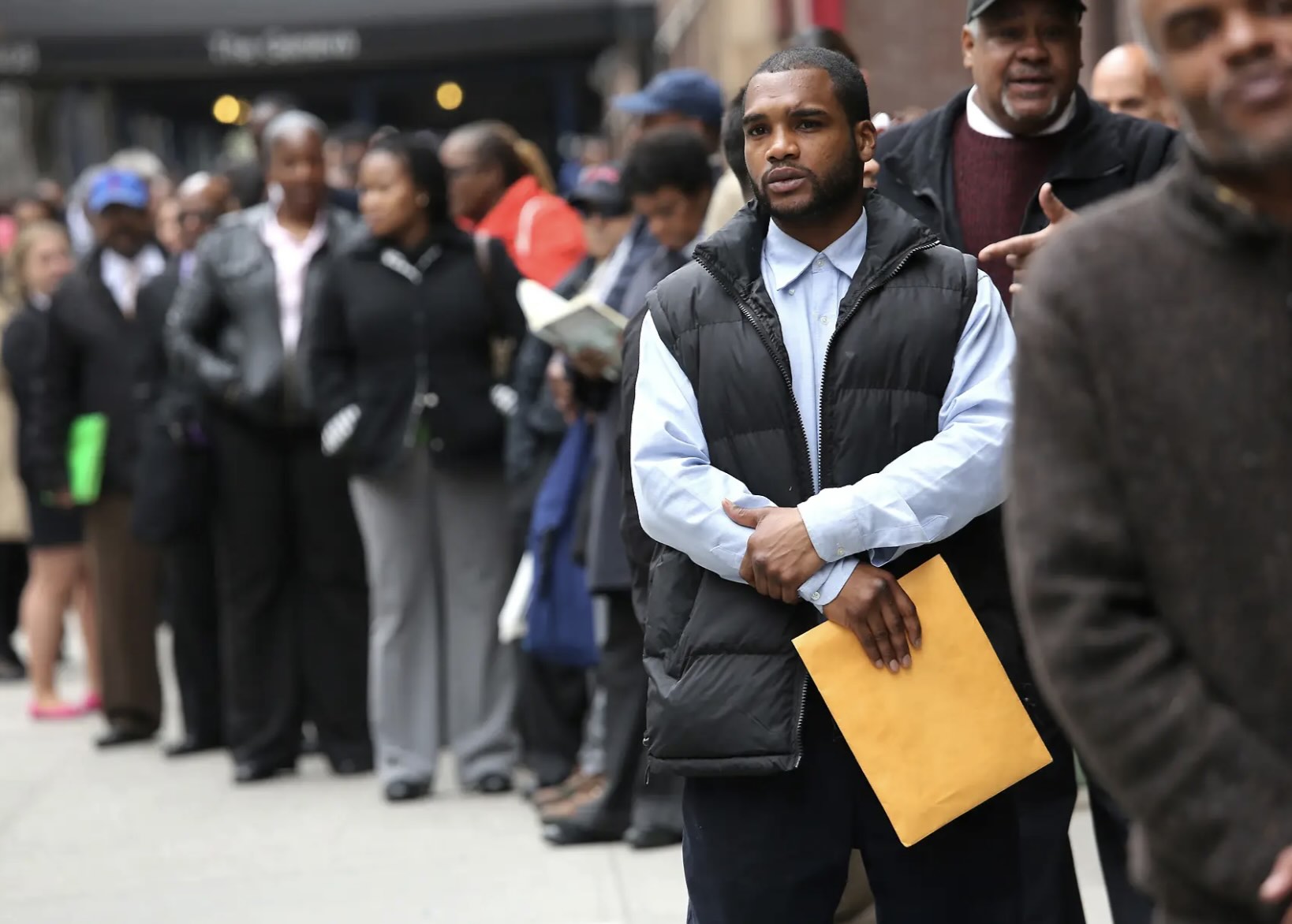
Photo: Getty Images
On Friday, the Bureau of Labor Statistics (BLS) released its August jobs report: the Black unemployment rate had dropped to 6.0%, a new low for the year. Yet, beneath the surface of this seemingly positive data lies a deeply entrenched structural failure—a statistical mirage that rewards exhaustion and masks a crisis of labor force participation.
The official unemployment rate (U-3) only counts people who are actively looking for work. If a worker becomes discouraged, stops searching, and leaves the labor force, they vanish from the calculation entirely. This is precisely what has happened over the summer months. The rate fell from 7.3% in April to 6.0% in August, but not because a wave of Black workers found sustainable employment. The drop is a mathematical artifact of a system that discards the disheartened.
The numbers paint a clear picture. While the unemployment rate for Black workers ticked down from 6.3% in July to 6.0% in August, the Labor Force Participation Rate (LFPR) for Black workers has cratered. It plummeted from 62.7% in March to 61.3% in July—a 1.4 percentage point drop in just four months. For a population of millions, this represents hundreds of thousands of individuals who have simply stopped looking. The BLS itself noted that the 0.3 percentage point drop from July to August was classified as "little change" due to the survey's margin of error, but the exact household data confirms a new low—a low built on attrition, not employment.
The Mathematics of a Mirage
The formula for the unemployment rate is a simple fraction: the number of people actively looking for work divided by the total labor force (working plus looking). When Black workers—who face significantly longer durations of joblessness than any other group—reach the point of financial and emotional exhaustion, they exit the workforce. This shrinks both the numerator and the denominator, forcing the percentage down.
The raw data tracks this sequence precisely. In March 2026, the Black LFPR stood at 62.7%. By April, it dropped to 62.2%; May, 62.0%; June, 61.9%; and July, 61.3%. In just four months, the participation rate plummeted by 1.4 percentage points. This mass exit was driven by structural pressures: major job losses in sectors like transportation, warehousing, and logistics—which heavily employ Black workers—forced a wave of involuntary departures. When people stop checking the boxes that the BLS requires to be considered "unemployed" (like filling out an application within the last 4 weeks), they are reclassified into the economic void of "not in the labor force." That is exactly why the unemployment rate fell to 6.0%—it is the math hiding the struggle.
The Cruelty of the Duration Gap
This mirage is built on a structural foundation: Black workers are trapped in unemployment for significantly longer than any other group. The BLS tracks the median number of weeks a person remains continuously unemployed, and the disparity is stark:
- White Job Seekers: Median of 8.4 weeks to find a job.
- Hispanic Job Seekers: Median of 8.2 weeks to find a job.
- Black Job Seekers: Median of 10.3 weeks (or more) to find a job.
This means the typical Black worker spends roughly 20% to 25% longer out of a job than White or Hispanic workers. When macroeconomic conditions sour, this gap stretches even wider. This prolonged job hunt directly feeds into why people drop out of the labor force entirely: running out of financial safety nets over months of searching leads to higher rates of giving up. Once a job seeker hits the 27-week mark (long-term unemployment), a "hiring scar" sets in, and resumes with long gaps face massive filtering discrimination, creating a compounding cycle that drives people permanently out of the system.
The Irony of the 'Improvement'
The deeper tragedy is that the worse the job market treats a demographic, the "better" their headline unemployment rate can look on paper. If the system makes it so difficult to find a job that people abandon the search, the government reports it as an economic victory. This "first fired, last hired" dynamic is amplified by occupational segregation, where Black workers are disproportionately concentrated in volatile sectors like logistics, retail, and service—industries prone to violent hiring and firing cycles. When these sectors slump, displaced workers are left stranded with zero nearby options.
This statistical mirage isn't confined to the Black community. It distorts the national average as well. The gap between the U-3 (standard) and U-6 (underemployment) rates is routinely double, revealing that underemployment and discouraged workers are climbing even as the headline rate drops. The national labor force participation rate is down 0.5 percentage points since January, and White workers are beginning to feel the squeeze as the white-collar realignment leads to massive job losses in tech and finance. However, because White workers have a larger buffer of generational wealth and white-collar roles, they are often insulated from the initial shocks, while Black workers bear the brunt of the downturn first and worst.
The evidence is clear: the 6.0% rate is not a sign of recovery. It is a sign of surrender. It is a mathematical illusion created by a system that rewards exhaustion. By exposing how long-term unemployment duration forces mass workforce dropouts, we identify the exact reason why this "reduction" is a mirage that masks widespread economic hardship. Until we look beyond the headline figure and address the structural barriers that force Black workers out of the labor force—hiring discrimination, occupational segregation, and a lack of quality jobs—the true measure of economic health will remain obscured by this cruel statistical mirage.
No Ads. By Us. For Us.
This article was made possible by readers like you. We hope it inspired you to support Emerald Book, so we can continue producing content like this.
We will never show you ads, sell your data, or require a subscription to consume our content. Your gift helps us keep the truth accessible.
Click the Support button to give a gift of any amount today.
Thank you for making this work possible.