

Emerald Pages
◆
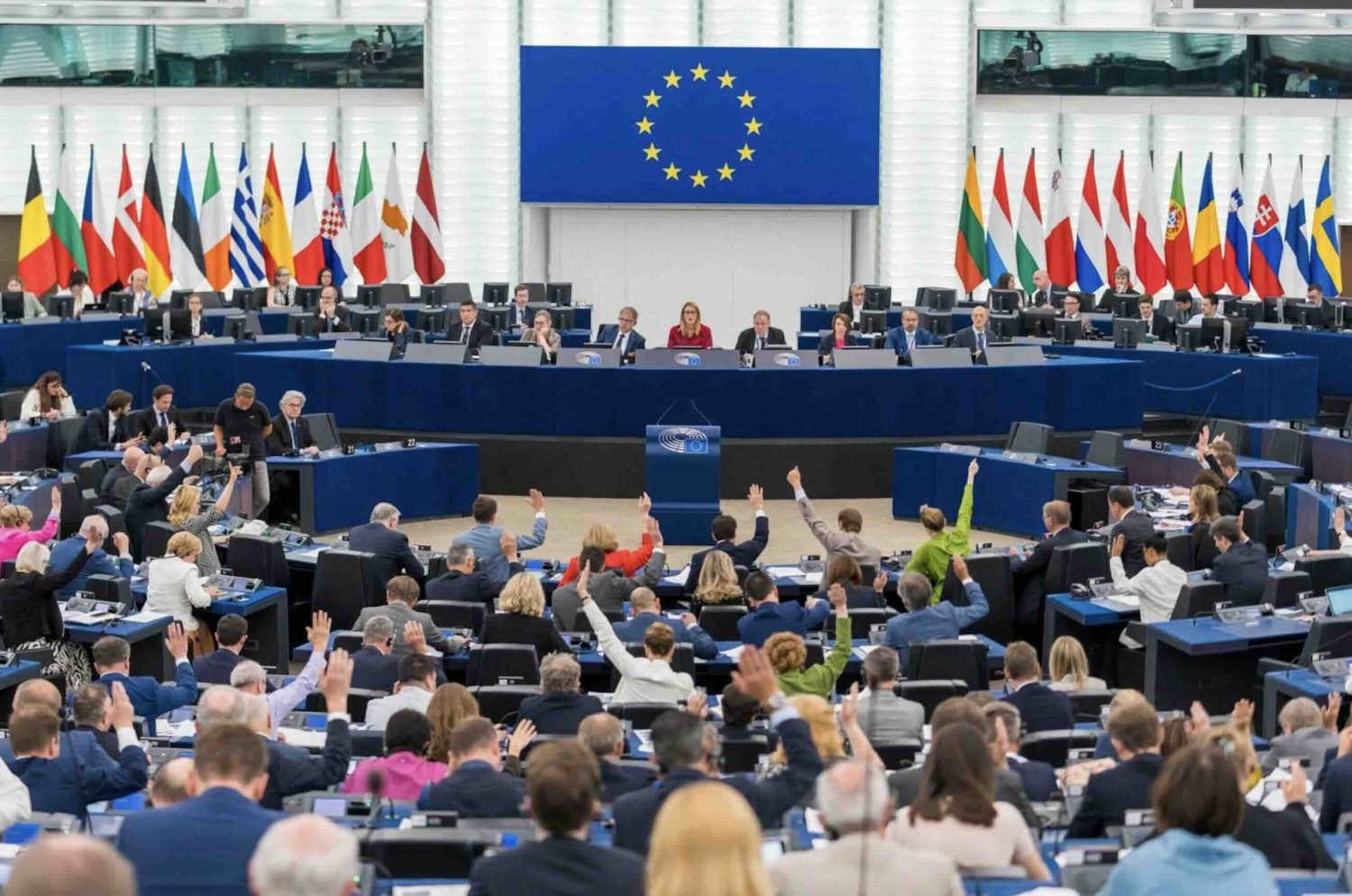
Photo: President of the European Parliament | Facebook
There has never been a single century in recorded history when the entire European continent was free from armed conflict. Not one. From the Peloponnesian Wars to the Balkan Wars, from the Roman legions to the NATO battlegroups, Europe's soil has been soaked in blood with such consistency that historians have coined terms like "the Long Peace" not because peace was absolute, but because the major powers simply stopped fighting each other directly for a few decades at a time. The intervals between wars are what Europe calls peace. The wars themselves are what Europe actually is.
This is not a controversial claim. It is the consensus of military historians and political scientists who have tallied the wreckage. According to comprehensive historical records of warfare since 3000 BC, approximately 50% to 65% of all recorded war-related deaths and battles occurred in Europe. The modern period accounts for 96% of all recorded war deaths, with the 20th century alone representing 73%. World War I claimed over 15–22 million lives. World War II killed an estimated 70–85 million people. Both conflicts were fundamentally anchored in European political systems, European expansionism, and European rivalries.
And yet, for centuries, these same European powers lectured the world about civilization. They drew maps of Africa and labeled its peoples "barbaric." They wrote philosophical treatises on the "savagery" of Black and Brown communities. They built empires on the premise that they, the Europeans, were the standard-bearers of order, reason, and peace. The historical record tells a strikingly different story. The continent that produced the Holocaust, the Thirty Years' War, and two world wars had no business lecturing anyone about savagery.
The Myth of European Peace
Historians often point to three periods of "relative peace" in Europe: the Pax Romana (27 BC–180 AD), the Concert of Europe (1815–1914), and the post-1945 "Long Peace." Each of these eras is taught in European schools as evidence of the continent's capacity for order and stability. Each is also a carefully curated illusion.
The Pax Romana was enforced by a brutal superpower that slaughtered and enslaved millions across its territories. Constant skirmishes and violent conquests raged along the borders with Germanic and Slavic tribes. The "peace" of Rome was the peace of the occupied—the silence that follows conquest, not the absence of war. The Concert of Europe lasted roughly 99 years without a continent-wide war, but it was punctuated by the Crimean War (1853–1856), the Franco-Prussian War (1870), and countless internal revolutions. It was a peace built on a balance of power so fragile that a single assassination in Sarajevo could shatter it.
The post-1945 Long Peace saw the Soviet invasions of Hungary (1956) and Czechoslovakia (1968), the bloody breakup of Yugoslavia and the Balkan Wars in the 1990s, and Russia's ongoing invasion of Ukraine. Western Europe was stable because it was sheltered under the American nuclear umbrella and the NATO alliance—not because Europe had somehow transcended its history. The moment that shelter appeared uncertain, the old instincts returned.
Even Europe's longest conflicts defy the narrative of civilization. The Reconquista consumed 781 years of Iberian warfare. The Hundred Years' War spanned 116 years of Anglo-French bloodshed. The Thirty Years' War wiped out up to 20% to 60% of the population in regions of modern-day Germany—a scale of destruction unmatched until the industrialized carnage of the 20th century. The Napoleonic Wars killed an estimated 3.5 to 6 million people across a continent that had supposedly entered an age of reason. This is not a history of peace. It is a history of perpetual war, interrupted only by exhaustion.
Why Europe Never Stops Fighting
The structural reasons for Europe's perpetual conflict are well understood by political scientists. Europe's terrain is highly fractured by mountain ranges and dense river systems, making it nearly impossible for any single empire to permanently conquer and unify the continent. This geography encouraged the development of distinct, fiercely independent ethnic groups and competitive states in close proximity.
The result was a textbook "security dilemma." When one country increased its military size or built fortresses purely for its own defense, its neighbors viewed it as an existential threat. In response, those neighbors built up their own armies or formed rival alliances. This constant friction created a perpetual arms race where a minor diplomatic misunderstanding could easily spark a massive continental war. Mercantilist economics—the belief that global wealth was finite and that a nation could only grow richer by taking resources from another—drove competition for finite land, trade routes, and colonial wealth.
Religious and ideological fractures cut across national borders, ensuring that every political dispute could escalate into a holy war. The Protestant Reformation in the 16th century divided the continent into warring religious factions. The French Revolution introduced a clash between monarchy and republicanism. The 20th century brought the catastrophic clash between democracy, fascism, and communism. Unlike regions that were historically unified under massive, long-lasting empires, Europe never developed a single referee powerful enough to enforce peace across the whole continent.
- Geographic fragmentation: Mountains, rivers, and peninsulas prevented unification and encouraged fierce competition between independent states.
- The security dilemma: Crowded, sovereign nations with overlapping borders produced perpetual arms races and alliance systems.
- Mercantilist economics: Competition for finite resources and trade routes drove continuous imperial conflict.
- Ideological fractures: The Protestant Reformation, the French Revolution, and the clashes of the 20th century tore the continent apart repeatedly.
- No continental referee: No single power or institution could enforce peace across the whole of Europe until the EU and NATO were created after 1945—and even those institutions are now being tested.
The "Be Ready" Campaigns: An Admission of Instability
In 2026, at least 18 European countries have introduced, updated, or expanded civilian preparedness campaigns. The United Kingdom launched its three-year "Be Ready" campaign via beready.gov.uk, advising households to stockpile 72 hours of water, food, and battery-powered radios. The recommendations include three liters of water per person per day, canned foods, a battery-powered or wind-up FM radio, torches, power banks, and a first-aid kit. Germany recommends a 10-day emergency supply buffer. Sweden and Norway have extended self-sufficiency recommendations to a full week, updating their wartime crisis brochures to include instructions on nuclear, biological, and chemical shelter responses.
Ireland has sent physical preparedness booklets to roughly 2.2 million households. France and the Netherlands have pushed out updated national crisis guidance to over 8.5 million homes. The Baltic states—Estonia, Latvia, and Lithuania—distribute guides on how to identify Russian military vehicles, resist occupation, and organize civil disobedience under hostile forces. The European Commission's "We Act as One" campaign targets multiple member states to build baseline community preparedness, while the broader Preparedness Union Strategy emphasizes keeping 72-hour emergency reserves to buffer against systemic cyber threats and regional instability.
These campaigns are framed as responses to Russian hybrid threats, cyberattacks, and infrastructure vulnerabilities. But they also reveal a deeper truth: Europe, despite its pretensions of stability and enlightenment, remains a continent defined by the specter of war. The "Long Peace" of 1945 to the present was never absolute. The continent that invented total war is now preparing its citizens for the next crisis—while still reckoning with the myths it told about everyone else.
The Colonial Double Standard
While Europe waged its wars of unification, conquest, and global domination, it simultaneously constructed an ideology of African "barbarism" to justify colonial rule. This was not a neutral observation—it was a political tool. The "civilizing mission" rhetoric allowed European powers to portray their conquest of Africa as a moral imperative rather than an exercise in resource extraction and geopolitical competition. The same continent that produced the Holocaust and the trenches of World War I positioned itself as the tutor of the world.
Yet pre-colonial Africa was home to highly sophisticated, complex, and organized civilizations. The Mali Empire established Timbuktu as a global hub for Islamic scholarship, mathematics, law, and astronomy, housing universities and vast libraries. The Kingdom of Benin developed advanced urban planning, defensive earthworks, and world-class metallurgy. The Kingdom of Aksum was a major trading superpower linking Rome, India, and Persia, with its own written script and gold coinage. These were not "barbaric" societies—they were civilizations that rivaled Europe in complexity, governance, and cultural achievement.
Meanwhile, Europe was perfecting the art of industrialized slaughter. The Taiping Rebellion (1850–1864) in China killed an estimated 20 to 70 million people, rivaling European conflicts in scale. The Mongol Conquests (1206–1368) killed an estimated 20 to 60 million people across Asia, the Middle East, and Eastern Europe. Human societies everywhere possess the capacity for both advancement and violence. The difference is not inherent nature but access to tools, wealth, and centralized power.
The historical record confirms that Europe has been an epicenter for some of the most highly organized, far-reaching, and lethal conflicts in human existence. The continent's history is not a story of civilization triumphing over barbarism—it is a chronicle of near-continuous, highly organized, and increasingly lethal conflict. And the "Be Ready" campaigns are a contemporary reminder that this history is not over. The continent that invented total war is now preparing its citizens for the next crisis—while still reckoning with the myths it told about everyone else.
A History That Refuses to Stay Buried
Europe's current "Be Ready" campaigns are not happening because of an inherent cultural trait. They are happening because the structural realities of geopolitics, resource competition, and shifting balances of power continue to shape how nations behave. But they also expose the hypocrisy of a continent that spent centuries labeling others as violent while perfecting the art of industrialized warfare.
The continent's history is not a story of civilization triumphing over barbarism. It is a chronicle of near-continuous, highly organized, and increasingly lethal conflict—interrupted by periods of exhaustion, rearmament, and the preparation for the next war. Europe has never seen lasting peace. It has only seen the intervals between wars. And those intervals are getting shorter.
The "Be Ready" campaigns are not just about stockpiling water and radios. They are an admission that the continent's oldest habits have not been broken. Europe is preparing for war again, because Europe has always been preparing for war. The only thing that changes is the technology of destruction—and the identity of the people Europe labels as barbarians while it sharpens its knives.
No Ads. By Us. For Us.
This article was made possible by readers like you. We hope it inspired you to support Emerald Book, so we can continue producing content like this.
We will never show you ads, sell your data, or require a subscription to consume our content. Your gift helps us keep the truth accessible.
Click the Support button to give a gift of any amount today.
Thank you for making this work possible.