

Emerald Pages
◆
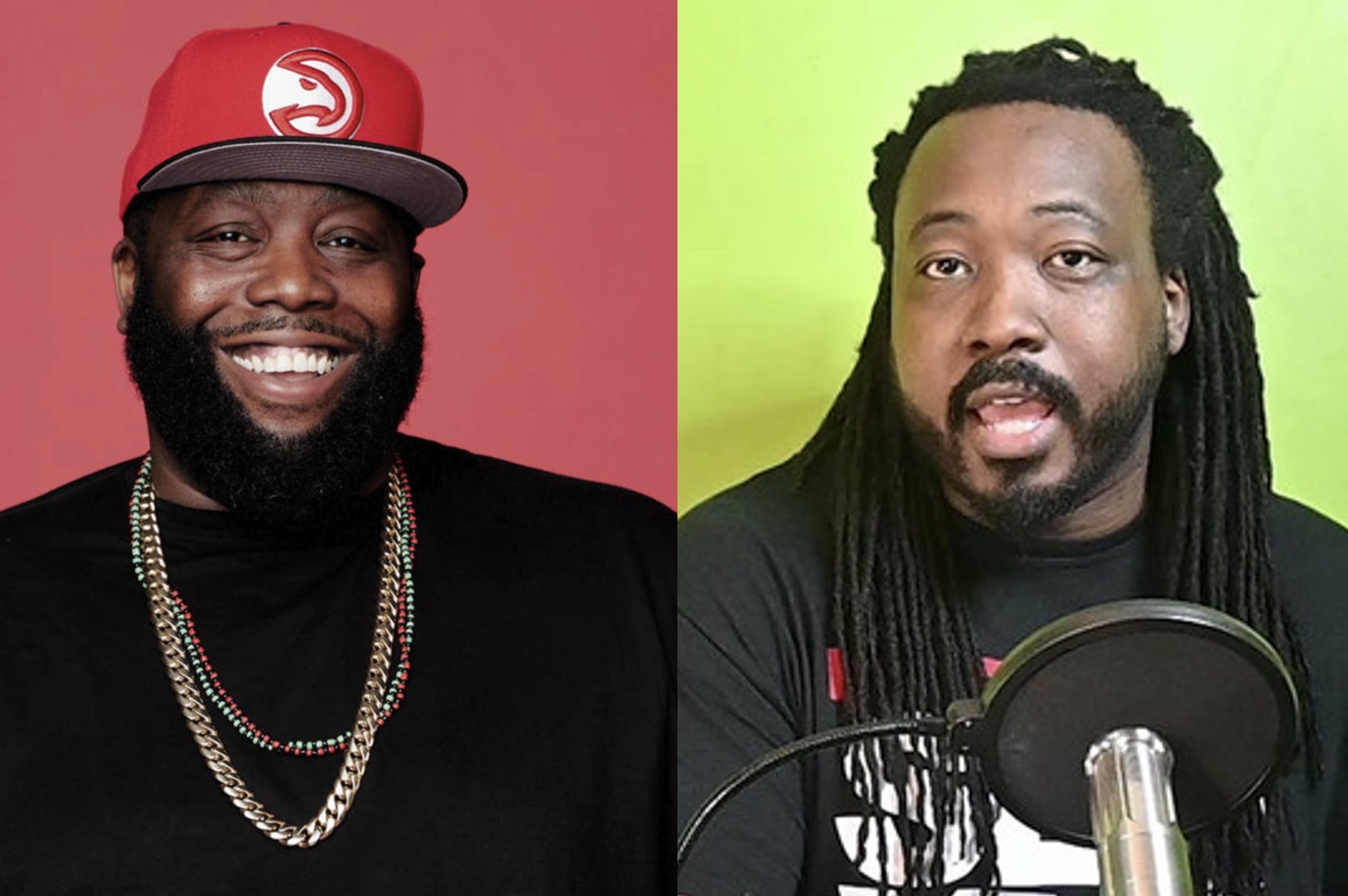
Killer Mike (left) and FD Signifier (right) | Photo: Emerald Book Archives
The year is 2026. The United States has survived a global pandemic, witnessed the rise of artificial intelligence, and watched billionaires accumulate wealth at scales previously unimaginable. And yet, within Black America, two competing economic philosophies—Black Capitalism and Black Socialism—continue to dominate intellectual discourse, each claiming to offer the path to liberation.
Both are wrong. Not because their theories are inherently flawed, but because the material conditions required for either system to exist simply do not exist. The Black community is not a capitalist economy. It is not a socialist economy. It is a resource-starved, capital-leaking, structurally dependent enclave operating within a white capitalist hegemony—and the numbers prove it beyond any reasonable doubt.
This is not a philosophical argument. It is a mathematical one. And the mathematics are devastating.
Part I: The Absurdity of Black Capitalism in 2026
Black Capitalism—the belief that individual entrepreneurship, business ownership, and capital accumulation within the Black community can secure racial justice and economic parity—rests on a foundational assumption: that the market is neutral, and that anyone with sufficient work ethic can buy their way to freedom. The data dismantles this assumption with surgical precision.
The Stock Market: A Near-Total Exclusion. Out of more than 4,000 publicly traded companies listed on major U.S. exchanges, there are only about six that are majority Black-owned and controlled. Mathematically, Black-owned businesses represent roughly 0.15% of the companies on the stock market, despite Black Americans making up over 14% of the U.S. population. The entire list of majority-Black publicly traded firms includes Urban One, RLJ Lodging Trust, Carver Bancorp, Broadway Financial Corp., Axsome Therapeutics, and American Shared Hospital Services. That is the full universe with only 2 (Axsome Therapeutics and RLJ Lodging Trust) actually being successful.
The Employer Business Gap. According to the U.S. Census Bureau's Annual Business Survey, there are approximately 201,000 Black-owned employer businesses—firms with at least one paid employee—compared to a total of 5.93 million employer businesses across the United States. This means Black-owned firms with employees account for just 3.4% of all employer businesses in the country. While Black entrepreneurs account for nearly 11% of all solo operations (non-employer firms), that ownership rate plummets to 3.4% the moment a business attempts to hire workers. The revenue wall is equally stark: the roughly 201,000 Black employer firms generate a collective $249 billion in gross revenue—less than 1% of the $50 trillion generated by all U.S. businesses combined.
The Billionaire Illusion. Within the United States, there are only 14 to 18 Black billionaires out of an all-time record high of 989 American billionaires. Black Americans, who make up roughly 14.4% of the population, account for less than 1.8% of the country's billionaire class. Globally, only 27 Black billionaires exist out of 3,428 total billionaires—0.79% of the global billionaire population. Together, all 27 Black billionaires on Earth hold a combined wealth of $121 billion—less than 15% of the wealth held by just one individual at the top of the global list. And the industry split reveals the deeper structural trap: over half of U.S. Black billionaires gained their status via sports, music, and media—intellectual property and personal performance—while white billionaires dominating the top of the global market derive their wealth from owning the fundamental industrial infrastructure of modern life: technology software monopolies, global supply chains, space logistics, energy networks, and massive private equity firms.
The Banking Chasm. Out of the $26.5 trillion in total assets held by all 4,238 FDIC-insured commercial banks, the nation's 24 Black-owned banks control roughly $9.4 billion combined. Black-owned banks hold just 0.035% of all U.S. banking assets. The upcoming historic merger of Optus Bank and Mechanics and Farmers Bank will create a $1.27 billion institution—the absolute pinnacle of Black banking power. Yet that entire landmark institution is still less than 0.05% of the size of a single corporate giant like JPMorgan Chase, which holds over $3 trillion in assets. In banking, a bank cannot issue a loan unless it has the baseline capital and deposits to back it. Because the combined deposit base of all Black banks is so small, they are structurally incapable of financing large-scale community infrastructure, commercial real estate, or industrial manufacturing.
The math is unambiguous: Black capitalism cannot exist as a competing macro-economy because the community lacks the baseline wealth required to fund major equity ventures or sustain businesses through economic downturns. It exists only as niche shielding—captive sub-markets in hair care, cultural media, and personal services—and defensive consolidation, where Black capital must merge just to stay alive. The system is not a pathway to liberation; it is a survival mechanism inside someone else's economy.
Part II: The Absurdity of Black Socialism in 2026
Black Socialism—the argument that true Black liberation cannot be achieved under capitalism and requires collective ownership of resources—rests on an equally foundational assumption: that ideological alignment can overcome a complete lack of physical infrastructure, defense, and material supply lines. The data dismantles this assumption with equal force.
The Enforcement Gap. Under capitalism, the state uses laws, police power, and financial regulations to protect private property. Socialism requires a mechanism of collective enforcement. Without control of state apparatuses or the military, Black communal or socialist experiments have historically been isolated, starved of resources, or actively dismantled by the state—as seen with the Black Panthers' survival programs and early agrarian cooperatives. The community does not own the primary means of production: the factories, utilities, and major food supply chains. Trying to build localized socialist enclaves means you are still entirely dependent on capitalist entities for daily survival goods.
The Infrastructure Deficit. Black businesses comprise only 0.5% of advanced manufacturing supply chains, 0.05% of utilities, and 1.3% of total manufacturing. The community is trapped in a low-margin consumer cycle. Black spending power is massive—roughly $2.1 trillion—but it goes toward consuming goods rather than producing them. True sovereignty would require owning the processing facilities, packaging plants, and shipping networks rather than renting them from white-owned conglomerates. It would require controlling the algorithmic code and automated assembly lines that dictate industrial throughput. None of this exists.
The Dependency Trap. Walmart, as the single largest private employer in the United States, employs roughly 1.6 million people domestically. Black workers make up between 19.8% and 28.8% of that workforce—between 315,000 and 460,000 Black Americans earning their living under a single corporate roof. Black labor is heavily concentrated at the operational base: distribution centers, fulfillment warehouses, cargo loading docks, and frontline grocery aisles. If workers "seized" a local Walmart store, they would inherit a building full of perishable food that would empty in three days. Walmart is entirely dependent on external global infrastructure that the workers do not control: international shipping lanes, diesel fuel lines, corporate farming conglomerates, microchip manufacturers, and the global internet grid. Seizing the means of production in a globalist economy is logistically impossible.
The Globalization Firewall. There is an exact physics of modern globalization in 2026. Under this system, the "means of production" are no longer a physical building rooted in an American city; they are an automated, hyper-fragmented, borderless network designed specifically to ensure that no single group of workers anywhere on Earth can ever truly capture the full pipeline of survival. If workers seize a physical facility in the United States, they haven't actually seized the means of production—they have merely seized an assembly plant. The production line dies the moment the software updates from a server in Europe, the microchips stop shipping from Taiwan, or the raw mineral components are cut off from Africa.
The conclusion is unavoidable: a pure Marxist or state-socialist revolution cannot happen in isolation within a marginalized minority community inside a dominant capitalist superpower. Black socialism cannot exist as a self-sustaining parallel economy because the community does not control the baseline manufacturing, energy, and digital infrastructure required to form a self-contained, self-defending collective.
Part III: The Structural Power That Does Exist
This is not a story of total powerlessness. When we stop focusing on who owns the top of the pyramid and start measuring who physically and operationally keeps the pyramid standing, the Black community's structural economic power becomes undeniable. The community does not need to own a trillion-dollar global monopoly to command massive, decisive leverage across the U.S. economy.
The Logistics Choke Point. While Black workers account for 14.4% of the total U.S. workforce, they represent a highly disproportionate share of the vital logistics sector: 25.3% of transit and ground transportation workers, 29.5% of couriers and messengers, and over 35% of all refuse and recyclable material collectors—with that number scaling past 60% to 70% in major urban centers like New York, Chicago, Atlanta, and Washington, D.C. A coordinated slow-down or labor action within just three major regional distribution networks wouldn't just affect retail stores; it would instantly freeze the flow of physical commerce to entire quadrants of the American eastern and southern seaboard. You don't need to own the railroad or the shipping container if you are the only one who can legally and physically drive it.
The Institutional Essential Labor. There are over 201,000 Black-owned employer firms in the U.S., and they are heavily concentrated in Healthcare and Social Assistance—over 52,500 firms generating $45 billion in annual revenue and employing more than 629,000 workers. Mainstream corporate structures treat healthcare as an expense line, but the reality is that Black-led labor and firms act as the community-anchoring bedrock of the nation's baseline health infrastructure. The physical withdrawal or intentional redirection of this specific care block would collapse municipal infrastructure in major metropolitan areas overnight.
The Sovereign Scale of After-Tax Income. Institutions like the Selig Center for Economic Growth and the Bureau of Economic Analysis calculate total disposable personal income across the entire Black population—not just isolated heads of households—capturing multi-earner homes, non-family living arrangements, gig-economy labor, proprietors' income from 3.45 million non-employer businesses, and non-cash government transfers. The result: $2.05 trillion in verified capital available to execute market leverage—an annual consumer economy comparable to the entire GDP of Canada or Italy. This spending is highly concentrated: Black households control one-third (33%) of the $45 billion annual discretionary spend in Atlanta, and nearly a quarter in Washington, D.C. (24%) and Detroit (23%). Over 70% of Black consumers report they will completely stop purchasing from brands that devalue or retreat from commitments to their community. Because major consumer packaged goods companies operate on razor-thin profit margins, an intentional, organized 1% shift of that $2.05 trillion pool ($20.5 billion) away from specific corporate entities would trigger immediate corporate board restructurings and credit rating downgrades.
The Cultural Intellectual Property Monopoly. Black culture, music, fashion, and athletic expression are the primary raw materials that power global entertainment platforms—from streaming giants to global sports leagues. While corporations often own the platforms, they do not own the generative source of the culture. If Black creators, athletes, and cultural architects collectively leveraged their intellectual property—demanding direct equity stakes and infrastructure distribution rights rather than simple endorsement fees—the multi-billion-dollar marketing machines of Western capitalism would lose their core fuel.
Part IV: The 1% Shift—Building the Buffer
The most immediate, actionable strategy lies in the mathematics of capital recirculation. Currently, only about 2% of the $2.05 trillion in after-tax income is captured by Black-owned businesses, meaning roughly $2 trillion leaks out of the community instantly into mainstream corporate pipelines.
If the Black community intentionally reroutes just 1% of its spending power back into the Black economy, it would redirect $21 billion in liquid capital annually away from external corporations. Using standard small-business payroll and revenue metrics from the U.S. Census Bureau—where a small-to-medium employer firm in labor-intensive sectors requires roughly $100,000 in gross revenue to sustain one entry-level or mid-tier private-sector job—that $21 billion in redirected revenue translates to over 210,000 new employer-backed jobs.
This is not a theoretical exercise. It is a survival strategy. Historically, the Bureau of Labor Statistics shows that the Black unemployment rate rests at roughly twice the rate of white unemployment. In American economic cycles, the system uses the Black working class as a shock absorber: when the Federal Reserve raises interest rates to cool the economy, credit dries up, corporate margins shrink, and frontline workers are the first to face layoffs. A self-funded 200,000-job ecosystem changes this dynamic. Jobs funded by internal community demand—localized healthcare firms, grocery cooperatives, and regional transit lines—do not depend on Wall Street private equity or corporate stock valuations. They remain stable because their revenue is anchored directly to the community's daily survival needs.
This same principle applies to banking. If the Black community shifts a portion of its after-tax income to increase Black bank deposits by just $10 billion—effectively doubling the current sector total—the lending capacity scales dramatically. Under the Federal Reserve's banking guidelines, a bank can leverage its deposit base to issue commercial loans. That $10 billion in new deposits could multiply into up to $90 billion in localized lending power. FDIC and MDI research proves that Black-owned banks lend a significantly higher percentage of their capital to minority borrowers and local small businesses than mainstream commercial institutions do. If just 6% of the 3.45 million Black-owned non-employer businesses receive enough capital to hire just one single employee, it instantly creates over 200,000 new jobs inside the community infrastructure.
Part V: The 51% Threshold—When the Conversation Becomes Warranted
The debate between Black Capitalism and Black Socialism is not wrong because the theories are bad. It is wrong because it is premature. You cannot choose an economic system until you actually control the economy. The Black community currently operates at just 2% economic participation—arguing about capitalism versus socialism when a community controls less than 4% of employer businesses and 0.035% of banking assets is putting the cart before the horse.
Reaching 51% economic participation—where the community controls its own food lines, real estate, credit networks, and employment base—shifts the focus to a concrete, tactical timeline. This is not a utopian target; it is the baseline structural power required to dictate your own terms of survival. At 51% participation, the theoretical debate finally becomes a practical, functional strategy rather than a textbook exercise.
The fundamental flaw of modern political discourse is that it treats ideology as infrastructure. It is not. Whether a system is called capitalist, socialist, or an indigenous hybrid model, its survival depends on raw material physics—food, shelter, energy, logistics, and capital retention. Grouping resources to achieve 51% internal economic participation isn't about picking a side in a European political debate; it is about building the baseline structural power required to dictate your own terms of survival.
In 2026, Black Capitalism does not exist. Black Socialism does not exist. What exists is a community at 2% economic participation with immense structural leverage—in transit, sanitation, logistics, healthcare, cultural production, and consumer spending—that remains atomized, divided into individual paychecks and isolated corporate silos. The challenge is not a lack of power. It is a coordination problem. And the first step toward solving it is acknowledging that the ideological debate is a distraction from the material work that must be done.
The conversation about capitalism and socialism can wait. The 51% threshold must come first.
No Ads. By Us. For Us.
This article was made possible by readers like you. We hope it inspired you to support Emerald Book, so we can continue producing content like this.
We will never show you ads, sell your data, or require a subscription to consume our content. Your gift helps us keep the truth accessible.
Click the Support button to give a gift of any amount today.
Thank you for making this work possible.