

Emerald Pages
◆
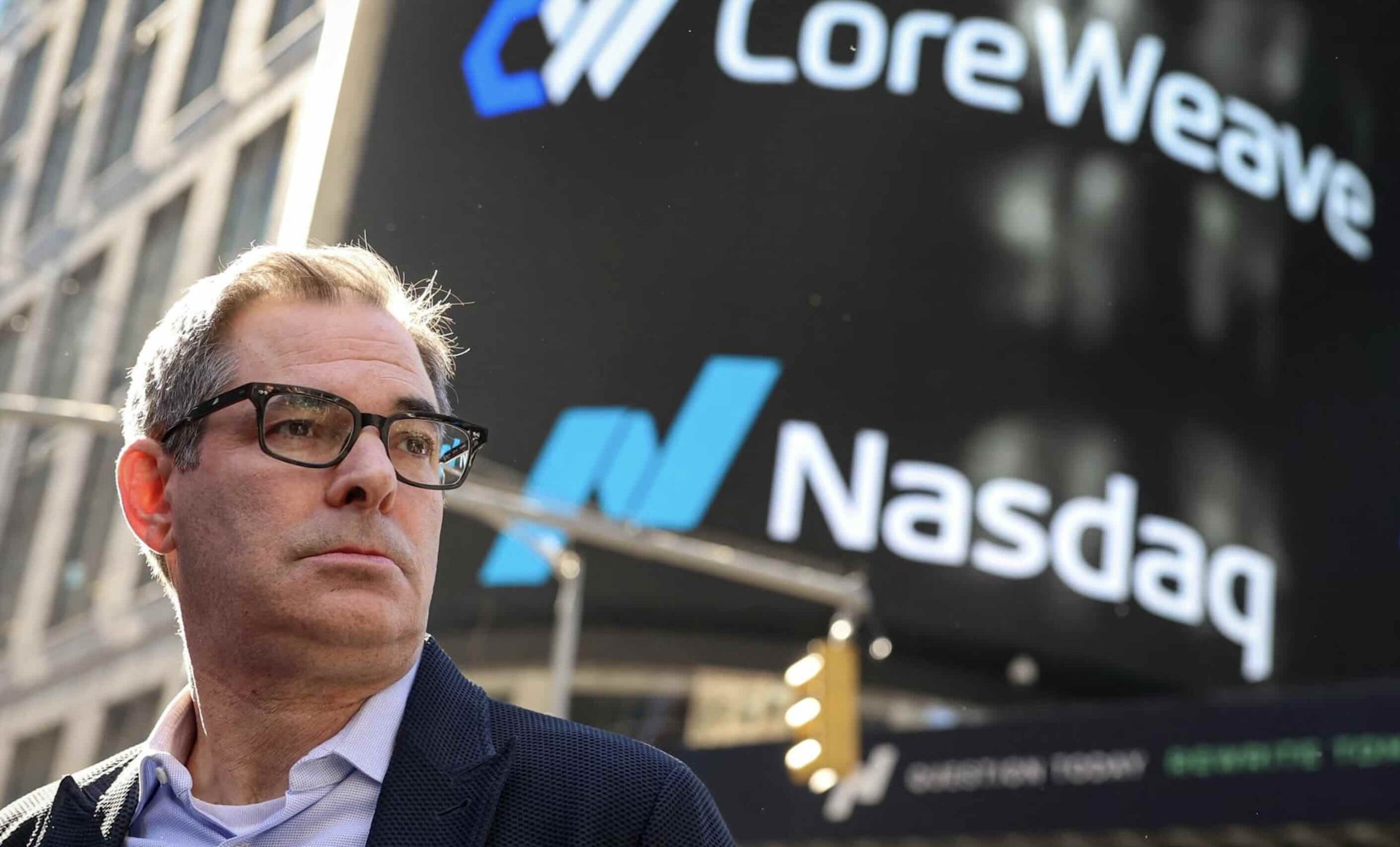
CoreWeave CEO Michael Intrator | Photo: Reuters
The first number that should terrify anyone who believes artificial intelligence is the next industrial revolution is $54.24. That is where CoreWeave's stock — the flagship of the so-called "neocloud" sector — closed on October 23, 2026. It represents a staggering 70% decline from its mid-2025 peak near $183 and a 36% collapse in a single month. But the stock price is not the real story. The real story is what that collapse reveals about the economics of generative AI itself: a business model in which every additional user actively drains cash from the company's bank account.
Neoclouds — specialized, AI-first cloud providers like CoreWeave, Nebius, and Crusoe — were supposed to be the backbone of the AI revolution. Unlike traditional hyperscalers such as AWS, Microsoft Azure, or Google Cloud, these companies focus almost exclusively on GPU-as-a-Service. Their data centers are filled with dense clusters of NVIDIA H100s and H200s, wired together with ultra-low-latency InfiniBand networking and cooled by direct-to-chip liquid systems. The pitch was simple: bypass the general-purpose cloud, rent raw accelerated compute at transparent hourly rates, and let the AI labs train their models.
On paper, the numbers looked extraordinary. CoreWeave's revenue grew 112% year-over-year to $2.6 billion in the second quarter of 2026, and its revenue backlog reached approximately $104 billion. Yet the company carries an estimated $35 billion to $50 billion in total debt, with capital expenditures expected to reach up to $39 billion this year. Its corporate bonds have fallen so far that yields have spiked to 15%–16% — a level that, in public markets, means investors are pricing in severe credit risk and openly questioning whether the business model is sustainable at all. Wall Street firms including HSBC and Bernstein have downgraded the stock, and CoreWeave's three co-founders have sold over $3.3 billion in shares since the March 2025 IPO, including $2.4 billion in 2026 alone.
This panic is not isolated to CoreWeave. It has triggered a sector-wide re-evaluation of the entire AI infrastructure trade. Rival neocloud Nebius is down over 31% this month. South Korean provider Elice tanked 32% on its very first day of trading in Seoul. Private operators like Nscale are struggling to secure new equity rounds and have paused planned IPOs. Even the physical landlords — former Bitcoin miners turned AI hosts like IREN, Applied Digital, and Core Scientific — have suffered identical double-digit crashes. A recent Gartner report warned that up to 80% of independent neoclouds could cease operations by 2030 because the revenue they generate is not keeping up with their staggering capital costs.
Why Neoclouds Must Borrow Billions
Traditional tech giants do not need to borrow to fund this. Microsoft, Google, and Amazon pay for their AI buildouts out of operating cash flow generated by enormously profitable core businesses — corporate software, search advertising, retail. Neoclouds have no such cash cow. They do not sell office software or search ads. Their only way to generate cash is to buy chips, rent them out, and collect the spread. Since they cannot buy chips without cash, they are forced to borrow from day one.
Worse, the asset itself expires quickly. In energy or heavy industry, a utility can borrow billions to build a gas turbine that lasts 15 to 20 years and generates predictable cash. An AI chip has a useful market life of only about three to four years before the next generation makes it obsolete or forces rental rates down. The result is a vicious loop: borrow billions, deploy hardware, collect revenue, service the debt, then borrow billions more almost immediately to buy the next generation of chips so the platform does not fall behind.
To make the math work, neoclouds pioneered a financial structure called chip-backed financing. When a neocloud signs a multi-year contract with a giant customer like Meta or OpenAI, it places that contract and the physical NVIDIA chips into an isolated corporate shell — a Special Purpose Vehicle — and Wall Street lenders issue massive loans based on the creditworthiness of the customer rather than the startup itself. It is clever engineering, but it does not change the underlying economics. It merely postpones the reckoning.
The Circular Money Furnance
The entire AI infrastructure boom is built on a circular economy, and the customer list proves it. Neoclouds' most critical customers are not small startups — they are the world's largest tech giants and frontier AI labs. OpenAI is a massive customer of CoreWeave and Crusoe. Anthropic leases capacity across CoreWeave, Fluidstack, and IREN. Meta uses CoreWeave and Nebius to supplement its Llama training. In a strange twist, Microsoft signed a staggering $19 billion deal with Nebius and a $9.7 billion deal with IREN, while AWS and Google regularly guarantee payments through orchestration platforms like Fluidstack.
Follow the loop. NVIDIA invests hundreds of millions into neoclouds like CoreWeave and Lambda Labs; those neoclouds use the money to buy billions in chips right back from NVIDIA, which records massive revenue and pushes its stock higher, allowing it to invest even more. Microsoft invests billions into OpenAI so OpenAI can build ChatGPT; OpenAI finds Azure full and takes that Microsoft cash to a neocloud to rent GPUs; Microsoft then signs a multi-billion-dollar deal to backstop the neocloud's infrastructure. Venture capital firms hand AI startups pre-paid compute vouchers instead of cash; startups spend them; neoclouds log the usage as "revenue" and show it to banks to borrow more billions. No external consumer paid for any of it. The same dollars simply traveled in a circle, inflating everyone's reported revenue along the way.
The risk is concentrated to a dangerous degree. CoreWeave's top three customers generate a massive 72% of its entire revenue. If a single AI lab decides to migrate workloads to its own infrastructure, or a tech giant cancels a lease, the financial model can unravel overnight. And the "take-or-pay" contracts that are supposed to protect neoclouds do not solve the liquidity problem: Microsoft does not hand over $19 billion on day one. It pays in monthly installments, while the banks, the landlords, and the electric utilities demand their money now.
The Real Weakness: Every User Costs More
In traditional software, the cost to build the first version is enormous, but the cost to serve the ten-millionth user is virtually zero. That is the engine of infinite scalability and fat margins. Generative AI flips the model on its head.
Every time a user types a prompt, a cluster of high-power NVIDIA chips must physically spin up, execute billions of matrix multiplications, and burn real electricity. Generating a single response can consume enough electricity to light an LED bulb for several minutes. If 100 million people use the service simultaneously, the electric bill scales linearly with the number of prompts. A chip can only process a finite number of tokens per second, so a surge in users does not just slow a website — it exhausts the hardware. To serve a growing user base, an AI company cannot simply optimize its code; it must go back to a neocloud and rent more physical GPUs, triggering the multi-billion-dollar debt loop all over again.
The problem worsens as the industry shifts from chatbots to AI agents that execute long, complex workflows. A chatbot answers in three seconds and shuts off. An agent might run in the background for three hours, browsing dozens of websites, writing code, and self-correcting — meaning a single user task can cost the provider dollars in raw compute while the user paid a flat monthly subscription. Meanwhile, fierce competition forces companies to offer free tiers to acquire users, and because the marginal cost of a prompt is so high, every free prompt is an absolute capital loss.
Where the Money Actually Goes
The revenue paid by AI companies to neoclouds does not create lasting wealth. It is a pass-through fund that briefly touches the neocloud's balance sheet before being routed to utility companies, landlords, and lenders. The money is not funding research and development or building a corporate surplus; it is paying the daily operational toll required to keep the lights on. If you stop pouring cash into the physical inputs — electricity, rent, and loan interest — the machines stop spinning and the revenue vanishes entirely.
This is why the neocloud sector behaves less like software and more like oil refining or airline operations: a physical commodity business with thin margins, heavy capital intensity, and relentless exposure to supplier and customer pricing power. NVIDIA extracts massive margins on the front end; the hyper-competitive market for raw compute forces neoclouds to slash rental rates on the back end. Whatever is left is consumed by 15% bond yields.
Financial analysts now expect the market to split into two outcomes. Smaller, purely independent neoclouds that rely entirely on high-interest debt will likely run out of cash and be forced into bankruptcy or fire-sale acquisitions as venture funding dries up. The strongest will stop operating as independent public companies and become outsourced infrastructure wings of Microsoft, Google, or Meta — the only players with balance sheets large enough to permanently subsidize the hardware costs. Crusoe, the private exception, already shows the template: last month it raised $3.9 billion in a Series F at a $30.9 billion valuation because it secures long-term contracts directly powering Microsoft and OpenAI's Stargate project, insulating it from the public rout.
But consolidation does not fix the underlying math. It only moves the losses onto a balance sheet big enough to absorb them. As long as serving an additional user requires additional physical chips, additional megawatts, and additional debt, the AI economy will remain a treadmill — one that runs faster and consumes more capital simply to stay in the same place. The neocloud collapse did not create that flaw. It just turned the lights up so the rest of us could finally see it.
No Ads. By Us. For Us.
This article was made possible by readers like you. We hope it inspired you to support Emerald Book, so we can continue producing content like this.
We will never show you ads, sell your data, or require a subscription to consume our content. Your gift helps us keep the truth accessible.
Click the Support button to give a gift of any amount today.
Thank you for making this work possible.