

Emerald Pages
◆
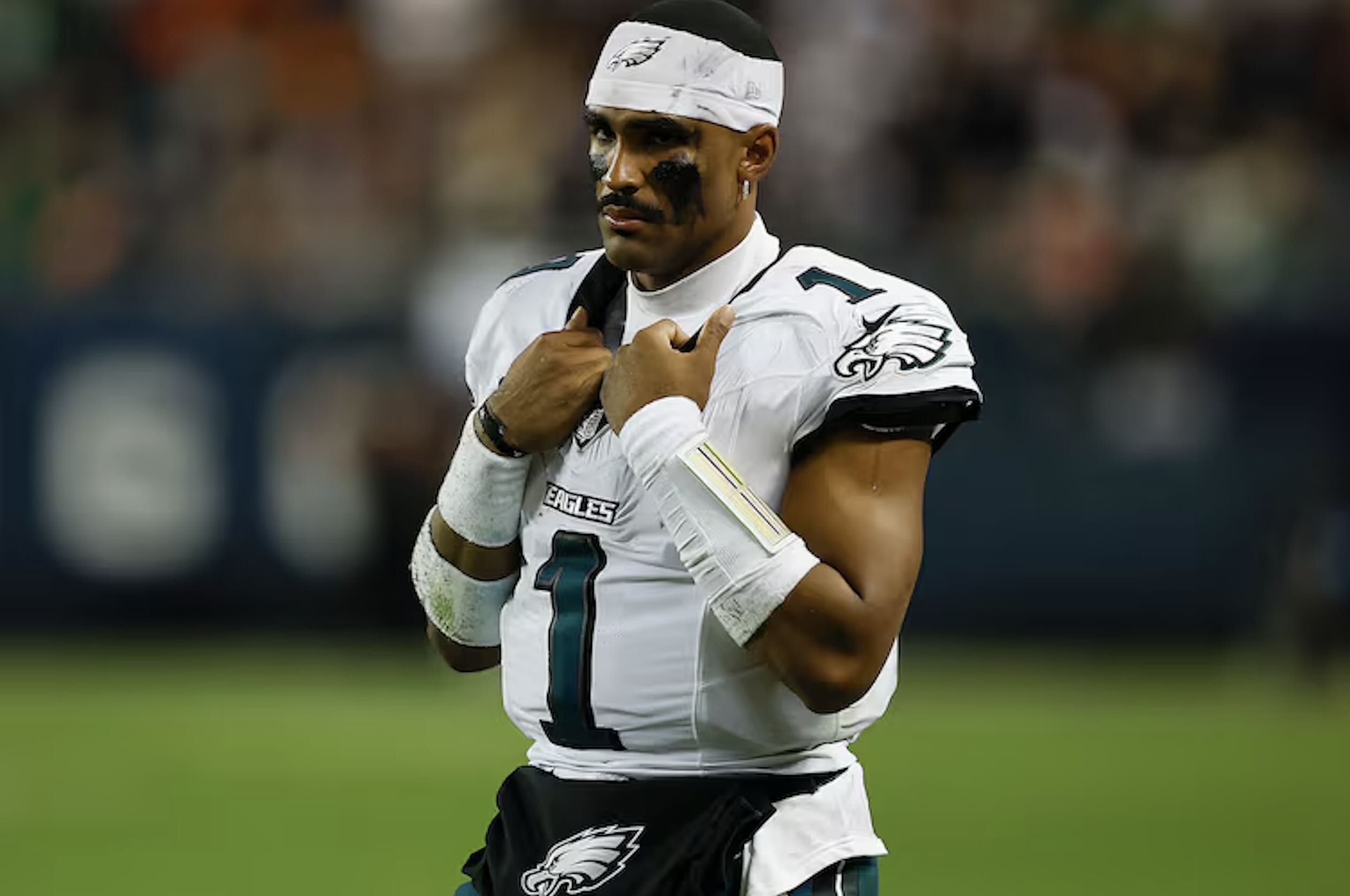
Photo: The Philadelphia Inquirer
On October 11, 2026, Philadelphia Eagles quarterback Jalen Hurts—the Super Bowl LIX MVP, the face of a franchise valued in the billions—walked onto a field in London with a blood clot in his left calf. He threw for 220 yards and a touchdown in a 19-17 loss to the Jacksonville Jaguars. Less than a week later, after an eight-hour flight home, doctors discovered that clot had traveled to both lungs. His season was over. It could have been his life.
The NFL Players Association is demanding a full independent investigation into how this happened—how a player was cleared to absorb sixty minutes of high-impact trauma and then sit immobilized on a transatlantic flight with a known vascular condition. The league, meanwhile, insists its medical care was "very conservative" and that the Eagles will face no punishment. NFL Chief Medical Officer Dr. Allen Sills called the handling "incredibly conservative and incredibly vigilant."
But the real question isn't whether the protocol was followed. It's who the protocol is designed to protect. And the answer, when you follow the money, is as predictable as it is damning.
The Production Line of Pain
The average NFL career lasts 3.3 years. The league is structurally designed to extract maximum value from young, cheap labor and discard it as soon as the financial or physical cost becomes too high. Rookie contracts control elite talent for four to five years at below-market rates. Contracts are notoriously not fully guaranteed, meaning a superstar who suffers a catastrophic injury can be cut with minimal financial penalty to the owner.
The player body, roughly 56 percent Black, is the fuel. The team brand, the stadium, and the surrounding real estate are the engine—assets that appreciate forever while the bodies that power them depreciate in real time. When a superstar retires, tears an ACL, or gets priced out of a contract, the stadium district doesn't lose a dime of value. The system simply inserts the next 22-year-old phenom into the same jersey and continues running the machine.
The NFL has masterfully branded this brutal turnover as a cultural virtue called "Next Man Up." In reality, it is a marketing strategy that trains fans to root for the laundry—the jersey, the logo, the city—rather than the individual human being. It also sends an unmistakable signal to injured players: the machine will keep rolling with or without you. Sit out to heal, and your backup might permanently take your job.
The phrase "healthy NFL player" is effectively a myth. An estimated 100 percent of players play through some form of pain or injury over the course of a season. To keep this labor force functioning week after week, the league relies on aggressive medical management—most notably Toradol, a powerful prescription anti-inflammatory that is a standard part of the Sunday pre-game ritual for dozens of players in every locker room.
Players describe lining up before games to receive injections that numb severe joint, bone, and muscle pain just enough to get through sixty minutes of collisions. These treatments allow players to perform, but they also mask the body's natural warning signs. Numbing an existing injury drastically increases the risk of turning a minor sprain into a catastrophic, career-ending structural failure.
NFL medical staffs are highly optimized to handle acute injuries—taping an ankle, bracing a knee, padding a bruised rib. But when it comes to systemic or chronic risks—a vascular blood clot, severe concussion buildup, internal organ stress—the standard protocol of "numb it and play" completely breaks down. The system is structurally incentivized to get the asset back on the field for the next seventeen-game window, frequently leaving the player to deal with permanent physical damage long after their short career is over.
Black Bodies for Real Estate Wealth
The true growth premium in an NFL team's valuation comes from controlling the stadium and the surrounding real estate. While the "floor" of a team's value is protected by billions in guaranteed television revenue, the teams with skyrocketing multi-billion-dollar valuations are explicitly valued for their property empires.
- Dallas Cowboys ($15.5B): Jerry Jones owns The Star, a 91-acre entertainment, retail, and medical campus in Frisco that operates entirely outside football revenue.
- Los Angeles Rams ($12.7B): Stan Kroenke's valuation is anchored by Hollywood Park, a 300-acre master-planned development surrounding SoFi Stadium.
- Cincinnati Bengals ($7.4B): The Bengals lease Paycor Stadium from Hamilton County. They own no venue and no surrounding land, so they miss the real estate boom entirely—their valuation rests almost solely on being a member of the league's cartel.
Real estate is vastly superior to a football team for corporate reasons. A stadium fills eight to ten times a year; a mixed-use district of offices, condos, concert venues, and hotels generates high-margin rental yield 365 days a year. And crucially, NFL rules dictate that national TV money, merchandise, and a portion of ticket sales must be pooled and split evenly among all 32 teams—but revenue from mixed-use developments outside the stadium walls is 100 percent exempt from league sharing. Owners keep every dollar of that property appreciation and rent. The salary cap applies only to football revenues; players do not get a single cent of the rent collected from the luxury apartments built next to the stadium.
This is why private equity firms are now buying minority stakes in NFL teams. They aren't buying in because ticket prices might rise ten percent; they are treating franchises as anchor tenants for massive urban real estate development funds. When a billionaire buys a sports team today, they aren't buying a football business that plays seventeen games a year. They are buying a commercial real estate empire wrapped in a sports brand helmet.
And the football team? It serves as a massive, free marketing engine. The game creates the culture, the hype, and the foot traffic. The real estate captures the permanent, unshared wealth.
Black Bodies for Content
The NFL's product is not football in the abstract—it is the spectacle of predominantly Black men colliding at extraordinary speed, week after week, for a global audience. That spectacle is the content networks pay over $12 billion a year to broadcast, the content that fills stadiums and gives the surrounding real estate its cultural gravity.
The demographics are stark: roughly 56 percent of players are Black; none of the 32 majority owners are. The people who generate the content absorb the physical cost; the people who own the stadiums, the land, and the broadcast rights do not. The average career lasts long enough for a highlight reel, not generational wealth. The owners hold assets that appreciate across decades.
This is by design. "Next Man Up" ensures that when one body breaks, another takes its place and the show goes on. The rookie wage scale keeps the freshest bodies the cheapest. Non-guaranteed contracts let owners discard the broken at minimal cost. Toradol numbs what should be resting and sends it back out for more.
Jalen Hurts is not an anomaly. He is the system working as intended: the clot in his calf was content, the London game was content, the eight-hour flight was the cost of doing business, and the clots in his lungs were the bill coming due—paid by the player, never the owner.
The real estate will outlast him. The apartments will still collect rent, the offices will still host tenants, and the next batch of young Black men will line up to become fuel. That is the trade: Black bodies for content, content for revenue, revenue for land. The players are temporary. The land is forever. The league has made clear which one it will sacrifice.
Until the NFLPA's investigation forces mandatory vascular and flight-risk protocols—until the league is forced to treat Black bodies as more than consumable fuel for the real estate engine—the calculus will not change.
No Ads. By Us. For Us.
This article was made possible by readers like you. We hope it inspired you to support Emerald Book, so we can continue producing content like this.
We will never show you ads, sell your data, or require a subscription to consume our content. Your gift helps us keep the truth accessible.
Click the Support button to give a gift of any amount today.
Thank you for making this work possible.