

Emerald Pages
◆
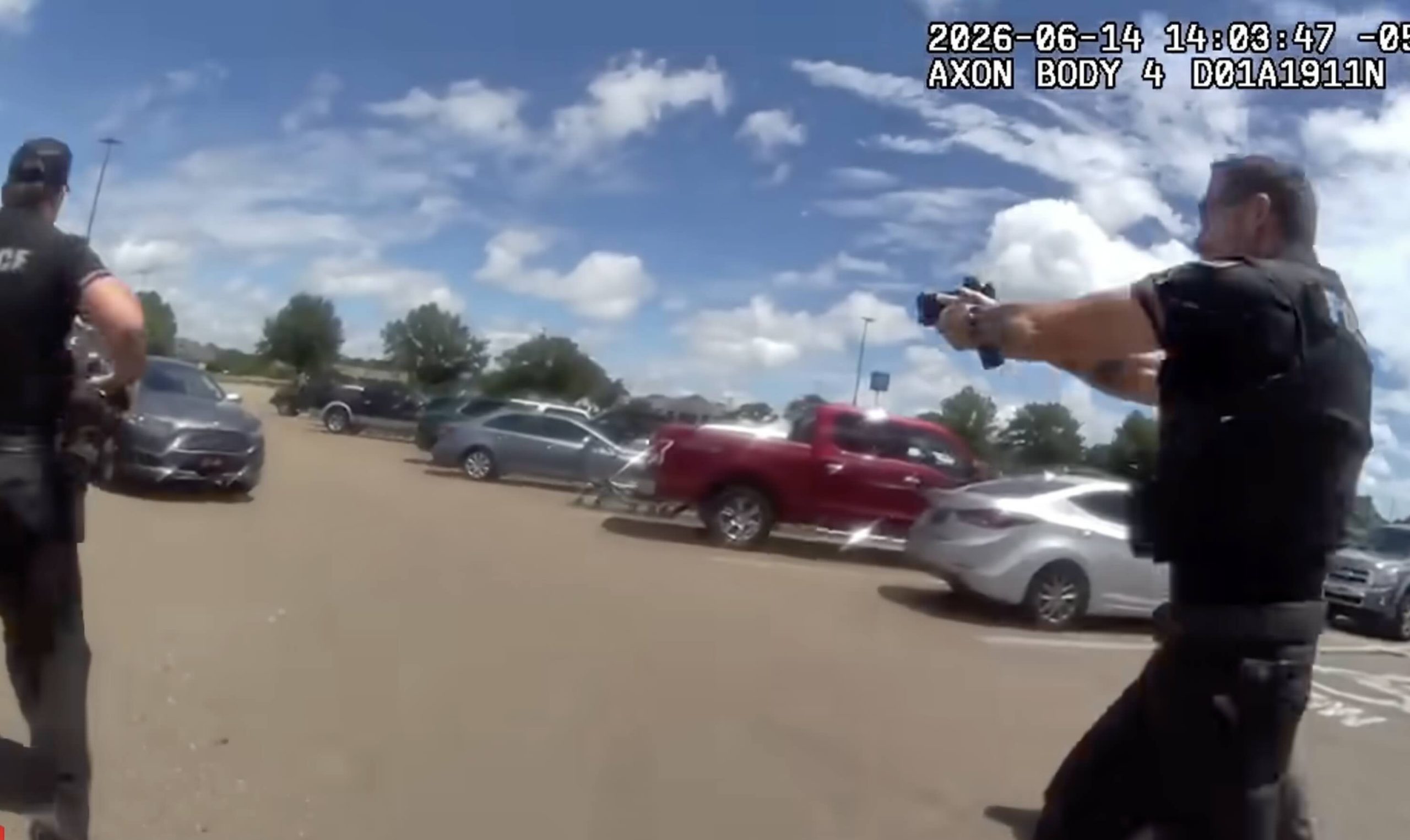
Officer Hunter Foster pointing his gun at shoplifting suspects. | Photo: Darkhorse Press
The leaked videos arrive in fragments, each angle more damning than the last. There is the Walmart security camera showing a loss-prevention guard stopping a young Black mother over a call involving diapers and baby clothes. There is the parking-lot footage of that mother—Vellesiya Wiley—sprinting toward a silver sedan with her one-year-old son, Kohen, clutched to her chest. And there is the bodycam of the responding officers, guns already drawn, swarming the vehicle like it contains an armed fugitive rather than a woman who, they believed, had stolen a pack of diapers.
What the footage does not show is the bodycam of Officer Hunter Foster, the man identified in incident logs as the one who fired the fatal shots. That omission is not incidental. It is the keystone of a story the state of Mississippi would prefer the public never assemble: that a routine shoplifting allegation became a death sentence because five officers with lethal weapons decided a misdemeanor was worth a tactical siege.
But a frame-by-frame review of the external angles, played in slow motion, reveals something the state's "justified" ruling cannot survive. Before Foster reaches the scene—before any officer even tries to open the car door—he comes into frame with his weapon already drawn and pointed directly at the driver. The mother responds by lifting Kohen up, holding her child toward the officers in a desperate, unmistakable signal that a baby is inside the vehicle. Foster keeps his gun trained on her. Then, as the car tries to steer away from the officers, he plants his right foot in front of it, lunges his entire body into its path with his hands outstretched—actually making contact with the moving car as if to physically stop it—then moves clear of the vehicle. Only after he has stepped out of the car's way does he fire into the passenger window, where Kohen sat on his mother's lap.
Watch the slow-motion footage: Darkhorse Press on YouTube — use the playback speed control to see the gun already drawn on arrival, the foot plant and hands-on contact with the moving car, and then the officer stepping clear before he fires.
Mississippi Attorney General Lynn Fitch announced just days before the leak that Foster's use of deadly force was legally "justified." The state's reasoning rests on the claim that the driver, Latoya Ferrell, accelerated the vehicle toward an officer, transforming the car into a deadly weapon. But the leaked angles tell a different story. The car was turning away. The officer stepped into its path anyway. The threat he says he feared was a threat he physically inserted himself into—twice, first with his foot and then with his entire body—after arriving on scene with his weapon already aimed at the driver and after being shown, in the plainest way a mother can show it, that a child was in that car.
The Gun Was Already Out
Standard tactical manuals instruct officers to stay clear of a vehicle's path of travel. By crowding directly against the panels and bumpers of the sedan—and by actively stepping into the car's path as it swerved away—the Senatobia officers placed themselves in what experts call "tactical jeopardy": a situation where an officer's own poor positioning creates the very lethal threat they later use to justify shooting. The car became a weapon because the officers stood in front of it. Foster feared for his life because he had stepped into the conditions for fear.
- Proportionality was abandoned: Diapers and baby clothes constitute a low-level, non-violent property misdemeanor. Drawing lethal weapons immediately escalated the situation to its highest possible stakes.
- The child was shown, and the gun stayed up: The mother raised Kohen toward the officers before the door was even opened. The weapon remained pointed at her.
- Shooting into a vehicle is heavily restricted: Federal guidelines discourage firing at moving cars because bullets rarely disable an engine, incapacitating a driver creates an unguided multi-ton weapon, and the risk of striking passengers is astronomically high.
- Bullets don't stop cars either: If the goal was truly to stop the vehicle rather than to punish its occupants, shooting at the tires would have been the only even marginally rational option. Firing into the passenger cabin accomplished nothing except killing a baby.
- Simpler alternatives were ignored: Officers could have recorded the license plate, followed from a safe distance, or processed a warrant later. Instead, they chose a parking-lot bottleneck.
The Superman Delusion
There is no tactical school, no training manual, and no rational police doctrine that instructs an officer to stop a multi-ton vehicle with his bare hands. Yet that is precisely what the slow-motion footage shows Foster attempting: he does not merely reach toward the car—his hands make contact with it as it moves past him, a reflexive, impossible gesture, as though the laws of physics might bend to the authority of a badge. A car weighs thousands of pounds. A human body weighs a fraction of that. The idea that a man can halt a moving sedan by touching it and planting his feet is not bravery. It is fantasy. And when the fantasy failed—when the car kept moving, exactly as physics required—he stepped clear and shot into the cabin anyway.
The family's legal team, led by civil rights attorney Ben Crump, has argued from the beginning that Kohen's mother was trying to signal to the approaching officers that her baby was in the car. The footage now confirms that the officers did not care. Because Officer Foster was standing directly next to the passenger-side window when he fired, the family contends he either saw the child and fired anyway, or fired blindly into an enclosed space without checking his target. Both, they argue, constitute reckless disregard for human life.
The legal system's response has been to look only at the final micro-second. Under Supreme Court precedent, courts evaluate use of force from the officer's perspective in a split-second, high-stress moment. If the state investigation concluded that the car's tire or panel was moving toward Foster at that exact instant, the law allows him to focus entirely on stopping the vehicle. But that framing skips the crucial facts the footage now makes visible: Foster arrived with his gun already pointed at the driver, kept it pointed after the child was held up, and then his own foot and body created the instant he claims to have feared. The reckless decisions—the drawn guns, the crowded bodies, the lunge into the car's path—are legally wiped away.
What the Leak Reveals About the State's Case
The leaked cache was provided to the independent outlet Darkhorse Press. It contains three body-camera recordings and two Walmart surveillance angles—but not Foster's bodycam. The omission is telling. The state has confirmed that Foster's footage exists and was a primary piece of the investigation. The Mississippi Department of Public Safety now says it will release all recordings in full "within the coming days."
The family's legal team has disavowed responsibility for the leak. The state had scheduled a private meeting to let the family view the video before any public records requests were fulfilled. Whoever leaked the footage chose the moment immediately after the Attorney General cleared the officer—and chose to leave out the one angle that would show exactly what Foster saw as he entered frame with his weapon drawn and then stepped into the car's path.
No shoplifting charges were ever filed against Vellesiya Wiley or Latoya Ferrell. No evidence has been released verifying that any items were stolen. The entire criminal review concluded without establishing proof of a theft. What it did establish, according to the state, is that an officer who drew his weapon over diapers, pointed it at a mother who was holding up her baby, stepped in front of a swerving car, and tried to stop it with his bare hands was legally entitled to fire into a cabin with a child inside because the car kept moving.
The leaked footage does not show a chaotic, unavoidable tragedy. It shows a series of choices. The choice to treat a shoplifting call as a tactical emergency. The choice to enter the scene with a weapon already pointed at a mother. The choice to keep that weapon up after a baby was held toward the officers. The choice to surround a vehicle with bodies instead of maintaining distance. The choice to plant a foot in front of a car that was turning away, then lunge into its path with outstretched hands. And finally, the choice to pull the trigger into a passenger cabin where a one-year-old sat on his mother's lap.
Kohen Wiley was not killed by a split-second decision. He was killed by a chain of aggressive incompetence, each link forged by officers who never should have been in that parking lot with guns drawn in the first place—and who, when the moment came, had already been shown the child they were about to kill. The bodycam footage makes that abundantly clear.
No Ads. By Us. For Us.
This article was made possible by readers like you. We hope it inspired you to support Emerald Book, so we can continue producing content like this.
We will never show you ads, sell your data, or require a subscription to consume our content. Your gift helps us keep the truth accessible.
Click the Support button to give a gift of any amount today.
Thank you for making this work possible.