

Emerald Pages
◆
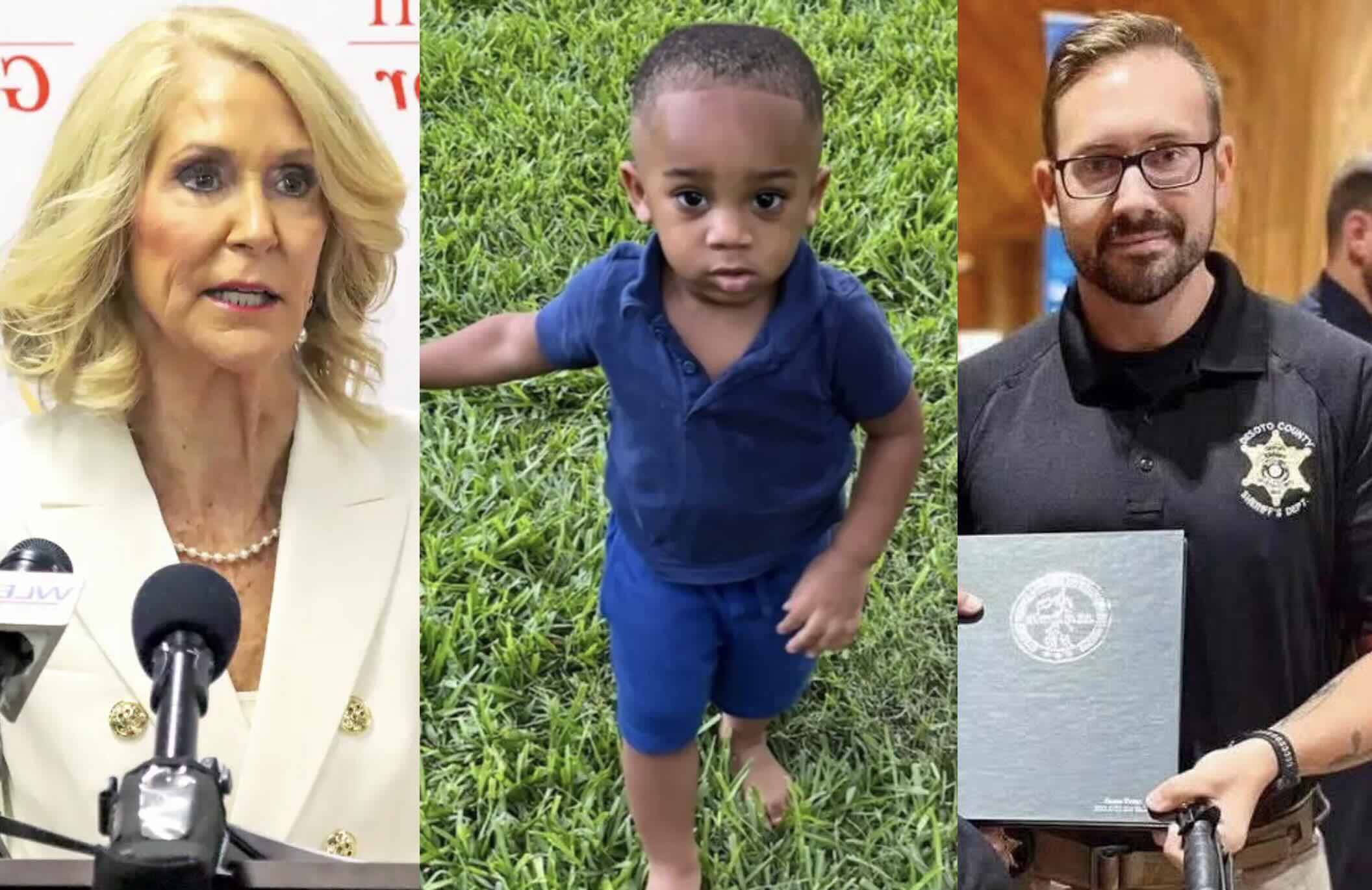
Mississippi AG Lynn Fitch (left), 1-year old Baby Kohen (center), Senatobia Police Sergeant Hunter Foster (right) | Photo: Emerald Book Image
It is sickening. There is no other word for it. On June 14, 2026, in a Walmart parking lot in Senatobia, Mississippi, a police officer fired his weapon into a car containing a one-year-old Black baby named Kohen Wiley. The alleged offense that brought armed police to that parking lot was the theft of a pack of diapers. Kohen was struck and killed. The bullet entered through the side window, according to the family's independent autopsy—meaning the officer was not standing in the vehicle's path when he pulled the trigger. A baby died over diapers.
Then came the second sickening thing. On October 19, 2026, Mississippi Attorney General Lynn Fitch's office announced the completion of its review. The finding: the officer's use of force was "justified." No criminal charges. No grand jury. No public release of the body-camera footage, the dash-camera footage, or the Walmart surveillance video. The state closed the case behind closed doors, accepted the officer's word as fact, and told a grieving family—and the nation—that the killing of an infant over diapers was lawful.
This is not a close call. This is not a complex legal gray area. This is a moral obscenity dressed in the language of jurisprudence, and every institution that participated in it should be ashamed. The Attorney General's office did not simply decline to prosecute. It affirmatively declared that a police officer with a documented history of racially offensive language toward Black coworkers—operating under a police chief who was later fired for routinely using racist slurs in private text messages—was legally correct to fire a deadly weapon into a car containing a baby because someone allegedly drove away from him.
The legal architecture does not require the state to argue that killing Kohen Wiley was acceptable. It only requires the state to argue that shooting at the driver was acceptable—and then the child's death becomes legally invisible. The baby is not a victim in this framework. He is collateral damage, a rounding error, an inconvenience to be absorbed by the doctrine. This is how the law works when it is designed to protect power. It does not say the child's life was worthless. It simply builds a structure in which his death requires no accountability, no trial, no jury, no explanation to the public.
The Footage Exists. They Will Not Show It.
Here is the fact that should make every American's blood run cold: the video exists. Body cameras. Dash cameras. Walmart parking lot surveillance. The state has it. The state has reviewed it. The state used it to reach its conclusion. And the state will not release it to the family or to the public.
Ben Crump, the civil rights attorney representing the Wiley family, put the challenge plainly: "If the footage supports the state's decision, release it. We will not stop fighting until this family gets the truth." The state's refusal to answer that challenge is an admission. If the video showed a car bearing down on Sgt. Foster, if it showed him with no choice but to fire, the state would release it tomorrow. It would hold a press conference. It would let the footage vindicate the ruling. Instead, the Attorney General's office declared the shooting justified and then sealed the evidence. That is not transparency. That is concealment with a legal stamp on it.
The family's independent autopsy found that the bullets entered through the passenger-side window—not the front windshield. That physical evidence directly contradicts the narrative that the vehicle was charging directly at the officer. A bystander reported seeing officers chasing the car on foot as it drove away. If the officers were behind or beside the vehicle, they were not in its path. The state had this information. The state had the video. The state chose the officer's story anyway.
- No charges for anyone. Neither woman in the vehicle has been charged with a crime. The state has not released public evidence confirming the shoplifting allegation that started it all.
- No grand jury. The Attorney General declined to present the case, so no ordinary citizens ever weighed the evidence or heard the family's account.
- No video. Body-camera, dash-camera, and Walmart surveillance footage remain hidden from the family and the public months after the killing.
- No accountability for the department. Sgt. Foster had been twice accused of directing racially offensive language at Black coworkers. The former police chief, Harold "Hal" Vanderford, took no disciplinary action—and was later fired after journalists exposed his own routine use of racist slurs in private texts.
This is the context the Attorney General's office asks the public to ignore. A sergeant with a history of racial hostility. A department led by a chief who used white supremacist language in private. A misdemeanor allegation over diapers. A baby in the back seat. A bullet through the side window. A ruling of "justified." A video nobody can see. If you assembled these facts as a hypothetical for a law school exam on systemic bias, students would call it too heavy-handed. This is not a hypothetical. This is Mississippi, October 2026.
This Is What America Does to Black Children
We must resist the temptation to treat this as an aberration, a bad apple, a tragic mistake. It is none of those things.
Qualified immunity shields officers from civil liability unless they violate "clearly established" law—a standard so narrow that courts routinely dismiss cases even when officers behave recklessly. The "objective reasonableness" standard, invented by the Supreme Court in Graham v. Connor, instructs judges to evaluate police conduct from the perspective of a reasonable officer on the scene, not from the perspective of the person whose child was killed. Transferred intent absolves officers for harm to bystanders when the initial target was lawful. These doctrines did not emerge from nowhere. They were constructed, case by case, statute by statute, to ensure that the state's monopoly on violence remains effectively unreviewable when it is exercised against the people the state has always been permitted to fear.
And who does the state fear? The pattern is not subtle. Black children are killed by police at wildly disproportionate rates. Black people are more likely to be stopped, searched, arrested, and subjected to force. The legal system then supplies the vocabulary—"justified," "reasonable," "lawful"—to make the violence legible as order. Kohen Wiley was one year old. He could not have posed a threat to anyone. He could not have committed a crime. He could not have driven a car. He was a baby in a car seat. And the Attorney General of Mississippi has ruled that his death requires no criminal consequence, no public explanation, no jury, no trial, no release of the evidence.
The state did not say Kohen's life did not matter. It did not have to. It simply built a ruling in which his life did not require accountability. That is worse. That is the quiet, bureaucratic erasure of a child—the reduction of a human being to a legal footnote in a self-defense analysis. And it happened in public, with the full weight of the state's authority, and the state expects the public to accept it.
The Fight Is Not Over
The family's attorneys are pursuing a federal civil rights lawsuit under Section 1983. In federal court, the rules change: subpoena power can force the release of the footage; a judge can strip qualified immunity if the family proves a constitutional violation; the U.S. Department of Justice can open an independent investigation into whether Sgt. Foster violated federal civil rights law and whether the Senatobia Police Department has a pattern of racist policing. The Mississippi Legislative Black Caucus is pushing for mandatory public release of body-camera footage within a fixed timeframe after any officer-involved shooting. Activists are organizing, protesting, and refusing to let Kohen's name be forgotten.
All of that matters. All of it is necessary. But none of it should be necessary, and the fact that it is necessary is the indictment. A family should not have to file a federal lawsuit to see the video of their child's killing. A community should not have to organize protests to persuade the state to hold a grand jury. A nation should not have to rely on private civil litigation to force the truth out of a government that claims to be transparent. The fact that the Wiley family must fight this hard is proof that the system is not merely failing them—it is actively working against them.
Mississippi has spoken. It has said that an officer who fires into a car over a pack of diapers, killing a baby, has committed no crime. It has said that the video of that killing is not the public's business. It has said that a sergeant with a history of racist language, in a department led by a chief with a history of racist texts, deserves the benefit of the doubt and the full protection of the law. It has said all of this without a trial, without a grand jury, without releasing the evidence, and without shame.
We should believe the state when it tells us who it is. The ruling is not a failure of the system. It is the system, speaking clearly. And the only appropriate response is not to ask politely for reform, not to trust the process, not to wait for the next election. The appropriate response is moral clarity: this is wrong, it is indefensible, and it is a continuation of a long American tradition in which the law protects the powerful and the armed, while Black children are left to be explained away as collateral damage.
Kohen Wiley deserved to grow up. He deserved a justice system that would at least look at the evidence before declaring his death acceptable. He deserved a state that would not hide the video of his killing. He deserved a country that would not respond to his death with a legal doctrine and a press release. He deserved so much more than "justified."
No Ads. By Us. For Us.
This article was made possible by readers like you. We hope it inspired you to support Emerald Book, so we can continue producing content like this.
We will never show you ads, sell your data, or require a subscription to consume our content. Your gift helps us keep the truth accessible.
Click the Support button to give a gift of any amount today.
Thank you for making this work possible.