

Emerald Pages
◆
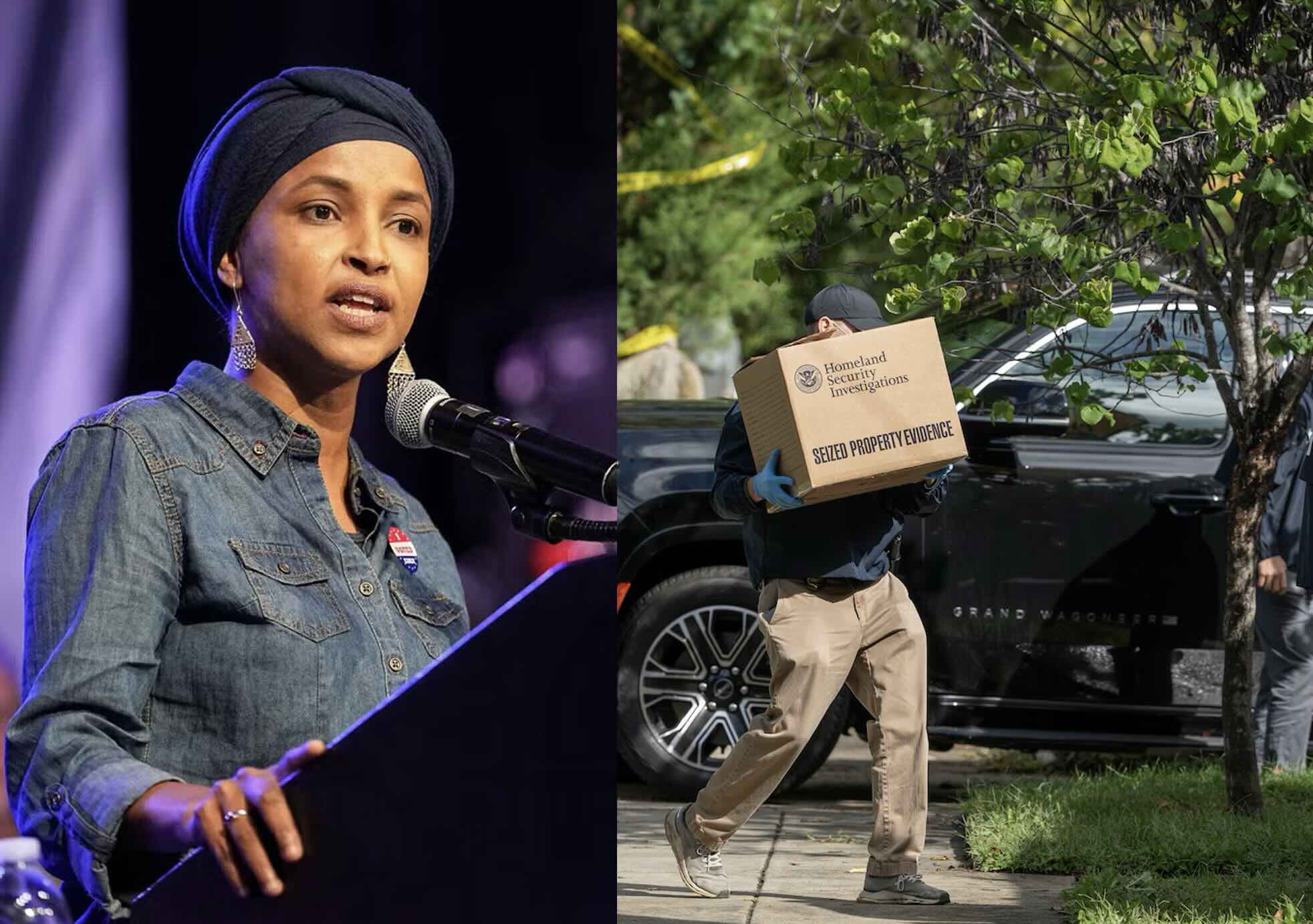
Photo: Emerald Book Image
The pre-dawn raid on Congresswoman Ilhan Omar's Washington, D.C.-area home on October 12, 2026, was designed to look like the culmination of a serious federal investigation. Agents from Homeland Security Investigations seized her phone, computers, notebooks, and passport. More than a dozen grand jury subpoenas went out to her relatives. Yet beneath the spectacle, the actual case is remarkably thin—and the government's path to any conviction is riddled with obstacles that may prove insurmountable.
To understand why, it helps to separate what the government needed to get a search warrant from what it would need to win in court. Securing a warrant required only "probable cause"—a reasonable belief that evidence of a crime might exist. Convincing a jury to convict, or a judge to strip citizenship, is a far higher bar. And on that bar, the government's evidence appears to collapse under scrutiny.
The Core Allegation: A 30-Year-Old Form
The criminal investigation centers on immigration paperwork filled out by Omar's late father when the family immigrated from Somalia in 1995, when Omar was a child. Investigators are examining whether her age was altered to obtain citizenship. But the father who actually completed and signed that paperwork, Nur Omar Mohamed, died in 2020—and with him died the government's ability to prove intent.
To prove criminal fraud, prosecutors must show a defendant intentionally deceived the government. Because the person who made the statements is dead, prosecutors cannot cross-examine him to establish what he knew, what he intended, or whether an error on a form was simply a misunderstanding or translation mistake during a refugee crisis. Under the Sixth Amendment's Confrontation Clause, relying on hearsay attributed to a deceased person is highly restricted in criminal trials.
The Statute of Limitations Problem
Federal immigration fraud generally carries a five-to-ten-year statute of limitations. The paperwork in question was filed in the mid-1990s—over 30 years ago. To bring charges now, prosecutors must prove a continuous, active conspiracy or ongoing fraud that extends into recent years. Legal experts view that as an exceptionally high bar for decades-old paperwork.
Simply living in the U.S. or holding office as a citizen does not legally constitute an ongoing criminal act. Prosecutors would need proof that Omar actively took recent steps to conceal or perpetuate a fraud—something no public evidence has established.
The Minor Child Defense
Omar arrived in the U.S. as a child refugee and gained citizenship automatically through her father as a minor. Under U.S. law, a minor cannot generally be held criminally liable for alleged false statements, omissions, or misrepresentations made by a parent or guardian on immigration paperwork. It is incredibly difficult to prosecute an individual for statements made on forms filled out by a parent when the individual was a child and lacked legal culpability.
The "Evidence": A Library Date Change
The primary piece of modern evidence the government is pointing to is a 2018 request by Omar's congressional staff asking a public library to update her birth year from 1981 to 1982. The prosecution theory is that she aged herself down to remain a minor—if born in 1982, she would have been 17 when her father naturalized in 2000, automatically becoming a citizen; if born in 1981, she would have been 18 and would have had to apply independently.
- It's not a federal filing: Requesting a correction at a public library or on a biographical website does not alter official government immigration records.
- It's easily framed as clerical: The defense can argue this was a routine correction of a public relations typo, which carries zero criminal liability.
- Career officials already dismissed it: The Washington Post reported that career immigration officials reviewed these exact discrepancies in 2019 and concluded there was insufficient evidence of wrongdoing to warrant a full investigation.
The Denaturalization Track Is Also Extremely Difficult
Some analysts believe the government's true strategy is civil denaturalization, which has no statute of limitations and a lower burden of proof than a criminal trial. But the Supreme Court has spent nearly a century building massive legal shields to protect naturalized Americans.
In Schneiderman v. United States, the Court ruled the government must prove its case by "clear, unequivocal, and convincing" evidence—so strong it does not leave "the issue in doubt." In the 2017 unanimous ruling Maslenjak v. United States, the Court held the government cannot strip citizenship over an irrelevant lie; prosecutors must prove a direct, causal chain showing the false statement actively caused the government to grant citizenship that would otherwise have been denied. If Omar's family qualified for refugee status regardless of a minor clerical error, the misrepresentation is legally immaterial.
The Court has also noted the government's burden becomes "especially heavy" when attacking citizenship long after it was granted, provided the citizen has since met their obligations. For a sitting, three-term member of Congress who has lived openly as a citizen for decades, judges are historically hostile to digging up 30-year-old childhood paperwork.
The Timing: A Violation of the DOJ's 60-Day Rule
Perhaps the most glaring problem is the timing. The raid occurred just three weeks before the November midterm elections, bypassing the Justice Department's long-standing "60-day rule"—an unwritten policy, reaffirmed by multiple Attorneys General, that prohibits prosecutors from taking overt, highly public investigative steps against a candidate within 60 days of an election.
Because the core allegations date back to 1995, there was no urgent law enforcement emergency requiring a raid in October 2026. Bypassing a cornerstone DOJ policy to execute a public raid right before voters cast their ballots strongly suggests the primary goal was political damage rather than routine justice. Democrats and legal critics have pointed out that the move speaks more to political theater than the strength of the legal evidence.
The Tactics: DNA From Trash
In a highly unusual pre-raid move, federal agents collected garbage outside Omar's residence to secretly secure DNA samples. While legally permissible under trash-collection precedent, using forensic DNA tracking—tactics typically reserved for identifying serial killers or high-level international terrorists—to investigate 30-year-old childhood immigration forms is practically unheard of in standard federal practice. Even if DNA proves a family tree looks different than stated on 1995 refugee forms, it cannot prove intent: it cannot show that a young child in a refugee camp knew her father was filling out a form incorrectly.
The One Wild Card: The Financial Audit
The only element of the investigation carrying a realistic threat of legal exposure is a secondary probe into a reported jump in the value of business interests tied to her husband, Timothy Mynett—from $51,000 in 2023 to $30 million in 2024. Unlike 30-year-old immigration forms, financial disclosure rules from 2024 are bound by strict, modern compliance laws. But a massive jump in a spouse's business valuation is not automatic proof of illegal activity; prosecutors would need to trace the money to an explicit illegal source. If the money came from legitimate investments or legal business restructuring, this track evaporates completely.
The Most Likely Outcome
Barring an unprecedented digital "smoking gun" discovered on her laptop, legal consensus suggests Congresswoman Omar is highly likely to retain both her U.S. citizenship and her seat in Congress. The extraordinary difficulty of proving intent for actions taken as a minor, combined with the heavily criticized timing of the raid, means the government's case is widely expected to collapse under judicial scrutiny long before reaching a trial.
In the short term, a drawn-out legal battle over seized property is expected, with a judge already restricting the DOJ's access to her devices through a filter team to protect Speech and Debate Clause protections. In the medium term, analysts expect the DOJ will quietly decline to bring formal immigration charges or file a denaturalization lawsuit once the political spotlight fades—mirroring how career officials previously dismissed the exact same allegations in 2019.
The raid may have been designed to look like the opening act of a major prosecution. But stripped of its spectacle, the case rests on a form filled out by a man who is dead, about events three decades past, involving a defendant who was a child—and a date change at a public library. That is not a foundation on which convictions are built.
No Ads. By Us. For Us.
This article was made possible by readers like you. We hope it inspired you to support Emerald Book, so we can continue producing content like this.
We will never show you ads, sell your data, or require a subscription to consume our content. Your gift helps us keep the truth accessible.
Click the Support button to give a gift of any amount today.
Thank you for making this work possible.