

Emerald Pages
◆
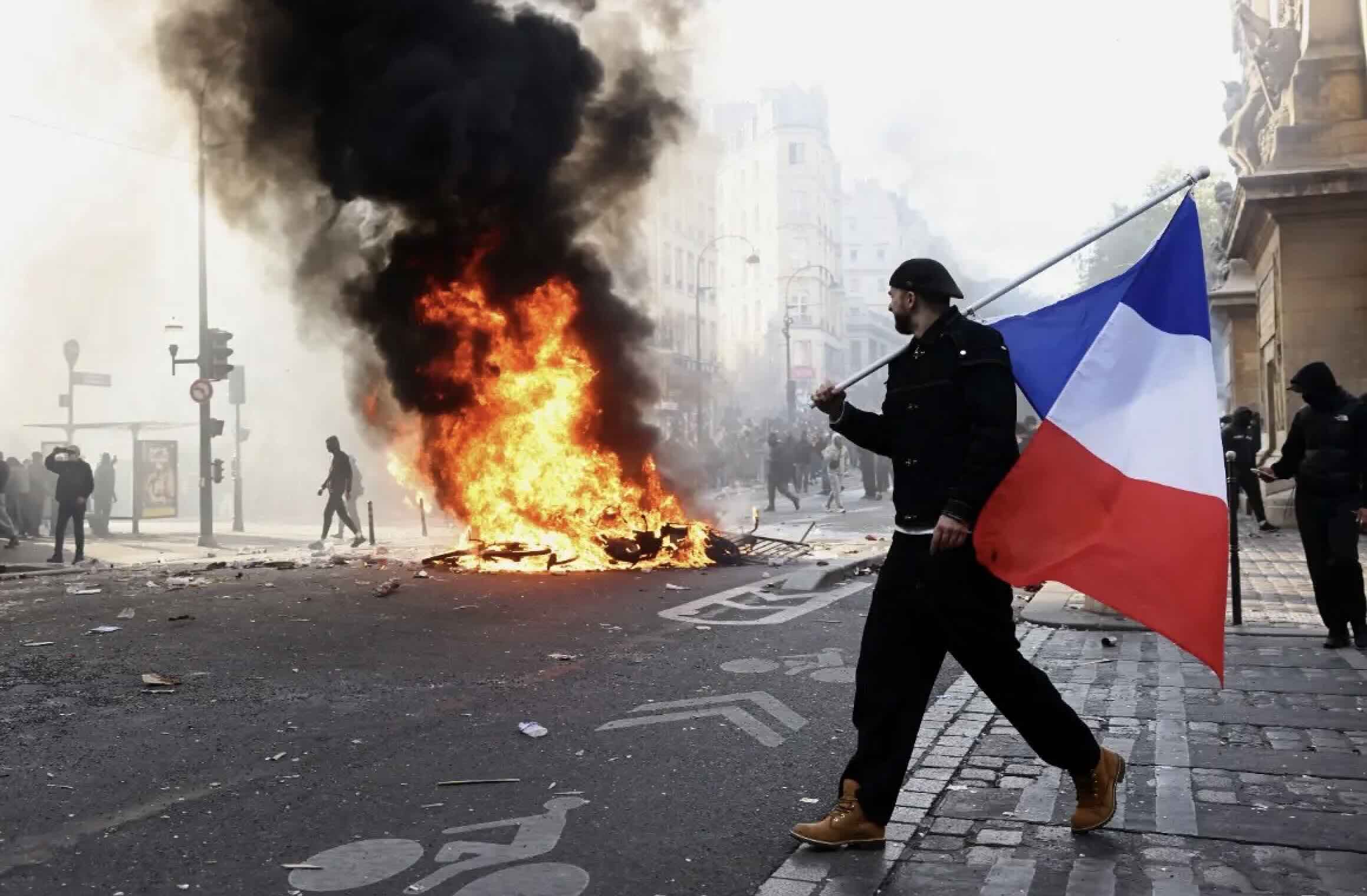
Photo: Reuters
France is burning. More than 1,800 arrests, a city hall roof collapsing in Limoges, a tourism office reduced to ash in Lyon, 150 police officers injured, and between 550,000 and 800,000 people marching from Paris to Saint-Étienne. The immediate trigger is a crisis in underfunded schools that began in September, when high school students walked out over overcrowded classrooms and missing teachers. But the deeper engine is something older: a citizenry that treats protest as a constitutional check on power, exercised routinely, without apology, and with the expectation that it will work.
Watching from across the Atlantic, many Americans ask the obvious question. The United States shares the same structural pressures—crushing housing costs, strained public schools, deteriorating infrastructure, a pervasive sense of economic exhaustion that has outlasted the official end of inflation. If the grievances are the same, why aren't the streets?
The answer is uncomfortable, and it is not about temperament. Americans are not less angry than the French. They are more controlled—and the architecture of American life makes a French-style uprising structurally improbable. Not impossible. Improbable. The difference matters, because it explains both why the country appears so calm and why that calm is more fragile than it looks.
The Survival Trap
In France, striking is a protected right. A worker who walks off the job does not lose their healthcare, because healthcare is not tied to employment. They do not risk bankruptcy to make a political point. The social contract is explicit: citizens pay some of the highest taxes in Europe, and in return the state guarantees a robust safety net. When the government moves to cut school funding or trim public services, French citizens experience it as a breach of contract—and they respond accordingly.
In the United States, health insurance is welded to the job. Most states practice at-will employment, meaning a worker who strikes outside narrow union protections can be fired instantly—and with that firing goes medical coverage, retirement matching, and housing stability. The cost of dissent is not inconvenience. It is existential ruin, often for an entire family.
This is the first mechanism of control: compliance through vulnerability. The state does not need to physically suppress protest when the price of participation sits one medical emergency away from financial collapse. Economic precarity does the work that force once did, and it does it quietly, without batons or tear gas, without generating the images that might galvanize a movement. A population worried about next month's rent is a population that absorbs pressure rather than organizing against it.
No Single Address to March On
France is centralized by design. Power flows from Paris. A curriculum decision made in a ministry applies to every classroom from Marseille to Lille, and a protest in the capital can freeze the entire nation—shut down Paris transit and you have shut down the country. That centralization gives French citizens two things Americans lack: a single, visible target for their anger, and a single geographic choke point through which to apply pressure.
The United States is the opposite by construction. Power is scattered across fifty states, thousands of municipalities, school boards, county tax assessors, district attorneys, and a federal government that constitutionally lacks general police power over daily life. When an American is furious about underfunded schools or rising rents, the blame is diffused across a web of private corporations, state governors, city councils, and federal gridlock. There is no single address to march on, and no single lever to pull.
Even the federal government's authority is narrower than most citizens imagine. Washington cannot set local rent prices, rewrite state grocery taxes, or force a school board to hire teachers. It buys compliance instead—attaching conditions to highway and education grants because it lacks the direct constitutional power to command. This is the irony at the heart of American politics: the institution that dominates the national imagination has the least control over the problems that dominate daily life, while the officials who actually hold the levers—the zoning board, the prosecutor, the school board—operate in near-total obscurity.
The Cultural Buffer
France was born out of a literal revolution in 1789, and generations have been raised on the victories of the street. Paid vacation, the 35-hour week, subsidized school lunches—these were not granted by enlightened politicians. They were taken through mass strikes in 1936, 1968, and beyond. French students routinely strike and blockade their own schools; protesting is a rite of passage and a lesson in democracy, with tactical know-how passed down through generations.
America's founding myth runs the other way. The state is viewed with suspicion, as a potential threat to individual freedom rather than the embodiment of the collective will. Hardship is internalized as a personal challenge rather than a collective failure. When schools fail or wages stagnate, the dominant cultural script asks, "What can I do to work harder, start a side hustle, or move to a better district?"—not "How do my neighbors and I organize to stop this?" That individualist reflex is a psychological buffer for the status quo. It converts potential political rebellion into personal stress and a second job, and it does so with remarkable efficiency.
Weakened Labor, Vast Geography
A general strike requires centralized organizations capable of coordinating millions of workers at once. France has powerful national unions that can shut down trains, refineries, and energy grids with a phone call. American labor has been hollowed out by decades of Right-to-Work laws, legal bans on sympathy strikes, and the slow erosion of bargaining power. Union density hovers around ten percent of the workforce, and most of those unions are legally barred from striking in solidarity with other industries.
Geography compounds the problem. France is roughly the size of Texas; a protester can board a high-speed train and be at a national demonstration in Paris within hours. The United States spans three thousand miles across four time zones. A strike in Los Angeles has no physical impact on lawmakers in Washington, and a march in New York barely registers with executives in Silicon Valley. The sheer size of the country dilutes national anger into isolated regional events, each easy for the national press to cover as a local curiosity rather than a national crisis.
The Hidden Flashpoint
None of this means Americans never rebel. It means they rebel differently—not through predictable, union-driven strikes over policy, but through sudden, decentralized eruptions that bypass political and labor structures entirely. These are the hidden flashpoints: tensions that accumulate quietly until a single spark ignites them.
The most volatile is the justice flashpoint. Because the American legal system is punitive and unevenly experienced, communities that feel targeted by the state internalize pressure for years. When a highly visible act of police violence or a wrongful conviction occurs, it becomes a national lightning rod. The 2020 George Floyd protests became the largest mass movement in U.S. history—an estimated 15 to 26 million people—without a single union boss calling a strike. It was organic, explosive, and it forced immediate changes to police budgets, local laws, and public monuments.
A second flashpoint is the economic breaking point: the threshold where survival overrides the fear of losing a job. This produces wildcat strikes and localized labor rebellions that official unions sometimes cannot control—the 1934 West Coast waterfront strike, the 1921 Battle of Blair Mountain, the 2018 "Red for Ed" teacher walkouts that spread across states and forced legislatures to capitulate within weeks. A third is localized infrastructure collapse: a water crisis, an environmental disaster, a total school system failure. When local government stops providing basic necessities, community mobilization can upend state politics overnight.
The Electoral Trap
There is one more layer, and it is the most seductive. Americans are told, constantly, that their power lies at the ballot box—that the way to change the system is to vote, every few years, for the right candidate. That belief is not false, but it is incomplete, and it functions as a deferral mechanism. Anger that might become a movement becomes a campaign donation, a yard sign, a Tuesday in November.
The trouble is that the officials with the most direct power over daily life—district attorneys, school board members, county assessors, zoning commissioners—run in elections with abysmal turnout, often decided by a few thousand voters. National politics absorbs the emotional energy, while the offices that actually shape a family's rent, schooling, and safety go uncontested. The system does not need to suppress civic participation. It only needs to misdirect it.
The Dangerous Side Effect
The critical distinction between the two systems is predictability. In France, protest is a negotiating tactic with a known script. In America, because there is no central valve, discontent becomes a social eruption—unpredictable, highly emotional, and often chaotic, driven by people who feel they have nothing left to lose.
That is the trade-off embedded in American life. A population that is highly controllable day to day is also far more volatile in the long run, because the pressure has nowhere to go until it goes everywhere. The establishment that benefits from the calm is the same establishment that will be caught off guard when the calm breaks. Americans are easier to control—but only until they are not.
The French view democracy as an active, daily negotiation conducted on the pavement. Americans have been conditioned to conduct it at the ballot box every few years, or not at all. That is not a difference in national character. It is a difference in leverage, engineered into the structure of ordinary life—and it holds right up until the moment the structure fails.
No Ads. By Us. For Us.
This article was made possible by readers like you. We hope it inspired you to support Emerald Book, so we can continue producing content like this.
We will never show you ads, sell your data, or require a subscription to consume our content. Your gift helps us keep the truth accessible.
Click the Support button to give a gift of any amount today.
Thank you for making this work possible.