

Emerald Pages
◆
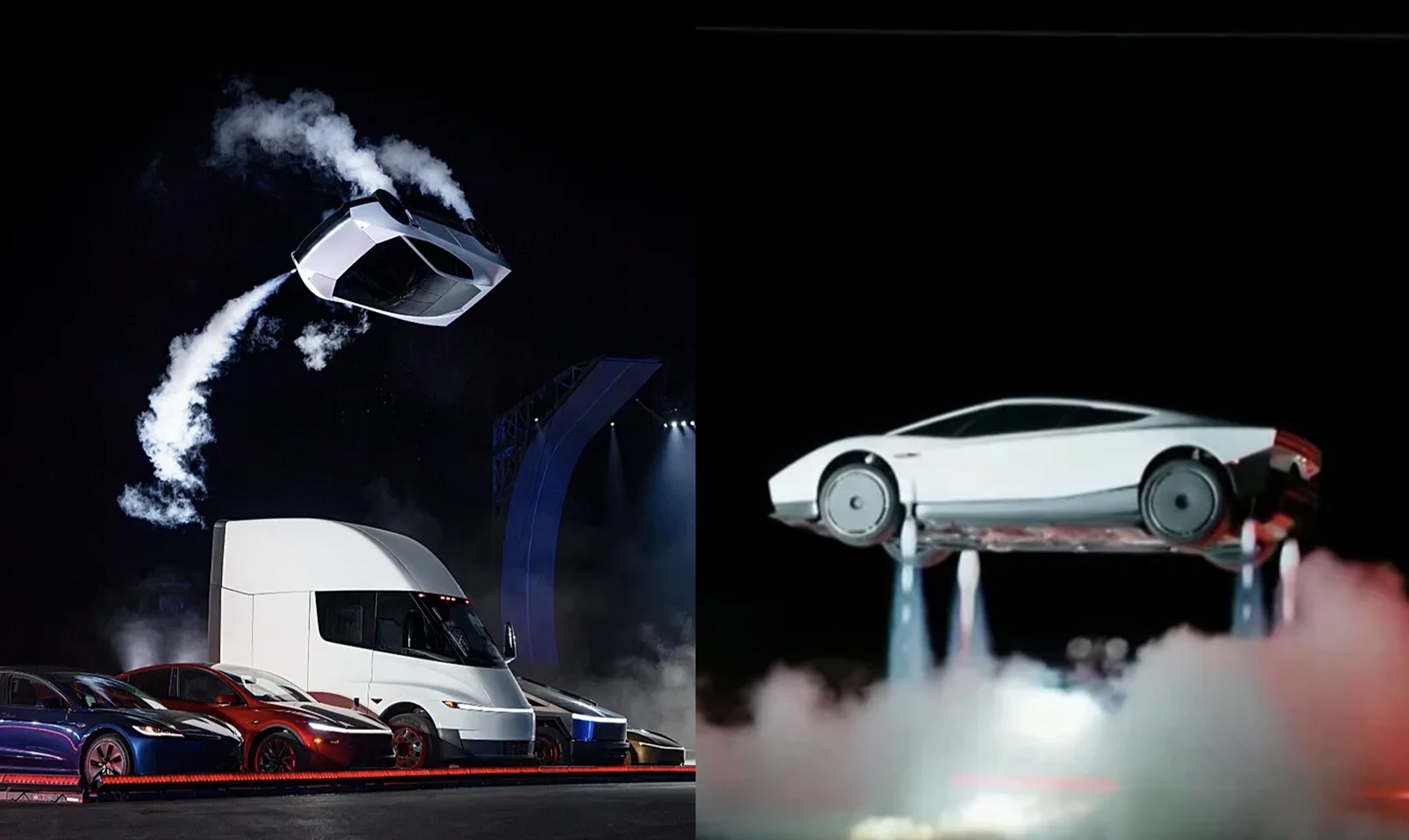
Photo: Tesla / SpaceX demonstration, October 2026 | Emerald Book Image
In November 2017, Elon Musk stood on a stage in Hawthorne, California, and unveiled a sleek silver sports car that he said would do 0–60 mph in 1.9 seconds, travel 620 miles on a single charge, and top out above 250 mph. Within days, thousands of people opened their wallets. They wired $50,000 deposits for the base model. They wired $250,000—the full purchase price—for the limited "Founders Series." Tesla collected tens of millions of dollars in what amounted to an interest-free loan from its most devoted fans. Nine years later, not a single production car has been delivered.
This week, Musk tried again. At a SpaceX rocket-testing facility in Texas, Tesla staged a driverless demonstration of a Roadster equipped with cold-gas air thrusters. The car drove up a ramp, hung upside down on a curved track using an underbody suction fan, launched into the air, flipped mid-flight, and used its air jets to land safely. The crowd cheered. The headlines followed. And then Tesla quietly reopened its reservation page, asking for another $50,000 deposit—or $250,000 for the "Thrust" tier—with fine print that explicitly states the company cannot guarantee if or when the car will ever be delivered.
It is, by almost any measure, an extraordinary arrangement. A company has held customer money for nearly a decade, missed every production deadline it has ever set, and is now asking for more money based on a stunt car that is explicitly not street legal. And yet, thousands of people are still lined up. The question practically asks itself: are Tesla customers the most gullible consumers in the world?
The Anatomy of a Nine-Year Wait
To understand the scale of this phenomenon, you have to go back to the original promise. When Musk unveiled the second-generation Roadster in 2017, he actually took deposits. The Founders Series was capped at 1,000 units and sold out quickly, meaning 1,000 people collectively handed Tesla $250 million in cash. Standard reservations at $50,000 followed, with analysts estimating between 2,000 and 5,000 additional buyers joined the queue. Tesla's financial filings from that era showed a massive surge in "customer deposits," confirming the scale.
Then the delays began. The 2020 production target slipped to 2021. Then 2023. Then past 2024, 2025, and mid-2026. Each time, Tesla offered no explanation, no apology, and no refund unless the buyer actively requested one. The deposits remained fully refundable—but most holders chose to stay in line, clinging to the hope that their low-number reservation token would eventually be worth something.
The Three Kinds of Roadster Buyers
Defenders of Tesla's deposit holders argue that these aren't ordinary consumers making ordinary purchasing decisions. Automotive analysts generally divide them into three categories, each with its own logic—however flawed that logic may appear from the outside.
- The ultra-wealthy "flex": For a billionaire, $250,000 is pocket change. Leaving that money untouched in Tesla's account for nine years without complaint is itself a status signal—proof that you have so much wealth that a quarter-million dollars is disposable. The low-digit reservation number functions like an exclusive club membership.
- The speculative flippers: Some buyers view the deposit as a risk-free financial bet. If Tesla builds only a few hundred Roadsters, the secondary market value could easily double or triple. An original reservation holder could theoretically take delivery and sell the car the same afternoon for $500,000 or more.
- The ideologues: A segment of core fans view Musk not as a CEO but as a futurist. For them, the deposit is crowdfunding the future of electric vehicles and rocket technology. They're buying into the mission, not the car.
But here's the problem with all three rationalizations: they require ignoring the fine print. The updated Tesla Reservation Agreement states plainly that the company "cannot guarantee when your vehicle will actually be delivered or if it will be delivered." Tesla is collecting up to $250,000 per person while explicitly reserving the right to never build the product at all. That's not a reservation. That's a donation with extra steps.
The Opportunity Cost Nobody Talks About
The most damning math is what the buyers didn't do with the deposits. Financial analysts have calculated that a $50,000 deposit placed in 2017, if instead invested in Tesla stock, would be worth approximately $850,000 to $900,000 today. In other words, the "risk-free bet" on the Roadster has already cost standard reservation holders nearly $850,000 in foregone gains. For Founders Series buyers who put down $250,000, the missed opportunity is in the millions.
Some prominent holders have finally had enough. OpenAI CEO Sam Altman canceled his long-standing reservation in 2025. Tech YouTuber Marques Brownlee publicly revealed he canceled one of his two Roadster reservations after eight years, directly calling out Tesla for sitting on his $50,000 without delivering a product. But for every high-profile cancellation, thousands of silent holders remain—still waiting, still hoping, still refusing to ask for their money back.
The Stunt as Distraction
The timing of this week's flying-car demonstration is not a coincidence. Tesla has spent nine years failing to deliver the Roadster. Rather than show progress on the production line, the company staged a theatrical performance designed to generate viral videos and shift the media narrative away from its broken promises. The car that "flew" was almost certainly a heavily lightened stunt shell—driverless, stripped of heavy batteries and safety equipment, remote-controlled, and followed a pre-mapped white line on a custom-built track. It was a magic trick, not a product launch.
The Federal Aviation Administration has already stated that the vehicle does not meet the legal definition of an aircraft. Tesla's own website notes that the rocket-thruster variant is "not approved for public road use." The entire spectacle exists for one purpose: to make people forget that the standard, street-legal Roadster they paid for in 2017 still doesn't exist.
So Are They Gullible?
It's easy—and perhaps a little unfair—to call these buyers gullible. Many are wealthy enough that the deposit genuinely doesn't matter to them. Others are sophisticated speculators making a calculated bet. And some are simply true believers who want to be part of something they see as historic. In their own frameworks, the decision makes sense.
But from the outside, the pattern is hard to ignore. A company takes hundreds of millions of dollars in deposits, misses every deadline for nearly a decade, stages a stunt car that isn't street legal, and then asks for another round of deposits—with fine print saying the car might never be built. And thousands of people say yes. If that isn't the definition of gullibility, it's certainly in the same neighborhood.
The Roadster has become the automotive industry's ultimate vaporware—a product that is endlessly promoted but never actually delivered. Tesla's customers are buying a story. And as any good storyteller knows, the most valuable thing you can sell someone is the promise of a future that never quite arrives.
If Tesla eventually delivers the Roadster, the faithful will be vindicated. If it doesn't, they'll have spent nearly a decade learning a lesson that the fine print tried to tell them all along: when someone asks for a quarter-million dollars and explicitly says they can't guarantee you'll ever get anything in return, the most gullible thing you can do is hand over the money anyway.
No Ads. By Us. For Us.
This article was made possible by readers like you. We hope it inspired you to support Emerald Book, so we can continue producing content like this.
We will never show you ads, sell your data, or require a subscription to consume our content. Your gift helps us keep the truth accessible.
Click the Support button to give a gift of any amount today.
Thank you for making this work possible.