

Emerald Pages
◆
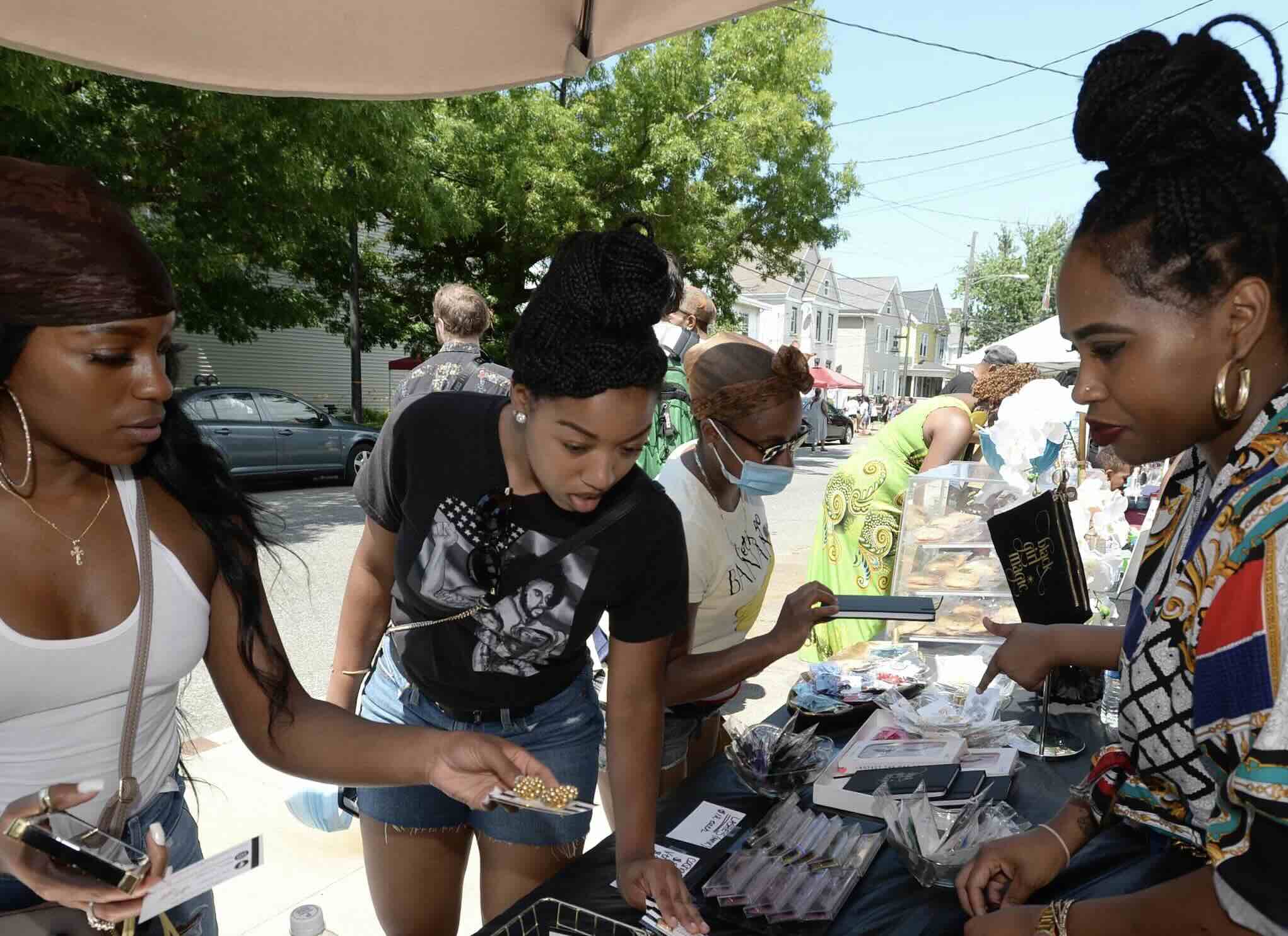
Photo: Erie Times-News
Recirculating the Black dollar is the final frontier in creating generational wealth for the Black community. Every prior strategy—the vote, the boycott, the lawsuit, the legislation—has been necessary but insufficient on its own. While some economists often point out that broader federal policy changes like homeownership equity, tax reforms, and student debt cancellation are also vital, there is an undeniable consensus that recirculating the Black dollar is the most direct, self-determined engine for building Black generational wealth. Policies and legal structures matter enormously; they shape who can own property, who can access credit, who can inherit assets, and who can build wealth across generations. But those very same policies and legal structures can be weaponized against the community depending on the administration in power. Laws that protect Black wealth today can be rewritten, defunded, or reversed tomorrow—which is precisely why the community cannot afford to build its future on a foundation that shifts with every election.
The 6-Hour Myth That is Empirically True
You have likely heard the claim that a dollar circulates for only six hours in the Black community, compared to 17 days in white communities, 20 days in Jewish communities, and 28 to 30 days in Asian communities. The exact numeric timeline traces back to a 1996 book by Brooke Stephens, who referenced an untraceable 1992 study. Prominent economists, including the late William Spriggs, former chief economist for the AFL-CIO, have classified the precise hourly calculation as an urban myth. Federal agencies do not track localized "money velocity" by race or religion, and calculating it with precise hourly metrics is scientifically impossible.
But here is the critical distinction: while the exact "six hours" metric lacks empirical backing, the sentiment behind it is entirely accurate. Economists universally agree that capital flows out of Black communities significantly faster than it does in other economic ecosystems. The math does not lie.
When you stack Black bank deposits and Black-owned business revenue directly against Black disposable income, the massive structural drain becomes immediately visible. Black Americans command $2.1 trillion in annual disposable income. Yet total gross revenue for all Black-owned businesses combined historically hovers around just $140 billion to $200 billion. Total assets across all Black-controlled banks and credit unions combined sit at roughly $7 billion to $8 billion. Nearly 90% of Black disposable income bypasses Black-owned businesses entirely, flowing straight into outside corporations.
The structural problem isn't the speed at which the dollar leaves—it is the lack of a dense business pipeline to catch it, hold it, and pass it along to the next local business. Black consumers cannot spend money at businesses that do not exist or have been starved of capital. Black businesses cannot scale up their revenue because they cannot secure large commercial loans from asset-starved local banks. Local banks cannot increase their assets because the massive stream of Black disposable income is being funneled into institutional systems outside the community. This mathematical reality disproves the biased narrative that the lack of wealth retention is due to poor personal spending choices. The math reveals a clear infrastructure and systemic design flaw.
How Recirculation Materializes into Generational Wealth
Generational wealth cannot be built on wages alone; it requires the creation and inheritance of appreciating assets. Recirculation systematically builds these assets through a compounding cycle:
- Commercial Real Estate Equity: When consumers buy Black, local businesses generate the consistent revenue needed to purchase their own commercial storefronts, warehouses, and land. This real estate becomes a massive, tangible asset that can be borrowed against, expanded, and passed down to future generations of founders.
- Funding the Next Generation: A robust local banking ecosystem—fueled by the deposits of middle- and upper-class households—creates a permanent pool of low-cost capital. Instead of a young Black entrepreneur or student starting out with predatory debt, they can secure community-backed business loans, venture capital, and down-payment assistance to launch their own wealth-building journeys early in life.
- The "Legacy Hire" Effect: Scaled, self-sustaining Black-owned firms do not just create jobs; they create corporate leadership pipelines. They provide positions where family members and community youth can gain high-level executive experience, operational expertise, and corporate ownership stakes that can be inherited.
Relying entirely on external economic systems to build community wealth has historically proven to be a structural dead end. Mainstream financial markets and major corporations are designed to extract value from consumer bases and concentrate it on their own balance sheets. By intentionally locking the dollar into an internal loop, the community stops funding the generational wealth of outside shareholders and begins funding its own. It shifts the economic paradigm from survival and consumption to production, ownership, and permanent legacy.
The Fatal Flaw of Relying on Policy Changes
Policy changes are vulnerable to political cycles and the shifting priorities of changing administrations.
Because legislative mandates, executive orders, and federal programs can be dismantled with the stroke of a pen or the results of a single election, relying on them as the primary tool to end systemic racism or close the wealth gap creates a cycle of temporary progress followed by systemic regression. This reality makes internal economic consolidation the only functional foundation for permanent self-determination.
History repeatedly shows that civil and economic protections granted by one administration can be defunded, reinterpreted, or completely erased by the next. The most stark historical example is the Reconstruction era. Following the Civil War, federal policies briefly established civil rights, protections, and political representation for newly freed Black Americans. However, when the federal government pulled its troops and funding out of the South, those political gains were instantly dismantled, ushering in decades of Jim Crow segregation and state-sanctioned economic extraction.
We see this same vulnerability today with policies like diversity, equity, and inclusion (DEI) initiatives, affirmative action, and targeted federal grant programs. A change in administration or judicial appointments can instantly halt or reverse decades of hard-fought policy progress.
Why Economic Muscle Outlasts Any Administration
Unlike a law or a government program, a community's tangible asset base cannot be voted out of existence. When middle- and upper-class households recirculate their dollars to build independent financial institutions, buy commercial land, and scale corporations, they build a fortress that is insulated from federal policy shifts.
- Asset Ownership is Protected by Law: Private property rights, corporate structures, and banking assets are deeply protected within the American legal system, regardless of which party is in the White House. A Black-owned bank with billions in deposits or a community land trust that owns commercial real estate cannot be dissolved by an executive order.
- Funding the Legal and Political Defense: When a community has its own independent wealth engine, it no longer has to beg a hostile or indifferent government for protection. It commands the capital necessary to fund its own civil rights attorneys, lobby for its own interests, and economically penalize entities that attempt to roll back its progress.
When the focus shifts from trying to eradicate deeply entrenched racism through the state to capturing and multiplying internal wealth, the community transitions from a state of dependency to a position of sovereignty. Recirculating the dollar creates an economic shield. While political power can provide temporary leverage, it is the permanent, un-dismantlable muscle of institutional capital that ensures a community can protect its people and pass down generational wealth, no matter who holds the keys to the government.
The Blueprint for Lasting Sovereignty
To turn this mathematical reality into a permanent, multi-generational structure that outlasts any political cycle, affluent households and professionals are focusing on three unassailable financial vehicles:
Institutional Banking Pools: Moving personal and corporate accounts into Black-owned financial institutions utilizes the laws of fractional reserve banking against systemic exclusion. Locking capital reserves inside these institutions creates a permanent, protected lending pool that politicians cannot defund or restrict.
Community Land Trusts (CLTs): By placing land and commercial real estate into community-governed trusts, neighborhoods can permanently de-commoditize their property. This prevents predatory gentrification, preserves affordable commercial spaces for local businesses, and locks wealth into the geography itself, completely separate from state or federal programs.
Private Equity Syndicates: Rather than waiting for traditional venture capital firms—which allocate less than 1% of their funding to Black founders—affluent professionals are pooling their capital into private investment syndicates. This self-funds the expansion of high-growth Black enterprises, scaling them to compete in the overarching global market from a position of total independence.
Ultimately, recirculating the dollar shifts the community's posture from defense to offense. It replaces the exhausting, fragile cycle of political petitioning with the unyielding, self-determined muscle of institutional capital. Recirculation creates an economic fortress that no election can dismantle. When you build an independent financial ecosystem backed by real assets, you are no longer at the mercy of political pendulum swings.
By forcing the dollar to rotate internally, capital stops acting as a passive stream of revenue for outside corporations and starts functioning as a self-renewing shield. This mathematical multiplication of wealth ensures that the community can fund its own schools, protect its own real estate, back its own entrepreneurs, and safeguard its future—completely insulated from whoever happens to hold power in Washington.
We Connect You to the Black for Free
Understanding the math and the history is only the first step. To actually participate—to move your deposits, redirect your spending, and invest in community-owned assets—you need a central hub that connects you directly to the Black economy. That is exactly what Emerald Book provides.
Emerald Book is the only platform with every tool needed to participate in the Black economy. We connect people directly to Black-owned businesses, Black banks, community maps, economic metrics, growth data, and a full directory of resources designed to make recirculation seamless. Everything is in one place—and it is completely free.
No Ads. By Us. For Us.
This article was made possible by readers like you. We hope it inspired you to support Emerald Book, so we can continue producing content like this.
We will never show you ads, sell your data, or require a subscription to consume our content. Your gift helps us keep the truth accessible.
Click the Support button to give a gift of any amount today.
Thank you for making this work possible.