

Emerald Pages
◆
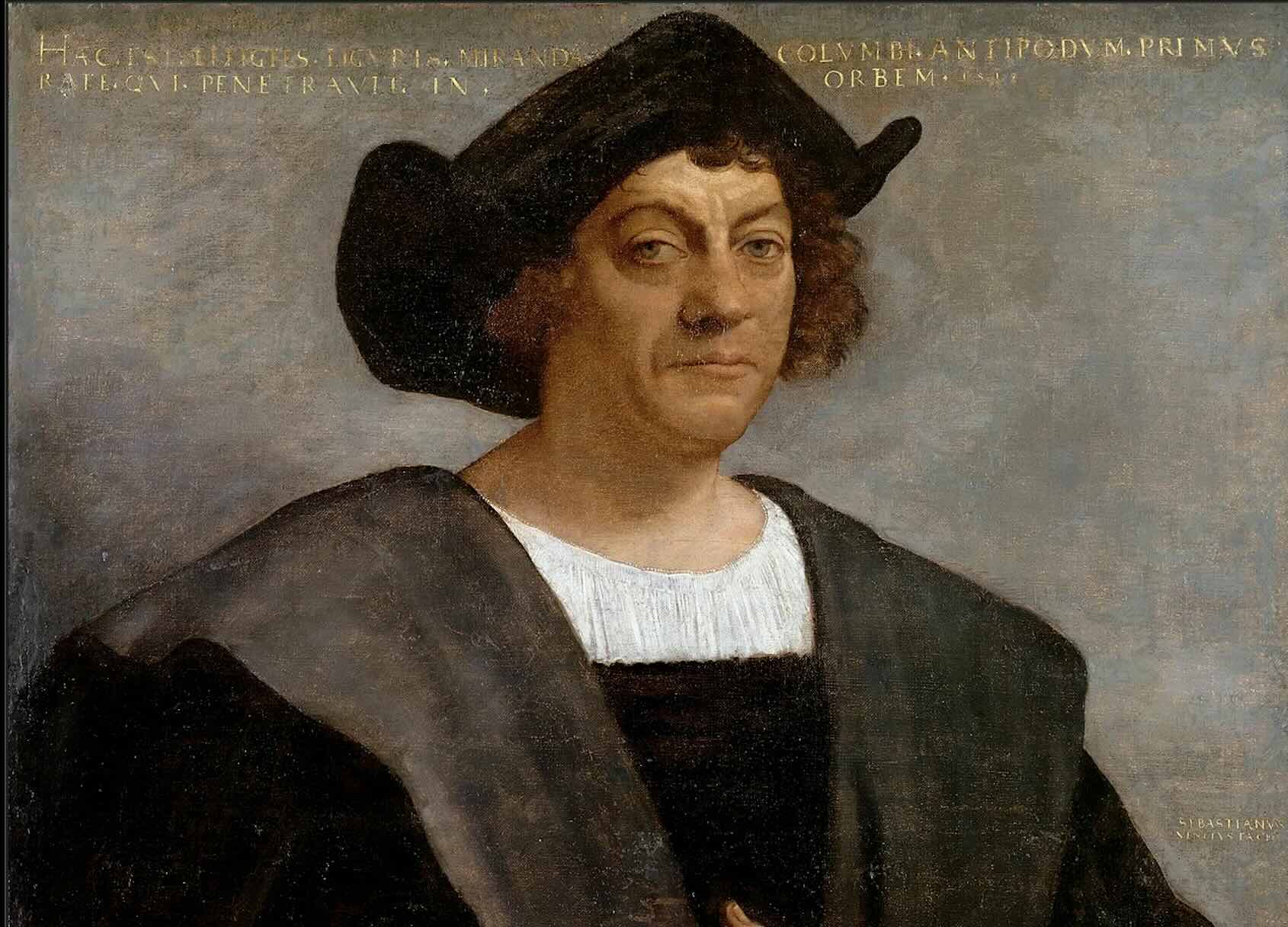
Photo: Wikipedia Commons
Christopher Columbus engineered a system of exploitation that would define European imperialism for centuries. While long idealized in Western history as the "discoverer" of America, his historical legacy is deeply complex. His arrival brought devastating consequences for Indigenous populations, including mass displacement, forced labor, and lethal disease outbreaks. But beyond the immediate devastation, Columbus established a repeatable blueprint: seize land, subjugate the local population, treat human beings as disposable capital, and import a secondary workforce when the primary workforce is depleted.
This is the story of how one man's voyages paved the way for chattel slavery and global colonization. It is a story that begins with the very first log entries Columbus wrote upon encountering the Taíno people of the Bahamas—entries that reveal a mindset that viewed human beings as commodities to be bought, sold, and worked to death for profit.
From his very first encounter with the Indigenous Taíno people, Columbus viewed them through the lens of servitude. On October 12, 1492, he wrote in his journal that the native populations were "ingenious" and "would make good servants." He noted how easily they could be subjugated. During his second voyage in 1495, Columbus rounded up over 1,500 Taíno men, women, and children on Hispaniola. He selected 550 of the healthiest individuals and loaded them onto ships bound for Spain to be sold in the slave markets of Seville. Mirroring the horrific conditions that would later define the Middle Passage, over 200 of them died during the voyage, and their bodies were thrown into the Atlantic.
Institutionalizing Forced Labor
When shipping Indigenous peoples to Europe proved less profitable than expected—largely due to high mortality rates—Columbus shifted his strategy to enslaving them on their own land to extract wealth. In 1495, he imposed a brutal tribute system on all Taíno people over the age of 14. Every three months, each individual was required to fill a copper token with gold dust. Those who failed to meet the quota had their hands amputated and were left to bleed to death.
Realizing the gold quotas were impossible because the islands lacked massive gold reserves, Columbus transitioned to the repartimiento system. He divided up the lands of Hispaniola and granted them to Spanish settlers, along with the absolute right to exploit the labor of the Indigenous people living on that land. This system was the direct precursor to the Encomienda System, which legally codified hereditary, permanent agricultural slavery across the Spanish Empire.
- 1492: Columbus writes that Taíno people would make "good servants" and could easily be subjugated
- 1495: Over 1,500 Taíno people rounded up; 550 shipped to Spain, 200 die during voyage
- 1495: Tribute system imposed—failure to meet gold quota results in amputation of hands
- 1498: Repartimiento system divides land and Indigenous labor among Spanish settlers
Dehumanization and the "Just War" Doctrine
To justify chattel slavery to the Spanish Crown and the Catholic Church—which had reservations about enslaving baptized Christians—Columbus and his contemporaries established specific legal and racial justifications. Spanish law permitted the enslavement of non-Christians only if they were hostile or practiced cannibalism. Columbus heavily promoted the narrative that certain tribes, like the Caribs, were aggressive, subhuman cannibals. This created a legal loophole that allowed the Spanish to wage "Just War" against any native group that resisted colonization, capturing and enslaving them legally.
Under Columbus's governorship, Indigenous people were officially treated as commodities. They were bought, sold, traded, and used as currency by Spanish colonists. The Catholic Church had already issued decrees—like Dum Diversas in 1452—that granted Christian monarchs explicit permission to invade, capture, and "vanquish all Saracens and pagans and other enemies of Christ," and to "reduce their persons to perpetual slavery" and take their lands. Columbus applied this exact wartime logic to the Indigenous people of the Americas.
The Transition to Transatlantic Chattel Slavery
The systems of overwork, starvation, and extreme violence established under Columbus—combined with the introduction of European diseases—had a catastrophic demographic impact. The Taíno population of Hispaniola, estimated to be hundreds of thousands in 1492, was virtually decimated within a few decades. Smallpox, measles, malaria, and influenza, to which Indigenous populations had zero immunity, wiped out up to 90% of the population in some regions.
Because the Spanish economic model in the Caribbean relied entirely on unfree, coerced labor, the rapid collapse of the Indigenous population created a labor vacuum. To preserve the highly profitable plantation system that Columbus initiated, King Charles I of Spain signed the Asiento de Negros in 1518. This official monopoly license allowed the direct, mass importation of enslaved Africans to the Caribbean. Enslaved Africans were forced into the exact same plantation and mining structures that Columbus had engineered for the Taíno.
Establishing the Blueprint for Global Colonization
Columbus proved to European monarchs that overseas conquest could be immensely profitable if treated as a commercial operation. He published letters detailing the islands' dense natural resources, timber, and potential gold mines, which instantly enthralled European elites. He demonstrated how to turn a colony into a purely extractive zone: stripping the land of resources, using forced labor to minimize costs, and funneling the raw wealth directly back to the mother country.
By establishing Spain's first permanent colony on Hispaniola, Columbus created a critical geopolitical launching pad. Hispaniola served as the primary logistical and military hub for the Spanish Crown. From this base, later conquistadors organized and launched the targeted invasions that collapsed the Aztec and Inca Empires, expanding European control deep into Central and South America.
The sudden influx of wealth and territory to Spain shattered the geopolitical balance of power in Europe, sparking a competitive frenzy among rival nations. To prevent immediate warfare between Spain and Portugal over these new territories, Pope Alexander VI helped broker the Treaty of Tordesillas in 1494, effectively dividing the non-Christian world between the two nations. Watching Spain accumulate unprecedented wealth from silver and gold, rival nations like Great Britain, France, and the Netherlands realized they had to build their own global navies and seize overseas colonies to survive.
Motivated by God
While wealth was a massive factor, Columbus was not motivated by money alone. He was a deeply pious, apocalyptic Catholic who believed the world was rapidly coming to an end. His ultimate, documented goal was to extract enough gold from the Americas to finance a massive Christian army to launch a new Crusade to wrest Jerusalem back from Muslim control before the anticipated Second Coming of Christ.
In his mind, the horrific means—slavery and territorial theft—were entirely justified by what he believed was a divine end. He compiled a text called the Book of Prophecies, in which he argued that his voyages were directly foretold by the Bible and that he was chosen by God to bring Christianity to the edge of the Earth to prepare for the end times.
Columbus was commissioned and bankrolled by the Catholic Monarchs of Spain, Queen Isabella I of Castile and King Ferdinand II of Aragon. On April 17, 1492, they signed the Capitulations of Santa Fe, granting him the hereditary title of "Admiral of the Ocean Sea," the position of Viceroy and Governor-General over all new lands he claimed, and a 10% cut of all wealth extracted from the territories.
Why America Celebrates Him
The historical celebration of Christopher Columbus—particularly through the creation of Columbus Day as a federal holiday—stems from a combination of political myth-making, the desire to create a national identity separate from Great Britain, and the 19th-century push to protect persecuted Italian immigrants. Over time, his image was heavily romanticized, masking the historical realities of chattel slavery and colonization.
After the Revolutionary War, the newly formed United States desperately wanted a national origin story that completely excluded Great Britain. They couldn't celebrate British explorers, so they latched onto Columbus. By focusing entirely on the image of a brave explorer staring at the horizon, early American writers completely erased the Indigenous populations from the narrative. They turned Columbus into a blank canvas that symbolized "discovery," progress, and the birth of a new nation.
The push to make Columbus a permanent, official holiday in the late 19th and early 20th centuries was actually a response to intense xenophobia and discrimination against Italian immigrants. In 1891, 11 Italian Americans were murdered by a mob in New Orleans in one of the largest mass lynchings in U.S. history. To soothe diplomatic tensions with Italy and push back against anti-Italian sentiment, President Benjamin Harrison declared a one-time national celebration of Columbus in 1892. In 1937, President Franklin D. Roosevelt officially made Columbus Day a federal holiday following intense lobbying from Italian American and Catholic groups.
The Modern Reality
Because the historical record clearly documents Columbus's direct role in slavery, torture, and systemic devastation, the holiday has faced intense re-examination. Today, a significant and growing number of U.S. states and cities choose not to celebrate Columbus. Instead, they observe Indigenous Peoples' Day on the same day to honor the history, cultures, and resilience of Native Americans, shifting the focus from the colonizer to the populations that survived colonization.
In 2021, the U.S. presidency issued presidential proclamation officially marking Indigenous Peoples' Day alongside Columbus Day, signaling a systemic shift toward honoring the resilience of the people who survived his blueprint, rather than the man who drew it. Over 17 states, including Alaska, Hawaii, Oregon, and New Mexico, have completely stripped Columbus's name from the day or refused to observe it entirely.
The tension is exactly why statues of Columbus are being pulled down across the country today. The public is forcing the nation to choose between holding onto an outdated, harmful myth or acknowledging the factual historical truth.
Ultimately, Columbus provided the global colonial project with a specific economic blueprint: seize land, eliminate or subjugate the local population, treat human beings as disposable capital, and import a secondary workforce when the primary workforce is depleted. This cycle was replicated by the Portuguese, British, French, Dutch, and American empires across the Western Hemisphere for the next 300 years. Understanding this history is not about erasing the past—it is about finally telling the truth about it.
No Ads. By Us. For Us.
This article was made possible by readers like you. We hope it inspired you to support Emerald Book, so we can continue producing content like this.
We will never show you ads, sell your data, or require a subscription to consume our content. Your gift helps us keep the truth accessible.
Click the Support button to give a gift of any amount today.
Thank you for making this work possible.