

Emerald Pages
◆
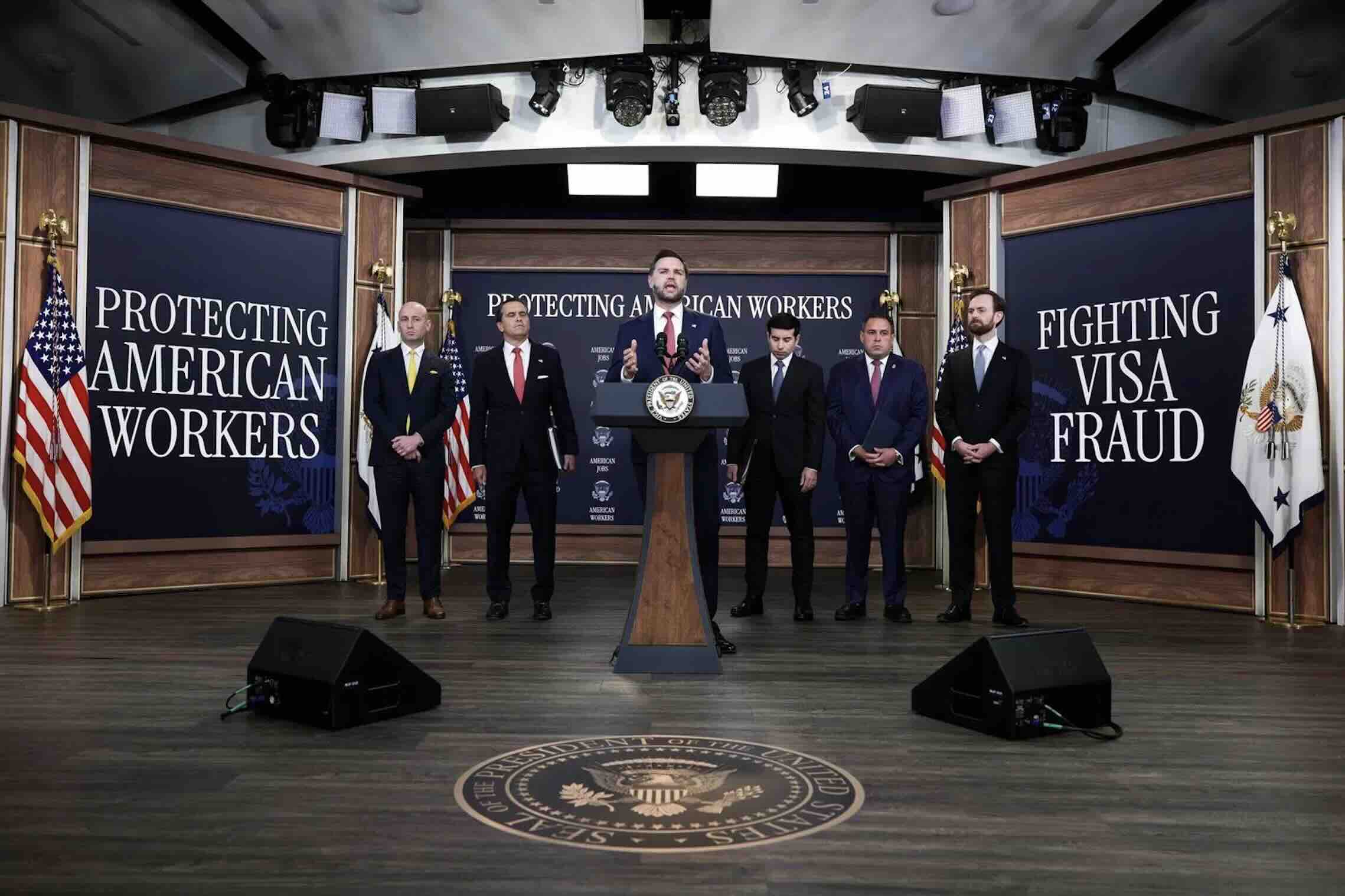
Photo: Getty Images
The Trump administration has fundamentally reshaped the landscape of high-skilled immigration in 2026. Through a combination of a $100,000 H-1B application fee, indefinite suspensions of major tech companies from the PERM green card program, and federal fraud investigations targeting J-1 visa usage at nine elite universities, the White House has declared war on what it calls "corporate laundering" of foreign labor.
The stated logic is straightforward: if you make foreign workers expensive and legally risky enough, American corporations will have no choice but to hire the millions of qualified Americans supposedly waiting in the wings. Similarly, if you crack down on J-1 visa holders at universities, more spots will open for domestic students.
There is just one problem: the empirical data shows this logic is almost entirely backwards.
The Corporate Escape Hatch: Offshoring, Not Hiring
When the Trump administration suspended Microsoft, Adobe, and other major IT firms from the PERM program on October 8, 2026, Vice President JD Vance framed it as a necessary punishment for companies that "laid off thousands of American citizens while continuing to utilize cheaper foreign labor."
The diagnosis is empirically valid. Data from the National Bureau of Economic Research (NBER) and the Economic Policy Institute (EPI) confirms that H-1B workers earn 10% to 16% less than comparable American workers in identical roles, saving corporations nearly $100,000 per worker over a standard six-year visa span. Sixty percent of H-1B jobs are paid below local median wages.
But the cure fails the most basic test of economic reality. Landmark research from the Wharton School and the Cato Institute demonstrates that restricting H-1B visas causes an immediate spike in job offshoring. When companies are denied visas, they do not hire Americans; instead, they expand foreign offices or open new foreign affiliates—predominantly in Canada, India, and China. The most globalized firms substitute nearly one foreign affiliate job for every single rejected visa.
Empirical evaluations by the Mercatus Center and the Richmond Fed found that H-1B restrictions do not increase native employment. In fact, denial of high-skilled talent leads to a decrease in domestic computer jobs, slower wage growth for native college graduates, and lower overall U.S. corporate revenue.
Studies from the Hoover Institution on the 2017 high-skill visa restrictions showed that the talent simply diverted to countries like Canada. This boosted the production and exports of Canadian firms, allowing them to compete more aggressively against American companies from abroad.
The J-1 Crackdown: Starving American Labs, Not Filling Classrooms
The administration's approach to the J-1 visa program mirrors its actions on H-1B visas: rather than a blanket statutory ban, it has launched a massive federal fraud investigation and compliance crackdown targeting major research institutions. On October 8, 2026, Vice President Vance announced that the Department of Labor has issued subpoenas to nine elite universities—Harvard, Yale, MIT, Stanford, Brown, Caltech, University of Pittsburgh, UC Davis, and Arizona State University—suspected of using the J-1 program to systematically undercut American workers.
Officials allege that universities are packing federally funded research projects with low-cost international scholars and postdocs on J-1 visas. According to Vance, the nine targeted universities fill 61% of their research positions with J-1 visa holders, compared to a national university average of 38%.
Historical federal audits dating back decades support the claim that the J-1 program operates heavily as a cheap labor mechanism. A significant percentage of J-1 issuances are strictly for employment rather than traditional cultural exchange. In higher education, universities save millions because J-1 visa holders are exempt from standard domestic payroll taxes for their first two years, making them structurally cheaper than American researchers.
However, empirical data from higher education groups and economic researchers shows that aggressively restricting J-1 visas heavily damages American research dominance. The vast majority of academic J-1 holders work in bleeding-edge STEM fields. When the U.S. makes its visa environment hostile, elite international researchers do not stay home, nor do universities easily replace them with Americans. Instead, that highly specialized talent moves to global competitors like the UK, Canada, and Australia, which actively recruit them with lower tuition and clearer pathways to permanent residency.
The assumption that cracking down on J-1 visas will open more spots for American students fundamentally misunderstands how academic enrollment works. The vast majority of university J-1 visas are held by postdoctoral researchers, visiting professors, and advanced lab technicians—not traditional students sitting in a classroom. Blocking a J-1 visa holder does not create an opening for an incoming freshman or a master's student. It simply leaves a highly specialized, vacant staff position in a scientific research lab.
Academic research is a massive revenue driver for universities, largely funded by competitive federal and private grants. If a university cannot find hyper-specialized talent to staff a lab because of a visa freeze, the project stalls, and the grant funding can be pulled. When labs lose funding, the university shrinks the size of the program overall. Instead of opening spots for Americans, the total number of available spots in that department actually decreases.
Furthermore, the standard international students on campus typically hold F-1 student visas, which are distinct from the J-1 scholar exchange visas targeted in this specific fraud probe. International students usually pay full, out-of-state tuition, which heavily subsidizes the financial aid, infrastructure, and spots available to domestic American students. Losing that revenue often forces universities to downsize overall class sizes.
The $70,000 Student Fee: A Self-Inflicted Wound
The administration has also proposed a $70,000 fee for international student work programs. This policy, combined with the J-1 crackdown, creates a hostile environment for global talent at every stage of the academic pipeline.
The empirical consensus is clear: by forcing a sudden labor shortage in higher education without first building, funding, and training a qualified domestic replacement pool, the policy functions purely as an economic drag. It hobbles America's premier research engines while doing absolutely nothing to solve the root problem of domestic workforce development.
The tension ultimately exposes a deeper systemic issue: whether the American workforce has a genuine skills gap or if the market has a structural wage suppression problem. The data suggests both are true—but the administration's policies address neither.
What Actually Works: Closing the Wage Gap
Based on a broad consensus of labor economists, researchers at the NBER, and non-partisan think tanks, the empirically validated solution to this problem is a shift from banning labor to pricing it accurately. If you want to protect domestic workers without driving high-paying tech jobs out of the country, the system must be reformed to remove the corporate profit incentive to underpay foreign workers, while simultaneously lowering the structural friction of hiring Americans.
- Wage-Ranked Allocation: Replace the random H-1B lottery with a system that sorts applicants by salary offered, from highest to lowest. This eliminates the 16% wage gap and ensures visas only go to truly exceptional, high-earning global talent.
- Job Mobility for Visa Holders: Give high-skilled visa holders immediate portable work authorization, allowing them to change employers freely. When foreign workers have mobility, corporations lose the leverage to underpay them, leveling the playing field for American job seekers.
- Funnel Fees into Domestic STEM Pipelines: Levy substantial visa fees but mandate that 100% of the revenue go toward subsidizing advanced tech apprenticeships, coding bootcamps, and STEM degrees for domestic workers. This organically shrinks the skills gap over time.
The empirical consensus is clear: Don't close the border; close the wage gap. By forcing companies to pay foreign workers premium market rates and using those fees to train citizens, you protect American wages, retain global innovation on U.S. soil, and prevent jobs from fleeing to Canada or Europe.
The Trump administration's visa restrictions are economically nonsensical because they treat a global economic challenge with a local border restriction. They do nothing to change the underlying cost structure of the American labor market, nor do they magically alter the global competitiveness of American workers. Instead, they subsidize the tech sectors of other nations, force U.S. companies to export capital and high-paying jobs abroad, and leave the domestic workforce completely out of the loop.
The jobs don't automatically reappear. They often morph into different formats or relocate to friendlier regulatory environments. And the university seats don't magically open up. They disappear along with the research funding that supported them.
This is not speculation. This is what the data has shown every time these policies have been tried. The question is whether the administration will heed the evidence before the damage becomes irreversible.
No Ads. By Us. For Us.
This article was made possible by readers like you. We hope it inspired you to support Emerald Book, so we can continue producing content like this.
We will never show you ads, sell your data, or require a subscription to consume our content. Your gift helps us keep the truth accessible.
Click the Support button to give a gift of any amount today.
Thank you for making this work possible.