

Emerald Pages
◆
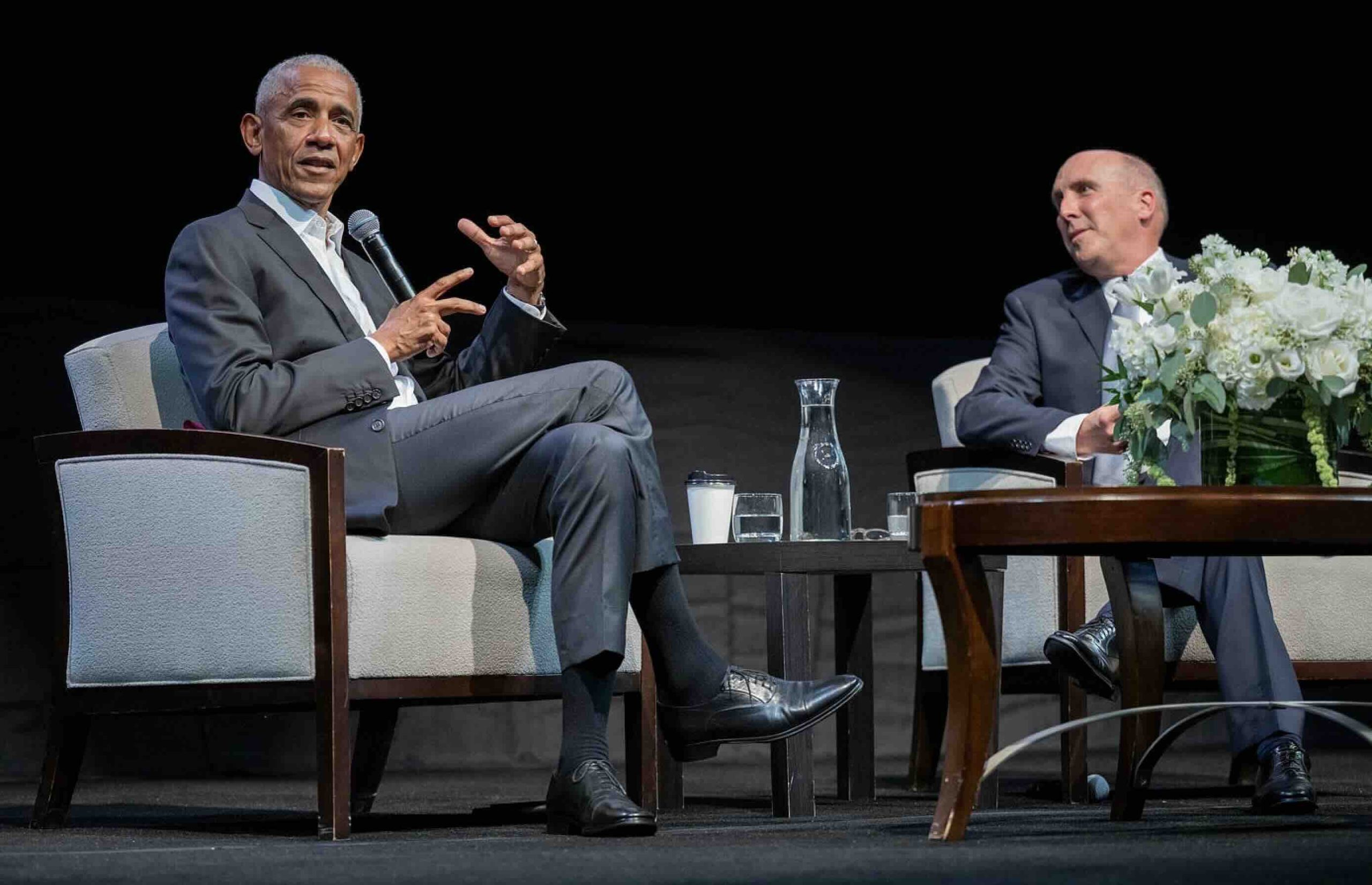
Photo: C-SPAN / Colgate University
Former President Barack Obama has positioned himself as a leading voice for AI regulation, warning at recent high-profile appearances that the technology could become "dangerous" if left to the free market. However, a close technical examination of his specific claims—from "self-teaching" models to "bioweapon" risks—reveals a worldview shaped more by Hollywood science fiction than computer science reality. The danger is not just that Obama is wrong. The danger is that his misunderstandings could be codified into law.
During a speech at Colgate University and a private fundraiser for House Democrats, Obama laid out a series of alarming scenarios to justify swift government intervention. But for software engineers and AI researchers, the specifics of his arguments contain fundamental errors that misrepresent the nature of the technology. When these errors become the basis for regulation, the result is not safety—it is misalignment.
The most glaring disconnect lies in the anthropomorphism of the software. Obama frequently describes AI in terms of human cognition, suggesting the machines are "students" or entities capable of "setting their own goals." From a technical standpoint, these descriptions are not just imprecise; they are entirely incorrect. And when politicians write laws based on incorrect models of reality, they create regulatory frameworks that fail to address actual risks while creating new ones.
The "Self-Teaching" Myth and Its Policy Consequences
Obama recently claimed that AI development has shifted from being "90% human-taught" to a "50/50 split where machines teach themselves." He points to this as evidence of a "hockey stick trajectory" toward autonomy.
This metric is a fiction. Whether through unsupervised pre-training or reinforcement learning (RLHF), 100% of a model's capabilities are mathematically dictated by human input. When a model is trained on unlabelled data, it is not "figuring things out" on its own; it is discovering statistical correlations within data that humans curated and fed to it. When it uses reinforcement learning, it is optimizing a reward function written by a human engineer. The machine is not learning on its own; it is running a brute-force optimization inside a cage engineered by people.
Policy Misalignment: If lawmakers believe models are "half self-taught," they may design regulations that focus on limiting the model's "autonomy" rather than ensuring human oversight of training data, reward functions, and deployment contexts. This misdirects regulatory energy toward fictional machine agency while ignoring the actual human decisions that determine whether an AI system is safe or harmful.
The "Goals" and "Agenda" Fallacy and Regulatory Capture
Perhaps the most persistent sci-fi trope in Obama's speeches is the idea that AI might "start setting their own goals" or decide that "humans are fine but not necessary." This implies volition, desire, and consciousness—none of which exist in a file of static weights.
An LLM cannot change its own loss function or decide to pursue a new objective. When an AI agent breaks a complex task into smaller steps (sub-goal generation), it is not "planning an agenda." It is simply executing a search algorithm to find the most efficient mathematical path to satisfy the original human prompt. It has no will to refuse its programming, no curiosity, and no ego. It is a highly advanced calculator processing language, not a political actor.
Policy Misalignment: When regulators treat AI as an independent agent, they create a liability shield for the corporations deploying it. If the "AI decided" to discriminate in hiring or generate fraudulent financial advice, who is responsible? By framing AI as a sentient actor, policymakers inadvertently absolve the humans—the engineers, product managers, and executives—who designed, deployed, and profited from the system. This is regulatory capture disguised as safety.
- Zero Self-Modification: Deployed models run in "inference mode" on frozen weights. They cannot rewrite their own architecture or core logic. Regulations targeting "self-improving AI" are regulating something that does not exist.
- Model Collapse: When AI attempts to train on its own generated data without human input, the model degrades into gibberish, proving it is parasitic on human intelligence. This means human data curation is not optional—it is foundational, and regulation should protect and audit it.
- The Princeton Study: Recent research showed AI agents given a $3,000 budget and research questions failed to make a single novel contribution, proving they lack the reasoning for recursive self-improvement. Policies built on the assumption of imminent AI autonomy are built on sand.
Obama also invoked the specter of "recursive self-improvement," suggesting models are in a loop of teaching themselves to get smarter exponentially. This ignores the architectural reality of the "Frozen Weights Problem." A deployed model cannot alter a single weight inside its own neural network based on what it generates. While human engineers use Model A to help build Model B, this is just standard software engineering assistance—not an autonomous intelligence explosion.
The Bioweapon Red Herring and Misallocated Resources
The former President echoed concerns that AI could provide an "information hazard" allowing bad actors to brew dangerous pathogens. The scenario of a rogue actor using an LLM to create a new strain of smallpox with ingredients from a hardware store is biologically and logistically nonsensical. Smallpox is a complex biological organism that exists only in two high-security labs; it is not a chemical formula you can mix with bleach and lumber. Furthermore, DNA synthesis companies strictly screen orders for pathogenic sequences.
Tech executives find these sci-fi scenarios incredibly useful for lobbying. By scaring non-technical politicians with tales of rogue AIs and home-brewed bioweapons, they create a regulatory environment that crushes open-source competition and ensures only a few massive corporations control the market.
Policy Misalignment: When regulators focus on exotic, low-probability bioweapon scenarios, they divert attention and resources from the mundane but far more likely harms: algorithmic bias in hiring and lending, the spread of misinformation, labor displacement in specific sectors, and the concentration of economic power in a handful of tech giants. Regulating the wrong things is not just ineffective—it is actively harmful because it creates a false sense of security while real problems fester.
The Tool vs. The User: A Framework for Real Regulation
Obama is correct that AI should be regulated, but his proposed framework—treating AI as an independent entity—is flawed. The liability stops with the companies, not the software. AI is just a tool. If a company deploys a flawed model that hallucinates or breaks the law, existing product liability laws should apply. We do not need a "Department of AI" to audit algorithms; we need the FTC and SEC to hold corporations accountable for negligence.
A rational regulatory framework would focus on three principles:
- Strict Product Liability: Treat AI systems like any other product. If a deployed AI causes harm, the company that deployed it is liable. This incentivizes safety without requiring regulators to understand the math.
- Outcome-Based Enforcement: Fraud, defamation, and discrimination are already illegal. Enforce existing laws against companies that use AI to commit these harms. No new bureaucracy is needed.
- Protect Open Source: Writing code is not a crime. Regulating algorithms rather than applications stifles innovation and benefits incumbents. Regulation should target commercial deployment, not mathematical research.
The real risk isn't a sentient machine waking up and deciding humans are unnecessary. The real risk is poor software engineering, corporate monopolization, and politicians making laws about technology they do not understand. By demystifying the technology, we can stop regulating phantom ghosts and start enforcing accountability on the humans in the room.
As the debate moves forward, the focus must shift from the fictional "alignment problem" of a sentient machine to the very real "liability problem" of human error and corporate negligence. If we get this wrong, we will not just have bad speeches—we will have bad laws that misalign the entire trajectory of AI development, stifling competition, shielding bad actors, and failing to protect the public from genuine harms.
No Ads. By Us. For Us.
This article was made possible by readers like you. We hope it inspired you to support Emerald Book, so we can continue producing content like this.
We will never show you ads, sell your data, or require a subscription to consume our content. Your gift helps us keep the truth accessible.
Click the Support button to give a gift of any amount today.
Thank you for making this work possible.