

Emerald Pages
◆
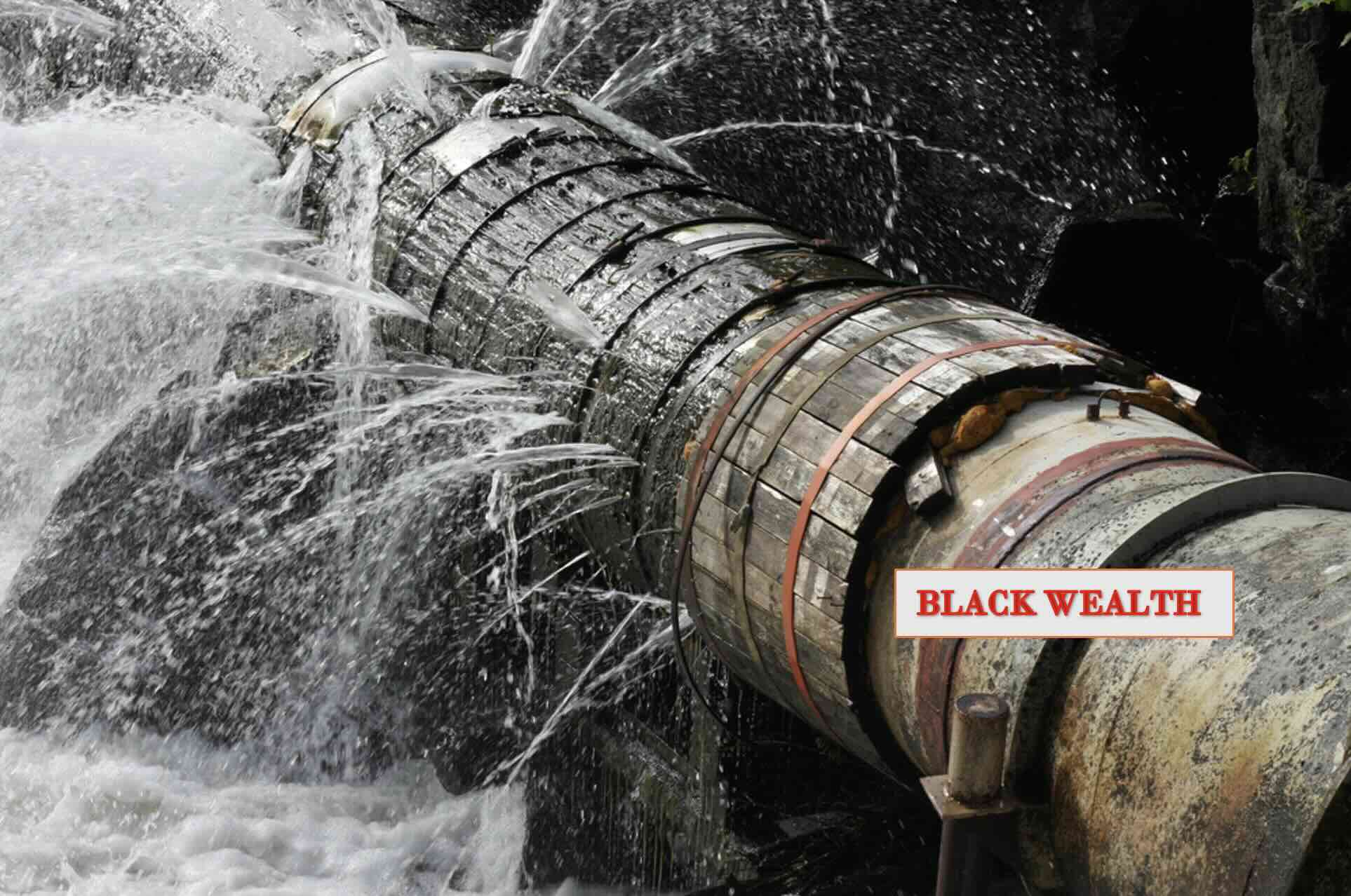
Photo: Emerald Book Image
The numbers sit side by side on the same federal spreadsheets, and they refuse to reconcile. Black Americans collectively command roughly $2.0 trillion to $2.1 trillion in annual disposable income — after-tax buying power that rivals the entire GDP of Canada, Brazil, or Italy. Yet the median Black household holds just $36,800 in total net worth, roughly one-ninth of the median white household's $332,100.
How does a community generate trillions in annual cash flow and retain almost none of it as wealth? The answer isn't a lack of effort, discipline, or consumer savvy. It's a geyser: a high-pressure system where income surges in from every direction, then bursts outward through pipes that were never designed to hold it. The money doesn't disappear. It flows — into white national banks, corporate landlords, mainstream retailers, and shareholder portfolios — compounding wealth for everyone except the households that generated it.
Economists describe this as a near-zero local money multiplier. In a self-sustaining economy, a dollar changes hands multiple times before leaving — paying a local worker, who pays a local grocer, who deposits profit in a local bank, which lends to a local homebuyer. Each bounce creates new income and builds equity. When $2.1 trillion flows through a community with virtually no internal capture infrastructure, the cycle breaks at the first transaction.
The Pipe Burst: Where the Money Actually Goes
If $2.1 trillion enters Black households annually and only $36,800 sticks per family, the outflow must be enormous. It is. Trace the pipes.
- Banking: All Black-owned commercial banks combined hold roughly $6.7 billion to $9.4 billion in assets — about 0.33% to 0.46% of annual Black income, and roughly 0.03% of the $24.9 trillion U.S. banking system. JPMorgan Chase alone is 425 to 597 times larger than every Black bank combined. More than 99% of Black deposits sit in mainstream megabanks.
- Business capture: Black employer businesses — about 200,900 firms with paid staff — generated $249.0 billion in receipts, roughly 12% of Black disposable income. All Black businesses including solo operators capture an estimated $330–$350 billion, about 16.6%. But much of that is business-to-business, government procurement, and healthcare reimbursement, not everyday consumer spending. Actual household capture is closer to 2%.
- Essentials: Housing, transportation, food, utilities, and healthcare consume 70% to 80% of Black household budgets. There are almost no Black-owned electric utilities, insurance underwriters, hospital networks, or national grocery chains to absorb those dollars.
- Housing equity: Roughly 43% to 47% of Black households own homes versus over 72% of white households. For the majority who rent, monthly housing payments generate zero long-term equity.
The result is a $1.7 trillion-plus mismatch between what Black households earn and what Black-owned institutions are structurally built to capture. The money does not vanish. It becomes stock appreciation, dividends, and commercial real estate equity for the white owners of the banks and corporations receiving it.
The Geyser Mechanics: Why the Pressure Keeps Building
A geyser needs three things: a heat source, a constricted plumbing system, and pressure that eventually forces the burst. Black America's economic plumbing has all three.
The heat source is income growth. Black buying power has climbed steadily, now accounting for roughly 9% to 10% of total U.S. consumer spending. That is genuine progress — more paychecks, more households, more consumer demand. But heat without containment produces steam, not storage.
The constriction is ownership. Black Americans are about 13.5% of the population and generate nearly 10% of national disposable income, yet hold only 3.1% to 3.4% of total national household wealth. Black-owned firms represent roughly 2% to 3.4% of all private employer businesses. Black-owned banks hold under $7 billion of $24 trillion in commercial banking assets. The pipes through which money could recirculate — banks, employers, landlords, insurers — are almost entirely owned by white people.
The pressure is structural extraction. Before a dollar even reaches a Black household, wage gaps shrink it: Black workers earn roughly 20% to 25% less per hour than white workers on average, and a substantial portion of that gap persists among workers with identical education, experience, and job title. After it arrives, higher costs drain it: Black borrowers are steered into higher-cost mortgages and auto loans even controlling for credit scores, homes in Black neighborhoods are appraised lower than identical homes in white neighborhoods, and insurance premiums run higher in majority-Black zip codes at identical risk profiles.
The Racism Acceleration Loop: Why the Gap Widens
Here is where the geyser becomes self-reinforcing. Wealth grows exponentially through appreciating assets; debt grows exponentially too. Because structural barriers push Black households toward higher-interest mortgages, auto loans, and student debt while white households hold the vast majority of corporate equities and real estate, one group collects compound interest while the other pays it.
The math is unforgiving. If Group A starts with $300,000 in invested assets and Group B with $30,000, a 7% annual return gives Group A $21,000 in passive growth in year one and Group B $2,100. Even if both save the same dollar amount from paychecks every month, the dollar gap widens every single year through multiplication alone. A $10,000 loss to lending bias or underpayment in a single year represents $75,000 to $100,000 in lost compounded retirement wealth over a 30-year career.
Between 2022 and 2025, inflation-adjusted median net worth rose 6% for white families to $332,100 while falling 25% for Black families from $49,100 to $36,800. The typical-family wealth gap widened from roughly 6-to-1 to 9-to-1, the largest ratio recorded since 2016, and is now worse than pre-Civil Rights-era levels. White households now hold roughly $130 trillion to $155 trillion in collective wealth against ~$14 trillion in annual disposable income, a wealth-to-income ratio of 9 to 10 times. Black households hold $4.2 trillion to $5.7 trillion against $2.1 trillion, a ratio of just 2 to 2.7 times.
What Proportionality Would Look Like
Disproportionality is measured by comparing a group's share of population to its share of wealth. Black Americans are ~13.5% of the population, generate ~9.5% to 10% of disposable income, and hold ~3.1% to 3.4% of national wealth — under-indexed by roughly 4-to-1.
- Current Black collective wealth: roughly $4.2 trillion to $5.7 trillion out of $165+ trillion in total U.S. household wealth.
- Proportional benchmark at 13.5% of national wealth: roughly $22 trillion to $23 trillion.
- Aggregate racial wealth gap: roughly $16 trillion to $18 trillion.
- Per-household shortfall across 19 million Black households: roughly $850,000 to $950,000 in missing wealth on average.
Black Americans earn nearly 10 cents of every after-tax dollar in the U.S. economy, yet hold only 3 cents of every dollar of accumulated wealth. That is the geyser in a single sentence.
Fight the Racism. Fund the Fix.
The $2.1 trillion figure proves that Black Americans generate massive economic output and consumer demand every year. The $36,800 median wealth figure proves that high living costs, lower asset ownership, lending discrimination, and student debt prevent most of that cash flow from sticking as permanent family wealth. Historical barriers — redlining, unequal GI Bill access, segregated labor markets — set the starting line near zero. Ongoing institutional extraction — wage gaps, appraisal bias, predatory pricing — drains cash before it can be saved. And the ownership deficit — under 0.5% of bank assets, 2% to 3% of employer firms — ensures 98% of remaining spending exits immediately to enrich white shareholders.
The response has to run on two tracks at once. The first is the fight against racism itself — the lending bias, appraisal gaps, wage disparities, and policy failures that keep draining the geyser at its source. That fight is not optional, because no amount of individual spending can outrun a system designed to extract. The second is building the capture infrastructure: deliberately directing more of that $2.1 trillion into Black-owned banks, businesses, credit unions, and investment vehicles, and scaling them so they can hold what the community earns. Participation in the Black economy is not a gesture — it is the funding mechanism. If we don't fund the fix, no one else will. Waiting for external institutions to rebuild plumbing they profit from is not a strategy; it is how the geyser keeps bursting.
The pressure is real. The question is whether the pipes get rebuilt before they completely burst.
No Ads. By Us. For Us.
This article was made possible by readers like you. We hope it inspired you to support Emerald Book, so we can continue producing content like this.
We will never show you ads, sell your data, or require a subscription to consume our content. Your gift helps us keep the truth accessible.
Click the Support button to give a gift of any amount today.
Thank you for making this work possible.