

Emerald Pages
◆
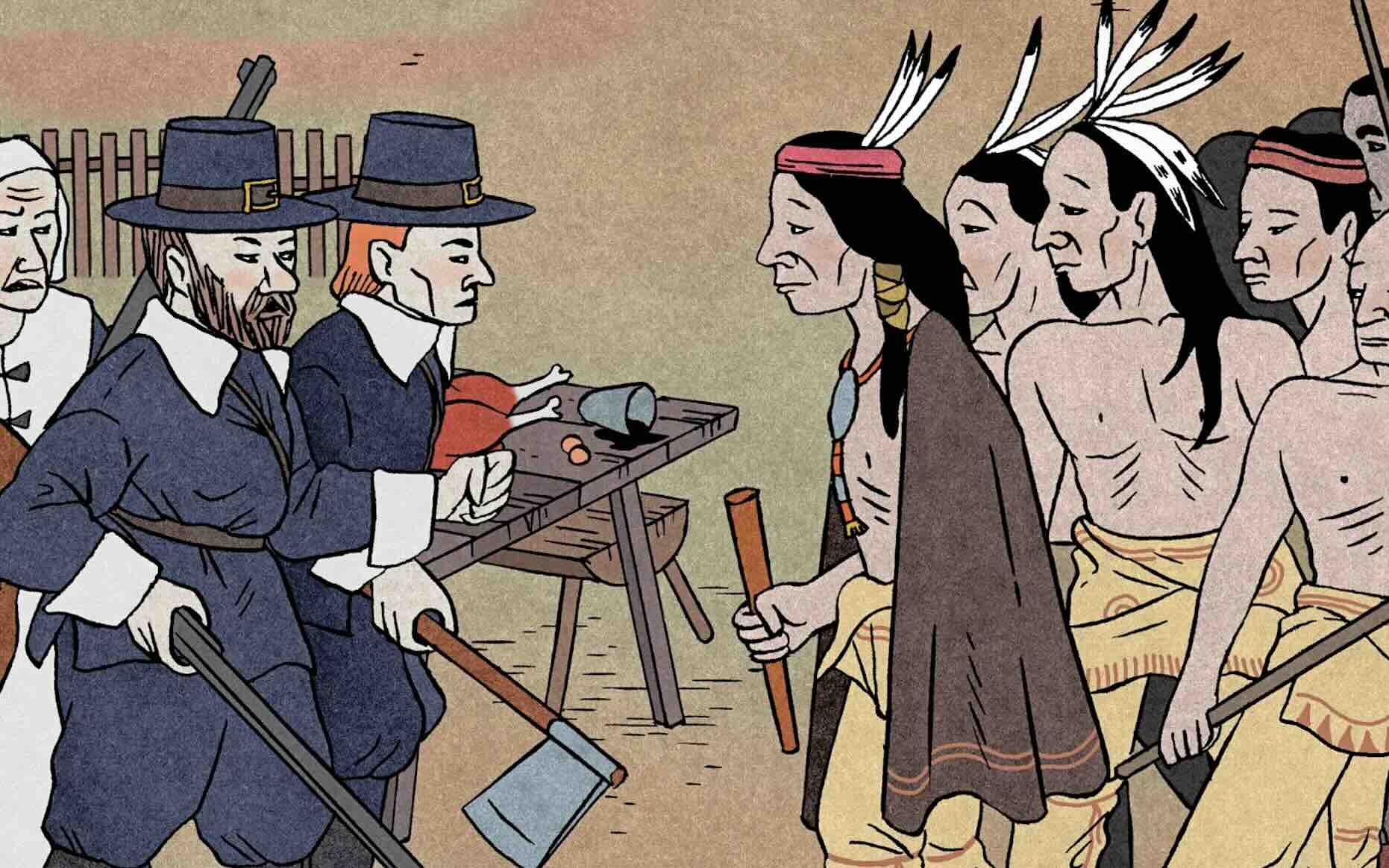
Photo: The New Yorker
Every November, American elementary school students cut out paper feather headbands and Pilgrim hats. They color turkeys and reenact a peaceful potluck. The story they are told—of friendly Indigenous people welcoming starving colonizers to a shared harvest table—is presented as the founding moment of American gratitude. But for the Wampanoag people, whose ancestors negotiated the treaty that made the 1621 gathering possible, and for hundreds of other tribal nations whose ancestors survived the centuries of violence that followed, Thanksgiving is not a celebration of cooperation. It is a reminder of genocide.
The gap between the classroom myth and the historical record is not an accident. It is the product of deliberate national mythmaking, political battles over curriculum, and a profound failure to confront what actually happened after the muskets were fired and the three-day feast ended. Understanding why schools omit this history requires looking at the forces that shape what American children learn—and what that omission means for the millions of Indigenous people who still live with its consequences.
Before the Mayflower dropped anchor, European traders and fishermen had been visiting the New England coast for nearly a century. Between 1616 and 1619, diseases introduced by those visitors—likely leptospirosis or smallpox—wiped out up to 90 percent of the coastal Wampanoag population. The Wampanoag village of Patuxet was completely emptied. When the Pilgrim colonizers arrived in late 1620, they built Plymouth Colony directly on top of that abandoned village, using its cleared fields and digging up buried winter corn stores left behind by the dead. Unburied bones still lay on the ground.
The 1621 gathering itself was a military and political alliance, not a holiday. Only about 50 English colonizers were alive by autumn. During their harvest celebration, they fired muskets into the air. Hearing gunfire, Wampanoag leader Ousamequin—known as Massasoit—arrived with roughly 90 armed men to investigate or reinforce their mutual defense treaty. They contributed five deer and stayed for three days. It was a diplomatic necessity for a Wampanoag population devastated by plague and facing threats from rival tribes like the Narragansett. To the Puritan colonizers, a "thanksgiving" was a solemn day of fasting and prayer, not a feast. The 1621 event was forgotten for over two centuries and mentioned only briefly in a single surviving letter.
The Genocide That Made the Myth Possible
The violence did not stay in 1621. In 1637, during the Pequot War in Connecticut, English colonizers and their allies surrounded a fortified Pequot village at Mystic, set it on fire, and killed roughly 500 men, women, and children in under an hour. Afterward, Massachusetts Bay Colony Governor John Winthrop declared a public "Day of Thanksgiving" to celebrate the slaughter—a practice that became common after colonial victories over Native tribes. The surviving Pequot were hunted down, executed, or sold into slavery in the Caribbean, and the English officially declared the Pequot nation dissolved.
Decades later, King Philip's War (1675–1676) pushed the Wampanoag to the brink after years of land theft and broken treaties. Ousamequin's son, Metacomet, led a coalition of tribes against the colonies. The English won, killing Metacomet, displaying his severed head on a spike in Plymouth for 20 years, and selling hundreds of surviving Wampanoag—including Metacomet's wife and young son—into slavery in the Caribbean. By the end of the war, the Indigenous population of southern New England had been reduced by roughly 60 to 80 percent. Colonial governments passed official laws offering cash bounties for the scalps of Indigenous men, women, and children, turning the killing of Native people into a state-sponsored enterprise.
- Up to 90% of the coastal Wampanoag population was wiped out by European-introduced disease between 1616 and 1619—before the Mayflower arrived.
- Plymouth Colony was built directly on top of the abandoned Wampanoag village of Patuxet, and colonizers looted buried corn stores to survive.
- The 1621 gathering was a three-day diplomatic meeting, not a holiday, and it was forgotten for over two centuries.
- Governor John Winthrop declared a "Day of Thanksgiving" after the 1637 Pequot Massacre, in which roughly 500 people were burned alive.
- Since 1970, Indigenous people have gathered at Cole's Hill in Plymouth every Thanksgiving to observe the National Day of Mourning.
How the Modern Myth Was Invented
The link between the 1621 meal and today's holiday was constructed in the mid-1800s to serve political and cultural goals. Starting in the 1830s, magazine editor Sarah Josepha Hale lobbied five presidents to create a uniform national Thanksgiving holiday, publishing recipes for turkey, stuffing, and pumpkin pie and framing the holiday around domesticity and New England heritage. In 1863, during the height of the Civil War, President Abraham Lincoln finally agreed, seeking to foster national unity and boost Northern morale.
Following the Civil War, writers, illustrators, and textbook publishers revived the forgotten 1621 Plymouth story. As the United States expanded westward and violently displaced Native nations on the Plains, romanticized paintings of peaceful "Pilgrims and Indians" sharing a meal gave white Americans a comforting, sanitized origin story—one that portrayed colonization as peaceful, consensual, and divinely blessed. In the late 19th and early 20th centuries, when millions of immigrants were arriving and Indigenous children were being forced into assimilation boarding schools, teaching the sanitized Pilgrim story was used to instill a single, dominant "American" heritage.
Why Schools Still Don't Teach the Real Story
The fuller, darker history of Thanksgiving is often left out of classrooms due to a mix of political, cultural, and practical forces. Because the United States has no national curriculum, state boards of education and legislatures decide what students must learn. In many states, lawmakers have passed restrictions on how race, racism, and U.S. history are taught, arguing that focusing on colonial atrocities or systemic oppression makes students feel guilty or divides the country. A few massive states—most notably Texas and California—make up the largest markets for textbook publishers, so political debates in one state often dictate what history gets printed for classrooms across the entire country.
There are also genuine pedagogical challenges. Thanksgiving is heavily celebrated in elementary schools, where educators generally avoid topics like massacres, slavery, and plagues. Because the holiday is introduced when children are five or six years old, the simplified, cartoonish version becomes the first impression most Americans ever get. In middle and high school, U.S. history teachers are racing against standardized tests to cover centuries of material, and early colonial history is often rushed through in the first few weeks of the school year.
Many teachers simply do not know the full history themselves because they were taught the same simplified version when they were in school. Teacher preparation programs rarely require deep coursework in Indigenous history. Without specialized training or access to updated materials, many educators default to familiar lesson plans and traditions. Curricula often treat Native Americans solely as figures from the distant past rather than living, contemporary nations—and when Indigenous voices are excluded from curriculum committees, their perspectives on events like Thanksgiving are easily overlooked.
The Living Memory
For millions of Indigenous people—including descendants of the Wampanoag, Pequot, Narragansett, and hundreds of other tribal nations—this history is not a distant textbook debate. It is lived memory, passed down through families and felt in the ongoing realities of tribal sovereignty, land loss, and cultural survival. Roughly 4,000 to 5,000 Wampanoag people live today, primarily in Massachusetts, including the Mashpee Wampanoag Tribe and the Wampanoag Tribe of Gay Head (Aquinnah). Their ancestors are the exact people who negotiated the 1621 treaty with Plymouth Colony and survived the devastation of King Philip's War.
Every Thanksgiving since 1970, Indigenous people and allies have gathered at Cole's Hill in Plymouth, Massachusetts—organized by the United American Indians of New England—to honor their ancestors, protest historical erasure, and draw attention to ongoing struggles over land, treaty rights, and missing and murdered Indigenous people. A plaque installed by the Town of Plymouth in partnership with the organization explicitly states that Thanksgiving Day is a reminder of the genocide of millions of Native people, the theft of Native lands, and the relentless assault on Native culture.
At the same time, Indigenous perspectives on the day are not monolithic. Giving thanks is a foundational practice in most Indigenous cultures—such as the Haudenosaunee Thanksgiving Address, which offers gratitude to the earth, waters, plants, animals, and ancestors every day, not just once a year. Many Native families still gather on the fourth Thursday of November to share food and spend time together, reframing the day not as a celebration of the Pilgrims but as a testament to their survival, resilience, and unbroken presence on their homelands despite centuries of efforts to erase them.
The Cost of the Comforting Story
Historians, Indigenous scholars, and sociologists argue that the traditional Thanksgiving narrative is not just an accidental oversight or a benign attempt to keep lessons simple for children. It is a deliberate form of historical erasure designed to sanitize the violence of settler colonialism. By framing the 1621 gathering as Indigenous people willingly welcoming colonizers and sharing their land, the myth obscures the reality of violent conquest, forced removals, and broken treaties. Acknowledging this reality directly contradicts the foundational American ideal of a nation built purely on liberty and justice.
Ignoring the history of genocide and dispossession makes it easier for institutions and governments to dismiss modern Indigenous demands for treaty enforcement, land rights, environmental protection, and sovereignty. When schools stop teaching about Native people after the 1621 feast—or portray them as vanishing peacefully—students grow up unaware that over 570 federally recognized tribal nations exist today as sovereign governments. The comforting story does not just distort the past. It shapes how Americans understand the present, and who they are willing to listen to.
There are signs of gradual change. More historians, Native educators, and museum initiatives are pushing accurate primary sources and Indigenous perspectives into the public conversation. Organizations like the Zinn Education Project and the National Museum of the American Indian have worked in recent years to provide free, historically accurate lesson plans, though adoption still depends largely on individual teachers and local school boards. But until the full story—the epidemics, the graves, the massacres, the bounties, and the living survivors—is taught alongside the myth, American schools will continue to celebrate a holiday whose true meaning millions of its victims still mourn.
No Ads. By Us. For Us.
This article was made possible by readers like you. We hope it inspired you to support Emerald Book, so we can continue producing content like this.
We will never show you ads, sell your data, or require a subscription to consume our content. Your gift helps us keep the truth accessible.
Click the Support button to give a gift of any amount today.
Thank you for making this work possible.