

Emerald Pages
◆
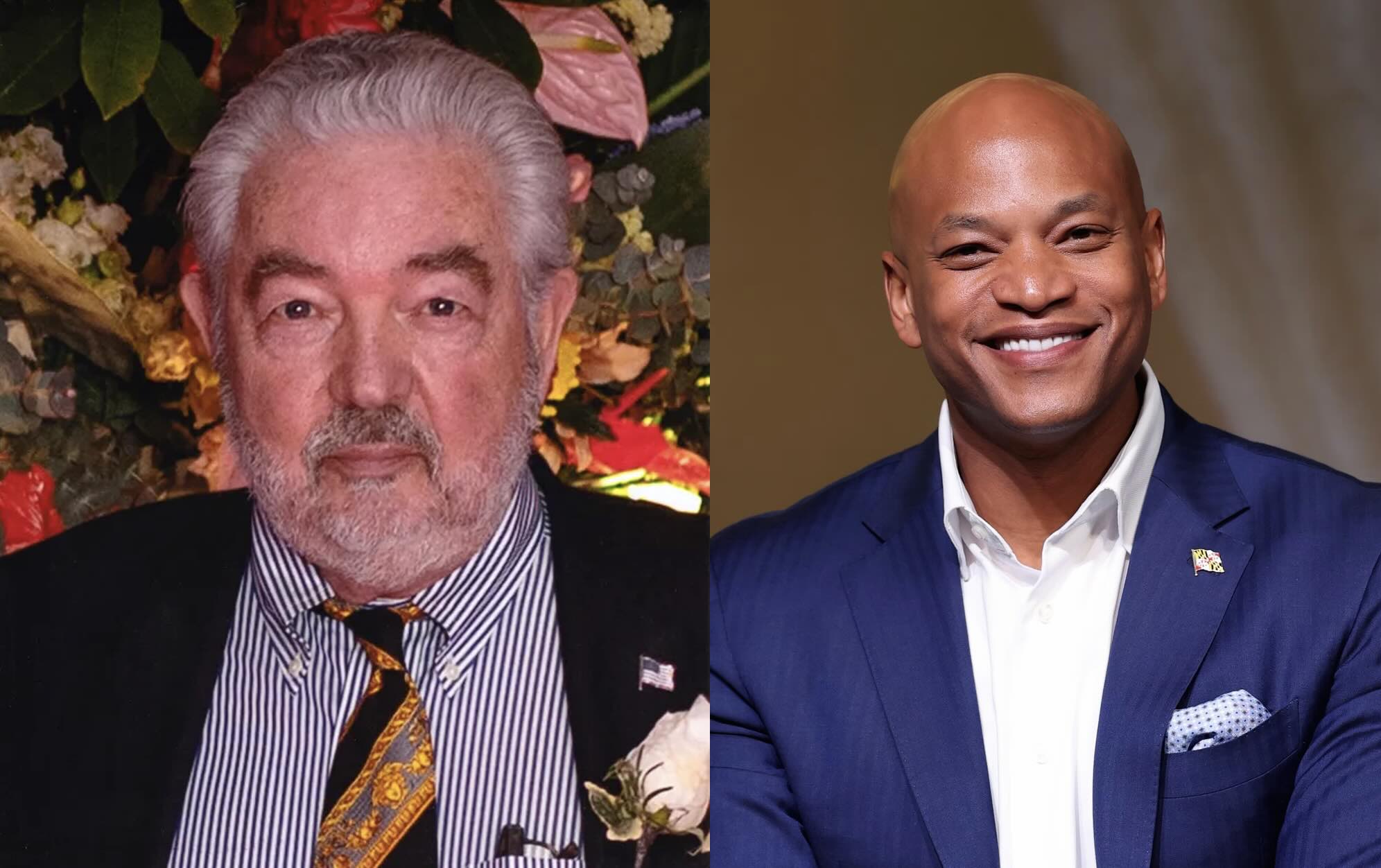
Majority owner of The Baltimore Sun David D. Smith (left) and Governor Wes Moore (right) | Photo: Emerald Book Image
On a November morning in 2026, Maryland Governor Wes Moore woke up to headlines demanding his resignation. The offense? A Bronze Star application filed twenty years earlier, a memoir timeline that didn't quite add up, and the phrase "led soldiers in combat" used to describe a deployment where he served as an information operations officer on a forward operating base under rocket attack.
The controversy, which has dominated Maryland's political discourse for weeks, is not a story about a politician's exaggerations. It is a story about infrastructure—the deliberate, coordinated machinery of a conservative media ecosystem that has spent nearly two years preparing to take down a rising Black Democratic star before he can mount a national campaign.
At the center of this machinery is David D. Smith, the white executive chairman of Sinclair Broadcast Group and, since January 2024, the majority owner of The Baltimore Sun. Smith's acquisition of Maryland's largest daily newspaper was not a philanthropic gesture. It was a strategic move to consolidate print and broadcast power under a single ideological umbrella—and to turn that combined force on the state's Democratic leadership.
The Architecture of a Smear
In October 2024, Sinclair announced the launch of Spotlight on Maryland, a joint investigative unit combining the resources of WBFF (FOX45 News) in Baltimore, WJLA (7News) in Washington, D.C., and The Baltimore Sun. The unit was marketed as a nonpartisan effort to hold powerful officials accountable. In practice, it became a specialized weapon aimed almost exclusively at Black Democratic officials in Baltimore and Annapolis.
Over the following two years, Spotlight on Maryland produced a steady stream of investigative pieces targeting Governor Moore, Baltimore Mayor Brandon Scott, and local nonprofits. Meanwhile, the same outlets—under Smith's ownership—ran virtually no sustained investigations into President Donald Trump's felony convictions, his business dealings, or the ethical scandals plaguing white Republican officials across the country.
- The Baltimore Sun, under Smith's ownership, has not published a single original investigative series on Trump's 34 felony convictions or his civil liability for sexual abuse.
- Spotlight on Maryland has dedicated more resources to investigating Moore's 20-year-old military paperwork than to any Republican scandal in the state.
- Sinclair Broadcast Group owns or operates nearly 200 local television stations, many of which syndicated Spotlight's reporting on Moore nationwide.
The November 2026 escalation—the coordinated rollout of stories questioning Moore's Bronze Star, his combat descriptions, and a memoir timeline discrepancy—followed a familiar pattern. Local reporting from Smith's outlets was picked up by Fox News Digital, amplified across Sinclair's national station network, and then fed back to local audiences as evidence of a "growing national scandal." Republican members of Congress, including Wisconsin Rep. Derrick Van Orden, joined the call for Moore's resignation. The loop was complete.
The Double Standard, Laid Bare
The disparity in treatment is not subtle. It is structural.
Consider the record. Richard Blumenthal, a white Democratic senator from Connecticut, repeatedly claimed he served "in Vietnam" when he had actually served stateside in the Marine Corps Reserve. He apologized, won his race, and remains in the Senate. Mark Kirk, a white Republican senator from Illinois, falsely claimed to have won the Navy's Intelligence Officer of the Year award and misstated his combat experience. He won election to the Senate in 2010. George Santos, a white Republican congressman, fabricated nearly his entire biography—including claims of being a Wall Street financier and a college volleyball star—and still won a congressional seat before being expelled. Donald Trump, a white Republican president, returned to office in 2024 despite 34 felony convictions and a civil liability finding for sexual abuse.
Wes Moore, by contrast, is a decorated Army captain who deployed to Afghanistan, received a Combat Action Badge for being under enemy fire, and was officially awarded a Bronze Star in 2024. His service is not in dispute. What is in dispute is whether he described it with perfect precision two decades ago—and whether a memoir timeline error constitutes a character flaw worthy of resignation.
The Baltimore Banner, a nonprofit newsroom founded by former Sun journalists, has directly challenged Spotlight's framing. In June 2026, the Banner published an extensive investigation defending Moore's military record, confirming he regularly traveled outside the wire in Afghanistan, and characterizing Sinclair's coverage as a partisan "swiftboating" effort. The Maryland Democratic Party seized on the Banner's reporting. But the damage was already done—the narrative had been seeded, and the national amplification machine was running.
Why Moore, Why Now
The timing is not accidental. Moore is widely viewed as a potential 2028 Democratic presidential contender—a charismatic Black leader with a compelling biography, a bestselling memoir, and a national profile. For a media empire built to advance conservative political power, that makes him a prime target.
Rather than debate Moore on policy—where his approval ratings in heavily Democratic Maryland remain strong—the strategy is to erode his credibility with moderate and independent voters nationwide before a potential campaign can begin. The weapon of choice is not policy criticism but character assassination: relentless questions about honesty, integrity, and whether he "deserves" his military honors.
Moore's own response has not helped. In November 2026, he publicly questioned the mental health of his former supervisor, retired Lt. Col. James Gottschling—a remark that drew a sharp rebuke and escalated the controversy from a debate over old paperwork into a current issue about how the governor treats veterans who criticize him. Critics seized on the comment as evidence of a defensive, thin-skinned leader. Supporters saw it as a human reaction to a coordinated attack.
The Bigger Picture
What is happening to Wes Moore is not an isolated incident. It is a template—one that has been applied to Black political leaders across the country and will be applied again. The template works like this: identify a rising Black Democrat with national potential, dedicate disproportionate investigative resources to any perceived flaw in their biography, amplify the findings through a network of aligned outlets, and then demand resignation or withdrawal from public life.
The facts of Moore's case—a delayed medal, an imprecise phrase, a memoir timeline error—are not nothing. But they are not scandals of resignation-worthy magnitude. They are the kinds of human errors that white politicians commit regularly and survive, often without a single headline.
The question is not whether Wes Moore is perfect. The question is whether the media ecosystem that is judging him is applying the same standard to everyone. The answer, when you look at the record, is clear.
David Smith's media empire is not in the business of objective accountability. It is in the business of power—and it has chosen its target.
No Ads. By Us. For Us.
This article was made possible by readers like you. We hope it inspired you to support Emerald Book, so we can continue producing content like this.
We will never show you ads, sell your data, or require a subscription to consume our content. Your gift helps us keep the truth accessible.
Click the Support button to give a gift of any amount today.
Thank you for making this work possible.