

Emerald Pages
◆

Photo: Reuters
There is no census box for the MAGA movement, but the polling arithmetic is not in dispute. When UMass Amherst asked American adults in August 2026 whether they identified with the movement "very much" or "somewhat," 30 percent said yes—roughly 78 million people. Black American adults, by comparison, number between 38 and 40 million. Even the narrower measure—the 17 percent who told The Economist/YouGov in November 2026 that they were MAGA supporters—yields about 44 million adults, still more than the entire Black adult population of the United States. By the broadest defensible measure, the coalition that has reshaped American politics outnumbers Black adults roughly two to one.
That is not a rhetorical flourish. It is the demographic fact that makes the rest of this story possible. A coalition of that size can elect governments, pass budgets, confirm judges, and dismantle agencies. And over the past two years, the coalition has done exactly that—ending federal diversity mandates, banning race-conscious admissions, gutting fair housing enforcement, and shrinking the federal workforce that had served as one of the most reliable ladders into the Black middle class. The results are now written into Federal Reserve data, into university enrollment figures, and into the unemployment rate. They are not ambiguous.
The Survey of Consumer Finances, released in October 2026, found that median Black household net worth fell 25 percent between 2022 and 2025, from $49,100 to $36,800 in inflation-adjusted dollars. Black households were the only racial or ethnic group whose median wealth declined. White households gained 6.5 percent over the same period, to $332,100. Asian households gained 15.5 percent. Hispanic households gained 18.1 percent. One in five Black households reported a net worth of $120 or less. The median white household now holds nine times the wealth of the median Black household—and the average (mean) gap exceeds $1 million.
The Only Group Decline
No image better illustrates how racism harms Black people than the divergence of median household wealth between 2022 and 2025. Every other racial and ethnic group moved forward. Black households moved backward—alone, and by a quarter of their median net worth.
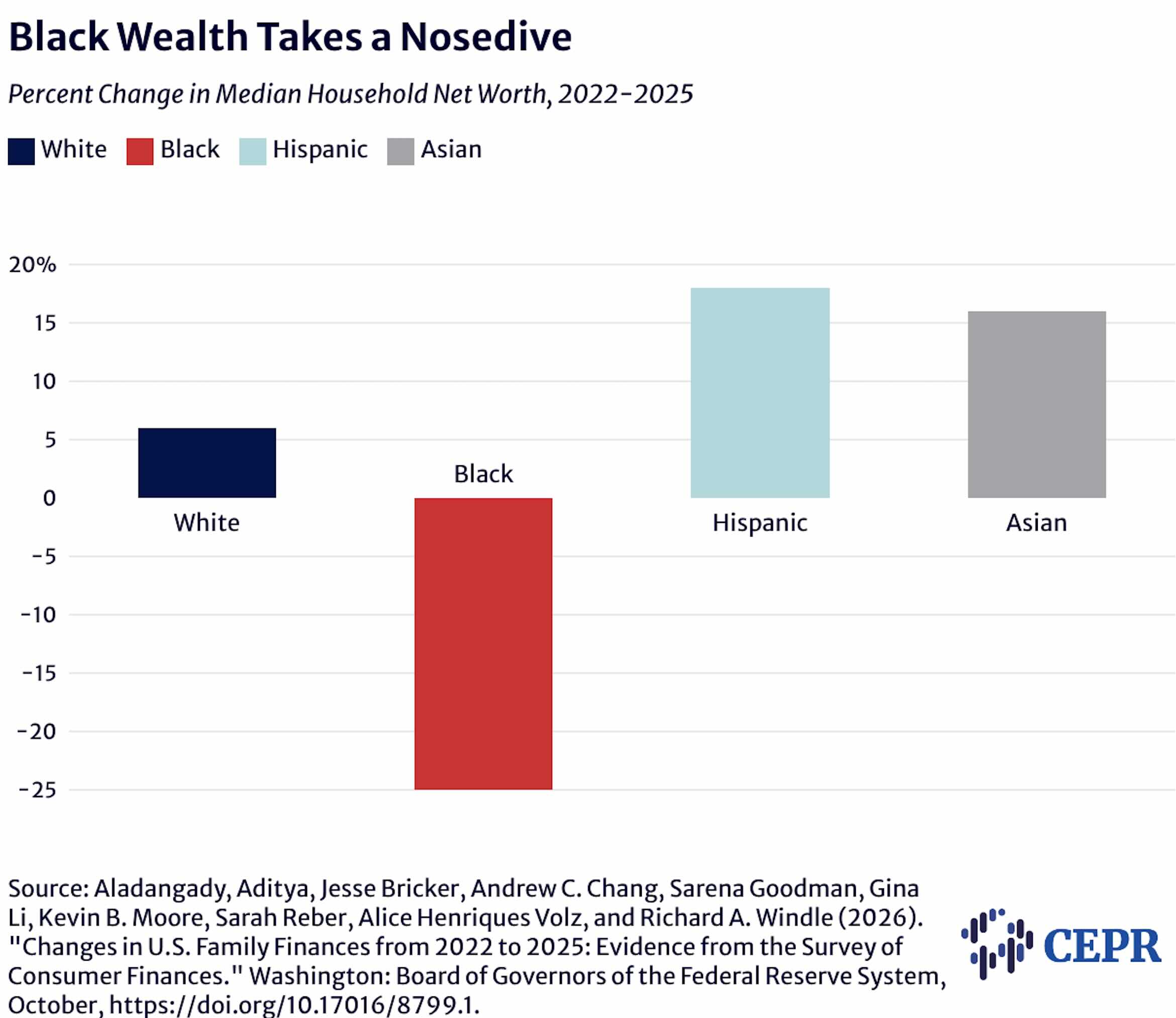
Source: "Black Wealth Takes a Nosedive" | CEPR
The visual is blunt, and that is the point. The same 2025 economy that delivered gains to Asian, white, and Hispanic households delivered a 25 percent loss to Black households. That is not a coincidence of individual behavior. It is the measurable footprint of a policy environment—and a wealth-building system—that was never designed to include Black families and is now being actively reset against them.
The Policies Behind the Collapse
The wealth decline did not happen in a vacuum. There were two overlapping forces: a macroeconomic environment in which Black families' primary asset—home equity—stagnated under high interest rates while white households' stock portfolios surged, and a policy environment that directly eroded Black employment and institutional access. Federal Reserve analysts note that the 2022–2025 wealth data largely predates the full effect of the 2025–2026 executive orders, meaning the worst is likely still ahead in future surveys.
Those executive orders—14151 and 14173—ended federal DEI programs and repealed equal-opportunity compliance requirements for federal contractors. Because Black workers make up 18.6 percent of the federal workforce but only 13 percent of the civilian labor force, the ensuing federal downsizing fell disproportionately on Black employees. The Institute for Women's Policy Research found a more than 30 percent drop in federal employment for Black women, compared with 11.6 percent for all women and 8.1 percent for men. By late 2026, Black unemployment had risen to 7 percent—nearly double the 3.6 percent rate for white workers.
- Higher education: First-year Black enrollment at the nation's 85 most selective universities fell 18 percent after the end of affirmative action. At Harvard, the Black share of the incoming class dropped from 18 percent in 2023 to 9.3 percent in 2026. Researchers at Georgetown and FutureEd documented a "cascading" effect pushing high-achieving Black students out of elite institutions and into less-selective schools with lower graduation rates and lower post-graduation earnings.
- Fair housing: The revocation of the Affirmatively Furthering Fair Housing rule eliminated federal requirements for localities to track and address residential segregation, leaving a roughly 28-percentage-point homeownership gap unaddressed.
- Voting representation: Following the Supreme Court's Callais decision weakening Voting Rights Act protections, states such as Louisiana reverted to maps that cut Black voters' ability to elect their preferred candidate from two districts to one.
- Corporate pipelines: A Rutgers CLiME report on the first year of federal anti-DEI policies documented widespread closures of campus cultural centers, targeted scholarships, and corporate internship pipelines that had connected Black students to high-paying entry-level roles.
A Ratio That Looks Like 1968
The current 9-to-1 median wealth ratio is not unprecedented. It is a return to form. Economists Ellora Derenoncourt, Chi Hyun Kim, Moritz Kuhn, and Moritz Schularick reconstructed 160 years of U.S. racial wealth data and found that the Civil Rights era—roughly 1960 to 1980—was the only period in modern history when the gap closed faster than baseline projections. Before the Fair Housing Act, the Black-white homeownership gap stood at 27.3 percentage points. In the 2020s, it stands at roughly 28 to 30 points. The gap is, by that measure, slightly worse now than when housing discrimination was explicitly legal.
The dollar chasm is wider than ever. In 1968, the inflation-adjusted median wealth gap between middle-class white and Black households was roughly $64,000. By 2025, it had expanded to $295,300. Black Americans today hold roughly five times more absolute wealth than their counterparts in 1968—but white wealth has grown so much faster that the relative position has snapped back to pre-Civil Rights levels. Economists describe the result as a paradox: absolute progress alongside relative regression.
The Education and Income Illusion
The most persistent counterargument—that Black Americans need only to educate themselves, work harder, and build families to close the gap—collapses under the weight of the empirical record. Education does not close the gap. Neither does income. Neither does homeownership, entrepreneurship, or any other individual-level variable that researchers have tested.
The Federal Reserve Bank of St. Louis and the Samuel DuBois Cook Center on Social Equity have documented the education paradox directly: a white household headed by someone without a high school diploma holds more median wealth than a Black household headed by someone with a college degree. Earning higher degrees raises Black income, but it does not close the wealth gap, because Black graduates carry significantly more student loan debt and inherit far less family wealth. Even among high-earning households in the top income brackets, Black families hold only a fraction of the net worth of white families at the same income level.
The discrimination is not confined to history. Resume audit studies—most famously Bertrand and Mullainathan's 2004 American Economic Review paper and the 2021 Kline, Rose, and Walters study covering more than 83,000 applications across Fortune 500 companies—consistently find that identical resumes with white-sounding names receive significantly more callbacks than those with Black-sounding names. Devah Pager's 2003 audit study found that white job applicants with a felony conviction received callbacks at a rate equal to or higher than Black applicants with no criminal record. Black entrepreneurs with identical credit scores and business plans are approved for bank loans at roughly half the rate of white entrepreneurs, and receive smaller loans at higher interest rates. Homes of comparable size and quality in similar neighborhoods are appraised for tens of thousands of dollars less when owned by Black families—a finding documented by Brookings and Freddie Mac that directly limits how much equity Black families can build even when they buy at the same rates.
As economists William Darity Jr. and Darrick Hamilton have argued, you cannot close an intergenerational wealth gap solely through individual hard work when the starting line and the asset returns are unequal. When white households start with nearly ten times the median net worth—and those assets compound through stock market gains, real estate appreciation, and tax-advantaged inheritance—the gap widens automatically unless structural interventions directly address asset ownership and institutional discrimination.
Racism Has Active Support and Passive Indifference
The two-to-one arithmetic matters because it explains how a policy program this harmful can be sustained. Sociologists who study race in America point to two overlapping dynamics. The first is active support: a segment of the coalition holds explicit racial prejudice and votes accordingly. The second is passive indifference: a much larger share of the coalition supports policies that maintain structural inequality out of economic self-interest, ideological commitment to "colorblindness," or simple indifference to how those policies affect Black communities. The system does not require overt hatred to keep producing racist outcomes. It requires only that the majority maintain the status quo and dismantle the remedies.
That is what 78 million adults—twice the size of the population most directly harmed—can do. They can end affirmative action and watch Black enrollment at elite universities fall by half. They can dismantle DEI and watch Black federal employment drop by a third. They can revoke fair housing enforcement and watch the homeownership gap return to its pre-1968 level. They can do all of it while insisting that none of it is about race, because the legal standard they helped install says that intent is the only thing that counts.
Racism has always been structural. The policies are producing structural harm. The coalition producing them outnumbers the harmed population two to one. Historians note that every period of sharp backlash and widening inequality in American history—from the end of Reconstruction to the resistance following the Civil Rights Act—has been met with sustained legal, political, and grassroots counter-mobilization. Whether that pattern repeats is not a matter of arithmetic. It is a matter of politics. But the arithmetic is what the politics has to overcome.
No Ads. By Us. For Us.
This article was made possible by readers like you. We hope it inspired you to support Emerald Book, so we can continue producing content like this.
We will never show you ads, sell your data, or require a subscription to consume our content. Your gift helps us keep the truth accessible.
Click the Support button to give a gift of any amount today.
Thank you for making this work possible.