

Emerald Pages
◆
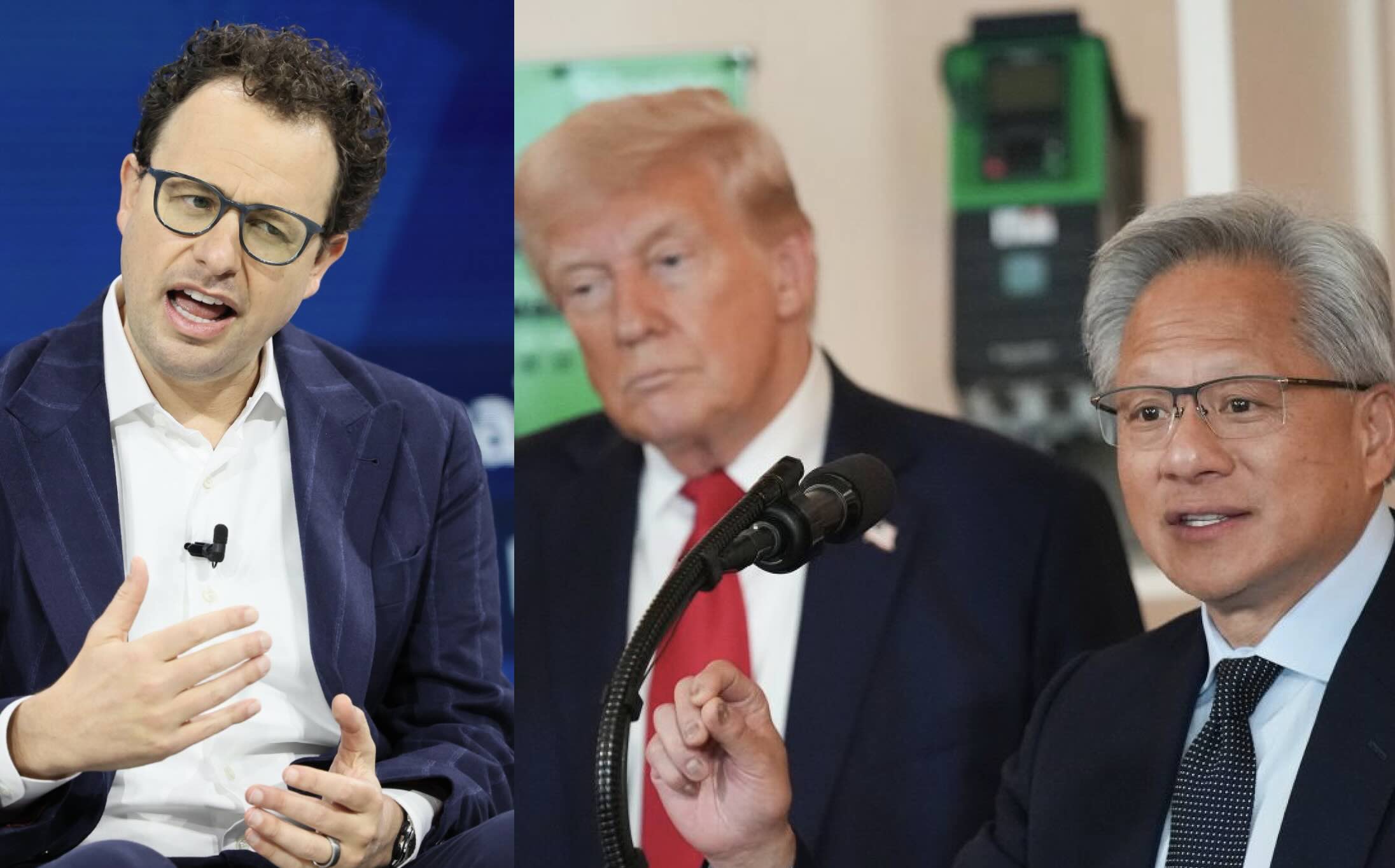
Photo: Emerald Book Image
The phones rang in Washington over the weekend, and by Monday morning, Jensen Huang was back at the helm of Nvidia. For roughly twenty-four hours, it looked like the most successful presidential intervention in modern corporate history — a $1.2 trillion wipeout reversed by a single weekend of lobbying, a board vote, and a press release acknowledging "input from senior levels of the United States government."
Then Tuesday happened. Nvidia gave back roughly 8% of its 31.5% Monday surge. Anthropic — the first pure-play frontier AI lab to trade publicly — crashed through its $83 IPO price and bottomed at $75.61 intraday, roughly a third below its November 19 debut peak of $115.10. AMD fell 10%. Micron fell 10%. CoreWeave fell 11.5%. The relief rally didn't just stall; it inverted the narrative. The market's message was blunt: you can reinstate a CEO, but you cannot reinstate confidence.
What the Weekend Deal Actually Accomplished
To understand why the bounce failed, it helps to be precise about what Trump actually accomplished. According to reporting from The Wall Street Journal and CNBC, the Nvidia board had removed Huang over fears of federal investigations tied to his affair with a suspected Chinese intelligence asset. The board's legal obstacle vanished when Trump and Attorney General Todd Blanche assured directors on Sunday that Huang was not under DOJ investigation and posed no national security threat. Nvidia's press release confirmed the board acted after receiving "input from senior levels of the United States government."
What the White House provided was legal cover and political capital. What it did not provide — and could not provide — was an answer to the questions actually driving the sell-off: whether the roughly $900 billion in AI infrastructure commitments sitting on Anthropic's books can ever generate commensurate profit; whether Nvidia's circular financing arrangements with its own customers represent genuine demand or an elaborate vendor-financing bubble; and whether the Federal Reserve can contain inflation near 4% while AI-driven capital spending keeps borrowing costs elevated.
Those are balance-sheet questions, not personnel questions. And no phone call from the Oval Office changes a discounted cash flow model.
Anthropic's Fall Below $76 Is the Real Story
If Nvidia's Tuesday pullback was a caution, Anthropic's collapse was a verdict. The company went public on November 19 at $83, opened at $111.50, peaked at $115.10, and by Tuesday morning had fallen to $75.61 — wiping out nearly $500 billion in market capitalization from its opening-day peak and pushing the stock roughly 9% below its offer price.
The reasons are structural, and they were visible in the prospectus before the first trade printed. Anthropic's IPO filings disclosed roughly $900 billion in long-term computing and infrastructure commitments, with $70 billion due within the next twelve months. The company raised roughly $79 billion to $81 billion in the listing — meaning the largest IPO in history covers only about 1.1 years of its near-term compute bills. Rating agencies are reportedly weighing a high-yield, or "junk," rating on the company's debt, which would make future borrowing expensive precisely when the company needs it most.
Then there's the supply problem. Unlike a traditional IPO with a six-month lock-up, Anthropic's structure allowed roughly 315 million insider shares — about a third of the IPO volume — to become eligible for sale almost immediately. CEO Dario Amodei and President Daniela Amodei each sold more than 3.37 million shares, worth over $280 million apiece, one day after the IPO. When insiders sell that fast, retail investors draw obvious conclusions.
- $900 billion in long-term computing commitments disclosed in Anthropic's IPO filings
- ~1.1 years of near-term compute bills covered by the record $79–81 billion raised
- 315 million insider shares unlocked almost immediately — roughly a third of IPO volume
- $75.61 intraday low on Nov. 24 — about 9% below the $83 IPO price
Add to that the loss of underwriter price support — Morgan Stanley exercised its full greenshoe overallotment, removing the stabilization mechanism banks normally use to defend a newly listed stock — and Anthropic was left to absorb the market's AI anxiety with no cushion at all.
Trump's Shady Deal
The ethical questions surrounding Trump's intervention are not peripheral to the market story — they are the market story. When a president personally lobbies a public company's board, assures it that federal investigators have cleared an executive, and then watches his own disclosed Nvidia holdings gain up to $15 million in value on the resulting surge, the market learns something dangerous: the rules are negotiable for the right companies.
That lesson cuts both ways. It encouraged a one-day rally, because traders priced in the possibility that Washington will backstop major AI stocks during sell-offs. But it also deepened the "too big to fail" moral hazard economists have warned about — the sense that risk-taking at the top of the AI food chain will be socialized while the downside lands on ordinary shareholders. Business Insider reported exactly this concern: that Trump's intervention signaled to Wall Street that the government will step in to rescue the AI sector from losses.
And it left the underlying investigations untouched. Trump's informal assurances did not stop the SEC accounting probe, California Attorney General Rob Bonta's subpoena-backed state investigation, or the Commerce Department's crackdown on chip smuggling through Southeast Asia. Huang still faces the Senate Banking Committee on December 3. The board's U-turn raised fresh governance doubts among analysts at Raymond James, who noted the chaos exposed unresolved tensions between national security hawks and business-friendly factions in Washington.
Why the AI Trade Is Bigger Than Any One CEO
The deepest problem with the intervention is that it mistook a leadership crisis for the actual crisis. Nvidia's stock fell because investors were already nervous about AI valuations before Huang resigned — the company had lost over $1 trillion in market value during his eleven-day absence, but the broader AI complex was wobbling on its own fundamentals. Apollo Global Management has estimated AI-related spending accounted for roughly 65% of U.S. GDP growth in 2026, while studies show little evidence of productivity gains outside major tech firms. Goldman Sachs found the ten largest AI stocks accounted for about half of the S&P 500's gains this year — concentration that makes the index hostage to a single sector's mood.
Anthropic's crash is what happens when that mood turns. As the market's only pure-play frontier AI stock, it absorbs the brunt of investor skepticism about whether massive data center spending will ever generate enough profit to justify the cost — especially with free and low-cost open-weight models from DeepSeek, Mistral, and Moonshot AI pressuring margins. Ironically, Huang's return is viewed by some analysts as a headwind for Anthropic, because Huang strongly champions the open-source ecosystems that compete with proprietary models like Claude.
Companies issued $500 billion in AI-related debt in 2026 alone, according to Oxford Economics, while New York Fed President John Williams has warned that surging AI demand is keeping inflation near 4%. If AI profits fail to materialize, unwinding that debt while interest rates remain elevated could severely damage the broader economy. Economist Paul Krugman and former SEC Chair Gary Gensler have argued on CNN that delaying a natural market correction allows debt and overinvestment to build, risking a far more painful crash similar to the 2000 dot-com bust.
Harvard Business Review has noted that because AI firms are tightly interconnected as each other's suppliers, customers, and lenders, a collapse in confidence at one node threatens to freeze credit across the entire sector. That is precisely what Tuesday's trading reflected: not a reaction to Huang's status, but a repricing of the whole ecosystem's risk.
What Comes Next
The calendar is not forgiving. MSCI is scheduled to add Anthropic to its global indexes after the November 30 close, and fast-track inclusion into the Nasdaq-100 could occur as early as December 21 — both of which will force passive index funds to buy shares, providing a mechanical floor that has nothing to do with confidence. Huang testifies before the Senate Banking Committee on December 3, where he will face questions from lawmakers in both parties about the affair, the Megaspeed blacklisting, and the circumstances of his return. California's investigation continues. The SEC accounting probe continues.
Meanwhile, the gap between analyst optimism and market reality is itself a signal — one that suggests the smart money sees value and the trading money sees danger, and neither is willing to blink.
The lesson of this week is uncomfortable for everyone involved. For the White House, it is that political capital cannot substitute for earnings. For Nvidia's board, it is that independence surrendered once is hard to reclaim. For Anthropic's insiders, it is that selling $560 million in stock on day two tells the market everything it needs to know about your confidence in day three hundred. And for investors, it is the oldest lesson of all: when the government starts picking winners in the market, the market starts pricing in the government — and that is a risk premium no one knows how to model.
Trump made a deal. The market didn't sign it.
No Ads. By Us. For Us.
This article was made possible by readers like you. We hope it inspired you to support Emerald Book, so we can continue producing content like this.
We will never show you ads, sell your data, or require a subscription to consume our content. Your gift helps us keep the truth accessible.
Click the Support button to give a gift of any amount today.
Thank you for making this work possible.