

Emerald Pages
◆
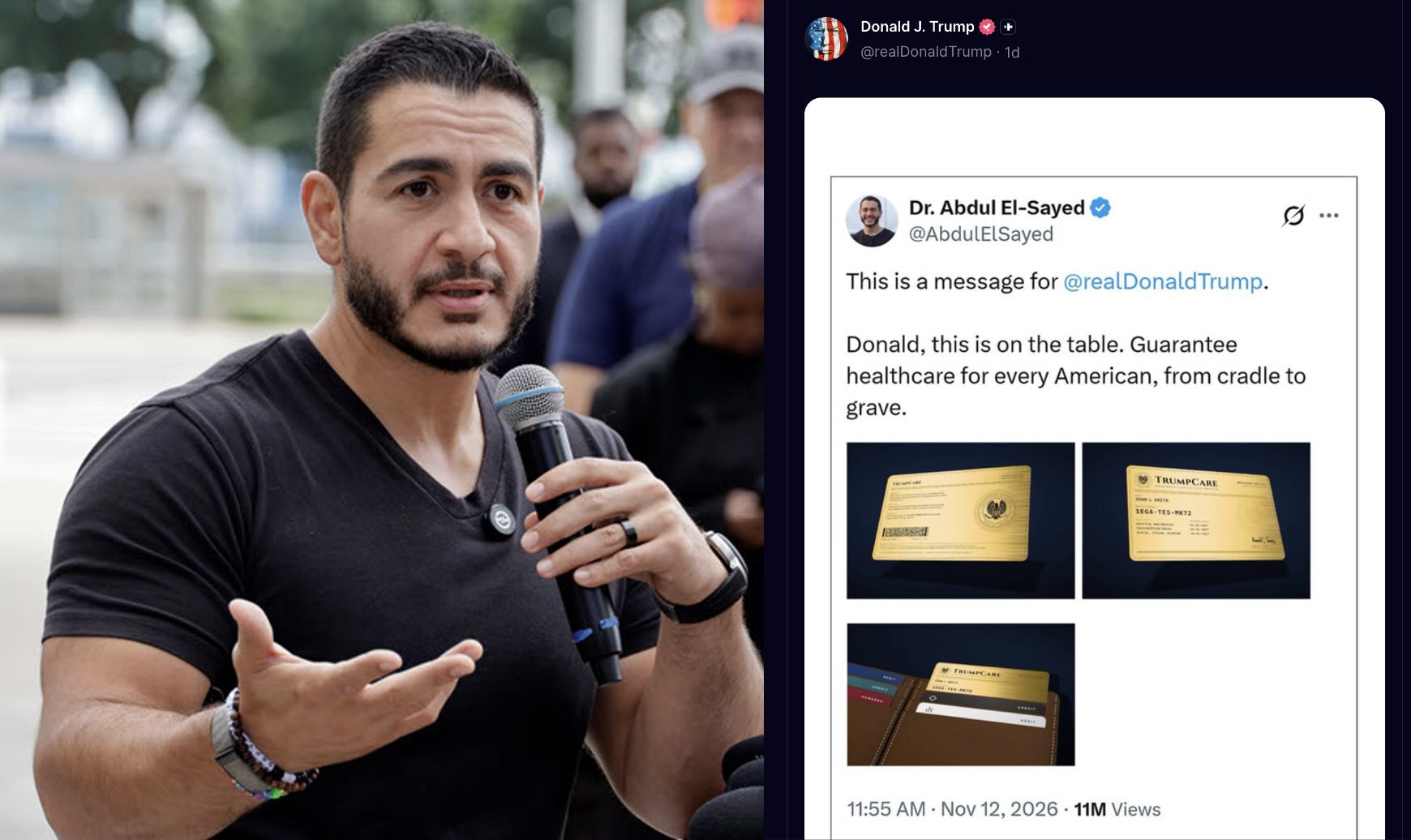
Senator-elect Abdul El-Sayed and Trump's Repost | Photo: Emerald Book Image
In the high-stakes ecosystem of Washington politics, there is a fine line between "dealmaking" and "political theater." When incoming Senator-elect Abdul El-Sayed shared a digital mock-up of a gold-branded "TrumpCare" card—complete with the Trump's name and signature—it appeared to the casual observer as a masterstroke of populist pragmatism. By tapping into Trump’s well-documented affinity for personal branding and legacy, El-Sayed sought to unlock the door to universal healthcare. Trump's subsequent reposting of the image on Truth Social sent shockwaves through the Capitol, leading many to wonder: Is the era of the single-payer revolution finally arriving via a bipartisan handshake?
The short answer is a resounding no. While the "TrumpCare" moment was a masterclass in social media engagement, it was a failure of political calculus. By attempting to use flattery as a legislative tool, El-Sayed has not only misread Trump’s fundamental negotiation style, but he has also placed himself in a political vice between a White House prepared for war and a Democratic leadership that has no intention of following his lead.
Why Ego is Not Leverage
The most glaring error in the El-Sayed play is the assumption that personal validation translates to policy concessions. El-Sayed’s strategy was built on the hope that a "gold card" would act as a psychological bridge. However, Trump's recent interactions suggest that he does not view praise as a reason to compromise; he views it as a sign of weakness.
In the zero-sum world of Trump's transactional diplomacy, flattery often functions as an invitation to extract more. Throughout his career—from his dealings with North Korean leadership to his interactions with domestic rivals—Trump has shown that while he may enjoy the spotlight of a "cordial" meeting, he only signs major legislation when his hand is forced by institutional or economic reality. When counterparts offer symbolic trophies or public praise, Trump often takes the media moment for himself while privately doubling down on his core demands.
By presenting the "TrumpCare" card without a written endorsement or a formal policy framework, Trump has effectively used the imagery to bolster his own brand as a "populist dealmaker" without committing to a single line of the actual legislation. He has captured the media cycle at zero policy cost, leaving the progressive wing of the Democratic Party to hold the bag.
The Veto Strategy
While the "TrumpCare" debate dominates social media, the actual mechanics of power in 2027 are being defined by a much darker reality: the presidential veto. Trump has been remarkably transparent about his plan for the incoming Democratic-majority Congress. Rather than seeking a "grand bargain," Trump has signaled a strategy of serial vetoes designed to exhaust the opposition.
Trump’s own words provide a chilling roadmap for the upcoming session. Having already been seen wearing a "VETO" hat in recent photographs, Trump has stated he is willing to block Democratic legislation for "two years and one month" if necessary. His goal is a three-step process of attrition:
- Step 1: The Standoff. Let Democrats pass partisan bills on healthcare and immigration, then repeatedly reject them to create a narrative of legislative failure.
- Step 2: The Breaking Point. Wait for the moment when Democratic leaders realize they cannot fulfill campaign promises without his signature.
- Step 3: The Dictated Deal. Force Democrats to the table on his terms, saying, "I'm going to veto unless you want to do this and this and this."
In this environment, El-Sayed’s gold card is essentially a paper shield. If Trump refuses to sign a single-payer bill, he can point to the repost as proof that he was "open to big ideas," effectively using progressive's own branding to deflect blame for the lack of progress.
A House Divided
Even if Trump were inclined to move, El-Sayed is attempting to lead a charge that his own party has already declined to take. The "TrumpCare" pitch assumes a unified Democratic front, but the reality in the halls of Congress is one of deep, strategic division.
Democratic leadership—specifically House Minority Leader Hakeem Jeffries and Senate Majority Leader Chuck Schumer—has made it clear that Medicare for All is not on the 2027 legislative roadmap. Instead, the party is coalescing around more incremental, politically "safer" proposals.
The actual center of gravity for healthcare policy in the coming year will not be found in "TrumpCare" branding. The fight will be over the survival of the existing system. According to The Hill and POLITICO, the Democratic priority is defensive rather than revolutionary.
- Restoration of Subsidies: The primary goal is addressing the expiration of Affordable Care Act (ACA) premium subsidies, which has left millions facing steep increases.
- The "Medicare for More" Approach: Leadership is focused on expanding existing benefits—such as lowering the eligibility age or adding dental and vision—rather than replacing private insurance with a single-payer system.
- Reversing Cuts: A major priority remains reversing the $800 billion in Medicaid cuts enacted under recent legislation.
This internal friction makes El-Sayed's strategy even more precarious. By positioning himself as the "dealmaker" who can work with Trump, he risks alienating the centrist wing of his own party, who view the single-payer push as a political liability ahead of the 2028 presidential election.
The Historical Lesson: Leverage vs. Flattery
To understand why this will fail, one must look at the history of Trump’s successful negotiations. Trump does not move for a brand; he moves when he is cornered.
The 2017 debt ceiling deal was not the result of bipartisan friendship, but of an urgent need to avoid a default crisis. The USMCA trade deal was not a result of charm, but of intense pressure from business groups and the necessity of replacing NAFTA. Even his handling of the 2018-2019 government shutdown showed a leader who would rather endure a historic stalemate than yield to anything short of a total surrender.
In contrast, the attempts to "charm" Trump during the 2017 DACA negotiations ended in failure. Democratic leaders offered cordiality and even discussed policy frameworks at White House dinners, but once the political winds shifted and conservative advisors pushed back, Trump abandoned the framework. This is the pattern El-Sayed is ignoring: Trump accepts the meeting, but he rarely accepts the terms.
The Trap is Sprung
Ultimately, the "TrumpCare" card is a strategic trap that has already sprung. By offering Trump a "win" in the form of a branding opportunity, Senator-elect El-Sayed has provided the administration with a perfect political shield.
When the inevitable legislative stalemates occur in 2027, the White House will have a prepared response: they will point to the gold card as evidence of their "openness" and blame the Democrats for failing to bridge the gap. For a progressive movement seeking fundamental change, the reliance on flattery has only served to provide the opposition with more cover. In the game of high-stakes Washington politics, El-Sayed may have won the headline, but he has almost certainly lost the leverage.
No Ads. By Us. For Us.
This article was made possible by readers like you. We hope it inspired you to support Emerald Book, so we can continue producing content like this.
We will never show you ads, sell your data, or require a subscription to consume our content. Your gift helps us keep the truth accessible.
Click the Support button to give a gift of any amount today.
Thank you for making this work possible.