

Emerald Pages
◆
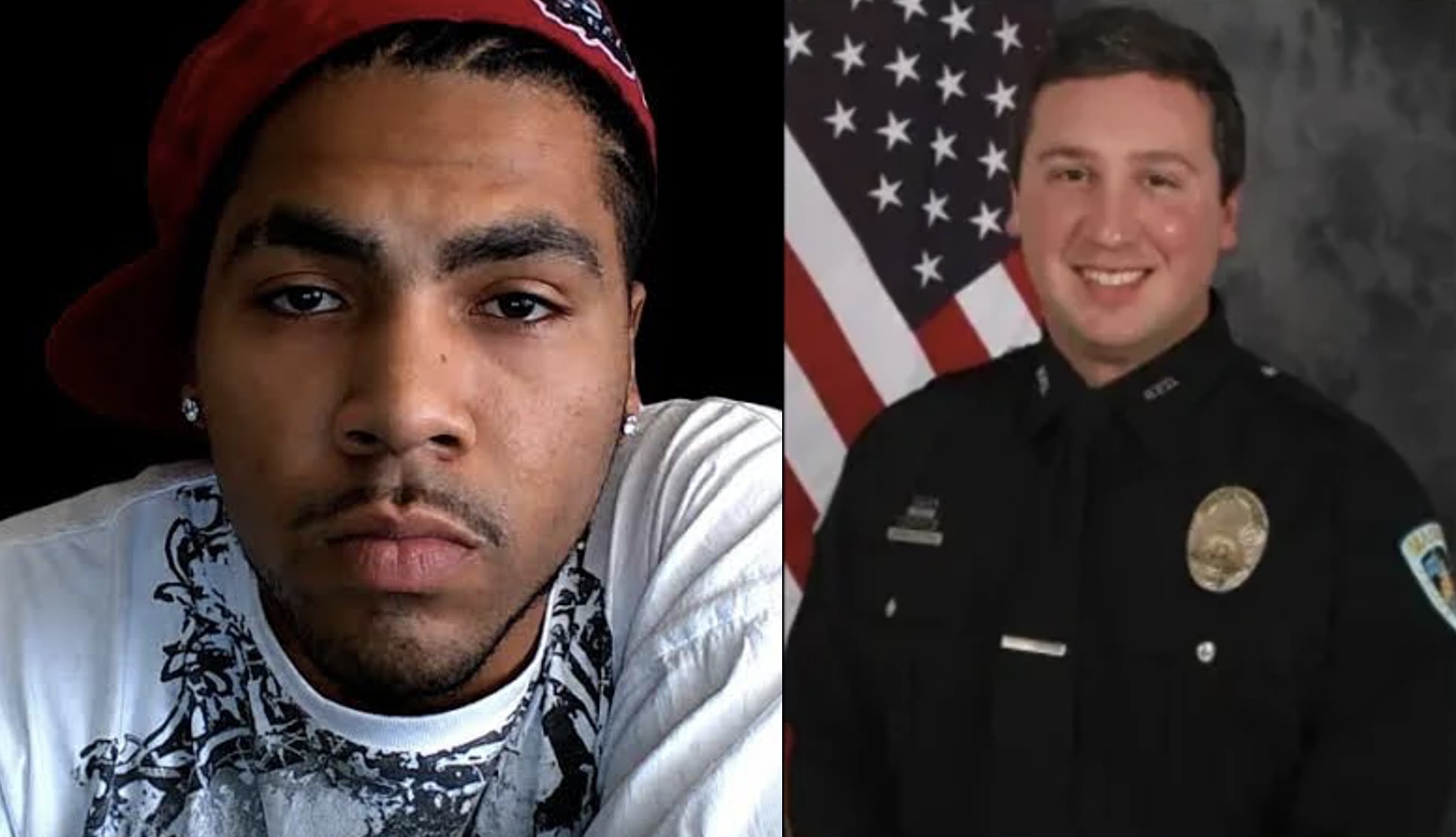
Corey Ruiz (left) and Officer Kiel Baitinger-Peterson (right) | Photo: Emerald Book Image
MADISON, Wis.—The video is not ambiguous. Slowed down, frame by frame, it shows Corey Ruiz—a 38-year-old unhoused Black man—being struck by a Taser, falling onto his right side on the pavement at the intersection of South Baldwin and Williamson Streets, and then, while he lies on the ground surrounded by four Madison police officers, Officer Kiel Baitinger-Peterson gets up off his knees, steps back, draws his firearm, and fires three shots downward at point-blank range. One of those rounds struck Ruiz in the head.
That sequence—captured on police dash-camera footage, surveillance video, and bystander cellphones—is at the center of the firestorm that erupted after Dane County District Attorney Ismael Ozanne announced on November 19, 2026, that no criminal charges would be filed against Baitinger-Peterson. To the Ruiz family, civil rights attorney Ben Crump, and thousands of protesters who have returned to the same intersection, the footage does not show a split-second self-defense decision. It shows an execution.
The encounter began with 911 calls about a man looking into parked cars, checking door handles, and allegedly attempting to steal bicycles on Madison's east side. No caller reported a weapon. No one reported violence. No one reported a theft in progress. Four officers responded, confronted Ruiz, and chased him on his bicycle when he fled. When they caught up to him in the middle of the intersection, a physical struggle ensued.
What the Video Shows
According to the investigative records and squad-car video released by the Wisconsin Department of Justice on November 19, the entire physical altercation—from the moment officers caught up to Ruiz's bicycle to the firing of the shots—lasted only a few seconds. During the struggle, Ruiz pulled out a folding pocketknife and injured Baitinger-Peterson's hands. Another officer deployed a Taser. The prongs hit Ruiz's left hand and left side, and the device was active for only about three seconds before its safety was switched off.
What happened next is where the official narrative and the video diverge. The District Attorney's report describes Baitinger-Peterson as physically tangled with Ruiz on the asphalt, holding onto his right arm, and firing because he feared Ruiz would stab him or another officer. But the footage, when slowed down, shows something different: Ruiz falling onto his right side, the officer rising from his knees, creating distance, and firing three downward shots while Ruiz was already on the ground.
Frame-by-Frame: The Final Seconds
The following four stills are taken from Associated Press video footage of the July 22, 2026, encounter at the South Baldwin and Williamson Streets intersection. Viewed in sequence, they show Officer Kiel Baitinger-Peterson on his knees during the struggle, then rising to his feet, then watching Corey Ruiz fall to the ground, and finally aiming his firearm downward at Ruiz—who is already on the pavement—in the moments before he fires three shots.
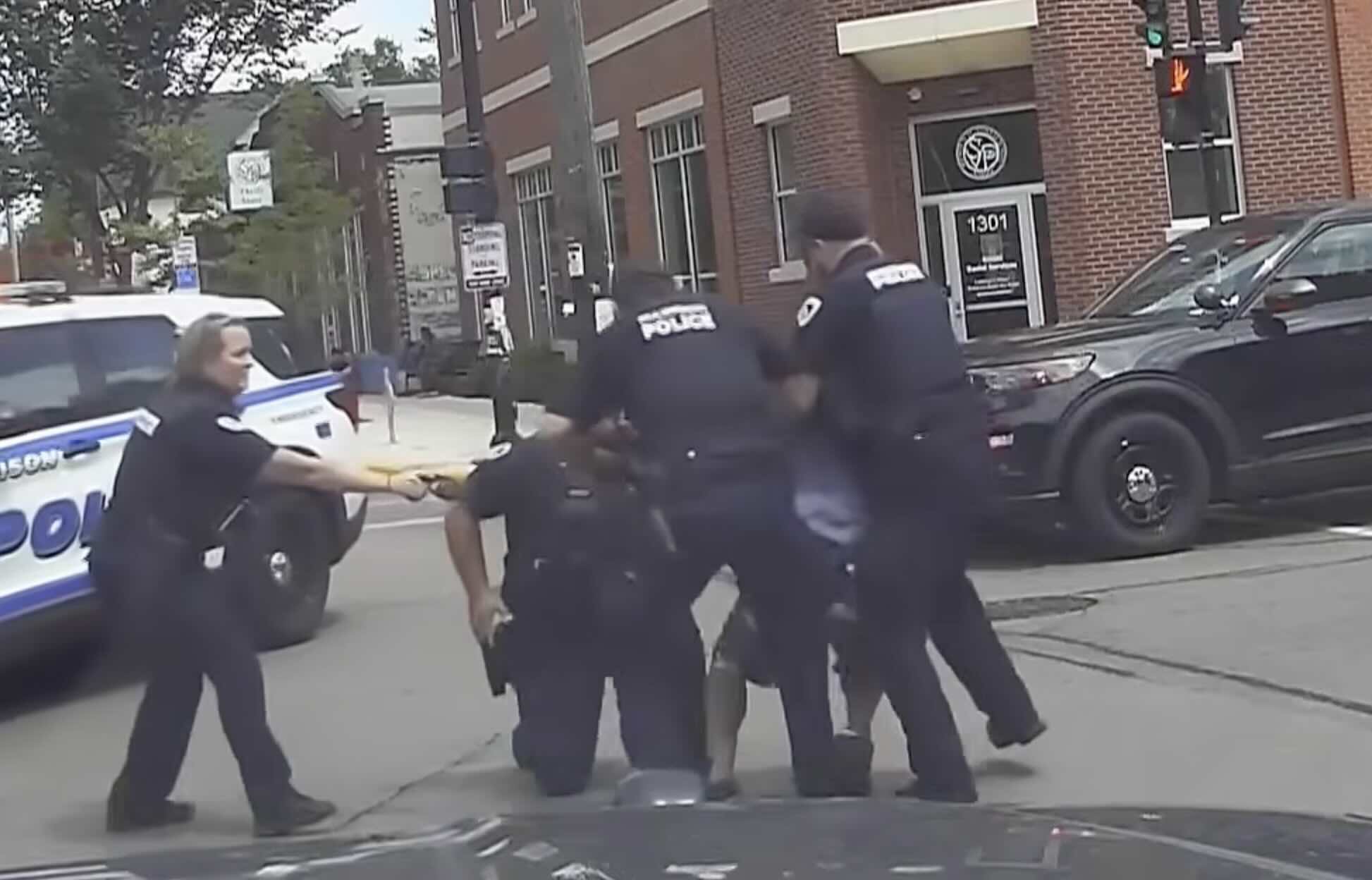
Officer Baitinger-Peterson is on his knees on the pavement, physically engaged with Ruiz during the struggle in the middle of the intersection.
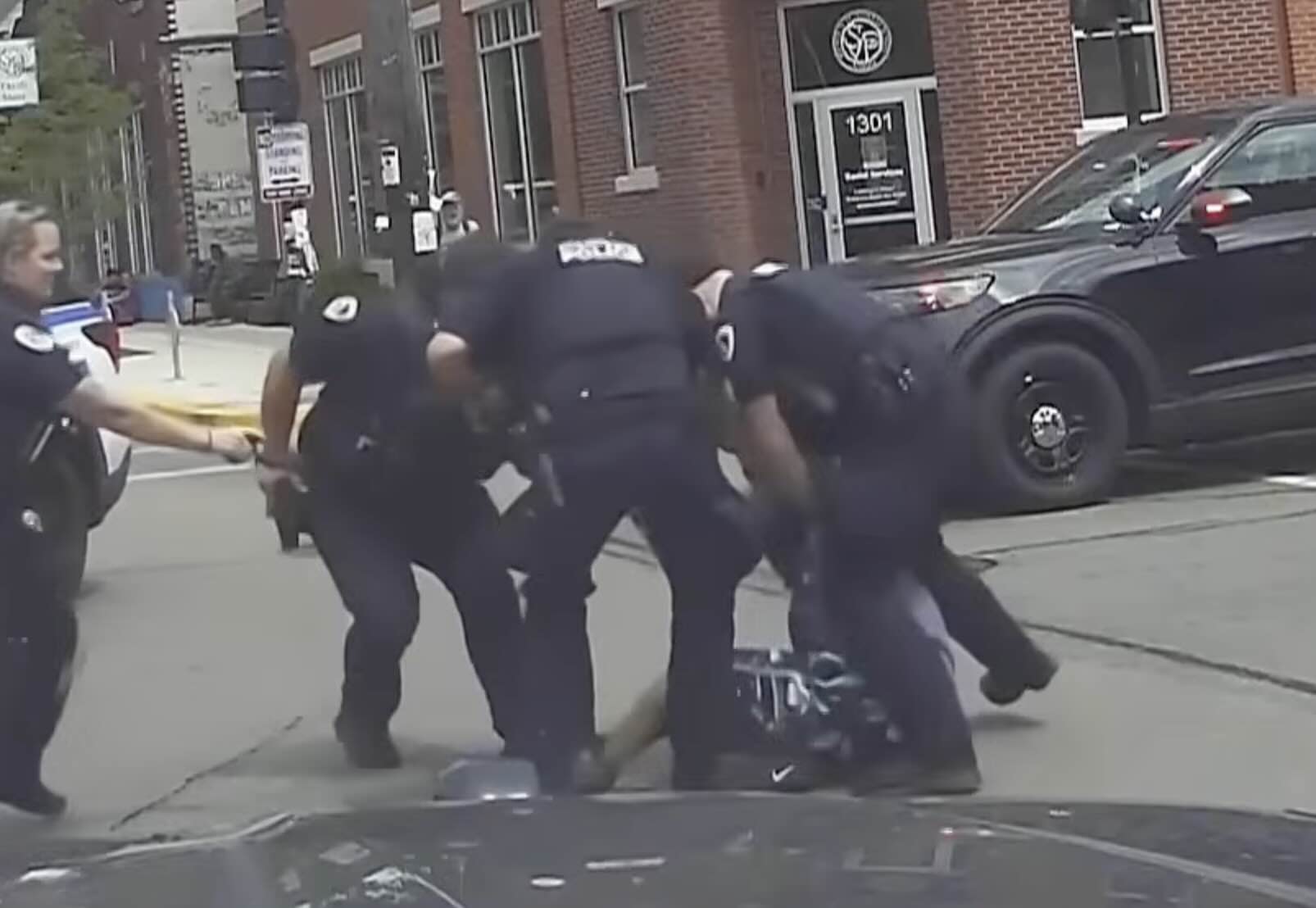
Baitinger-Peterson rises from his knees to a standing position, separating himself from the ground-level struggle as Ruiz goes down.
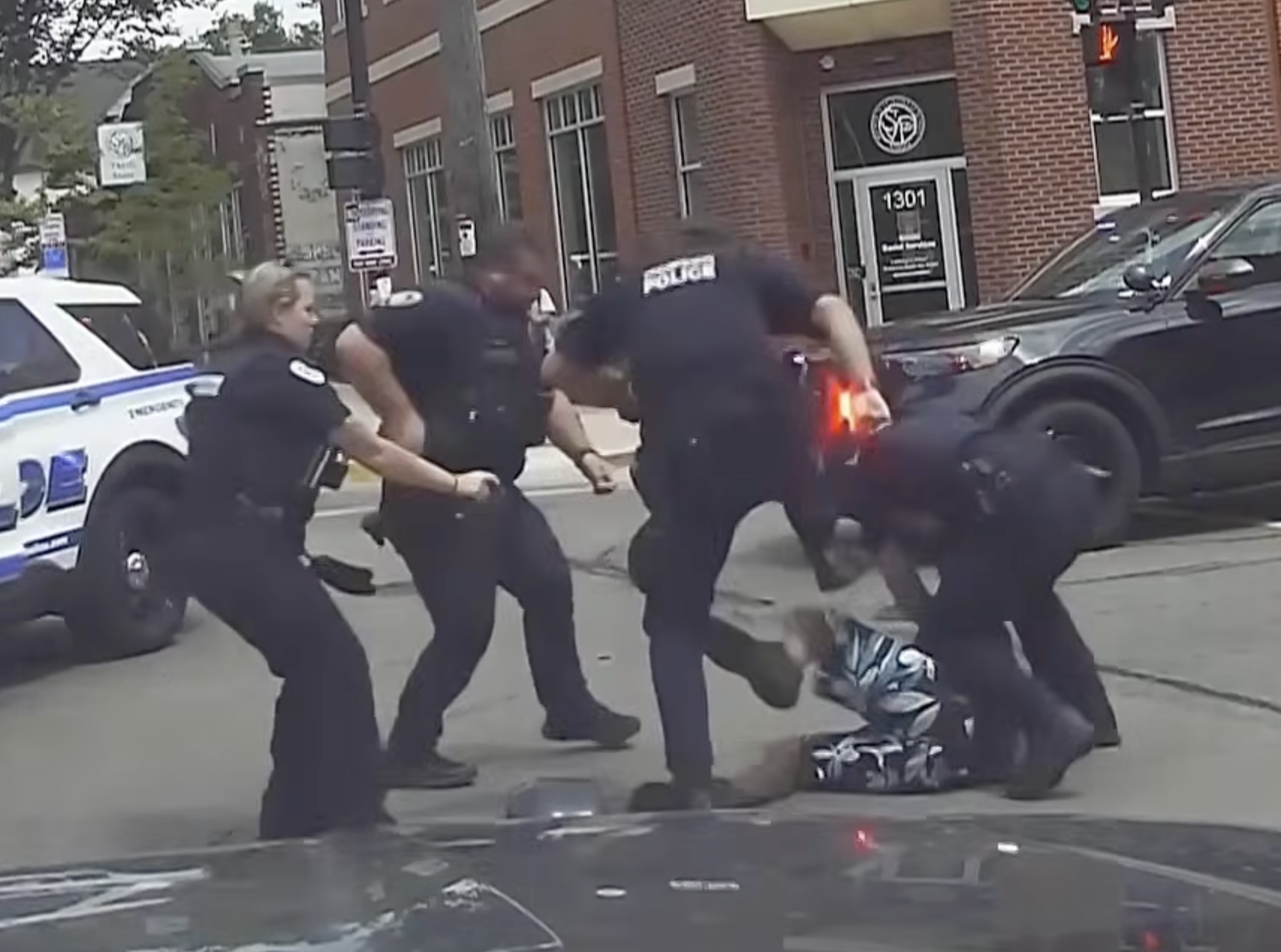
Baitinger-Peterson, now on his feet, watches as Ruiz—struck by the Taser—falls onto his right side on the pavement.
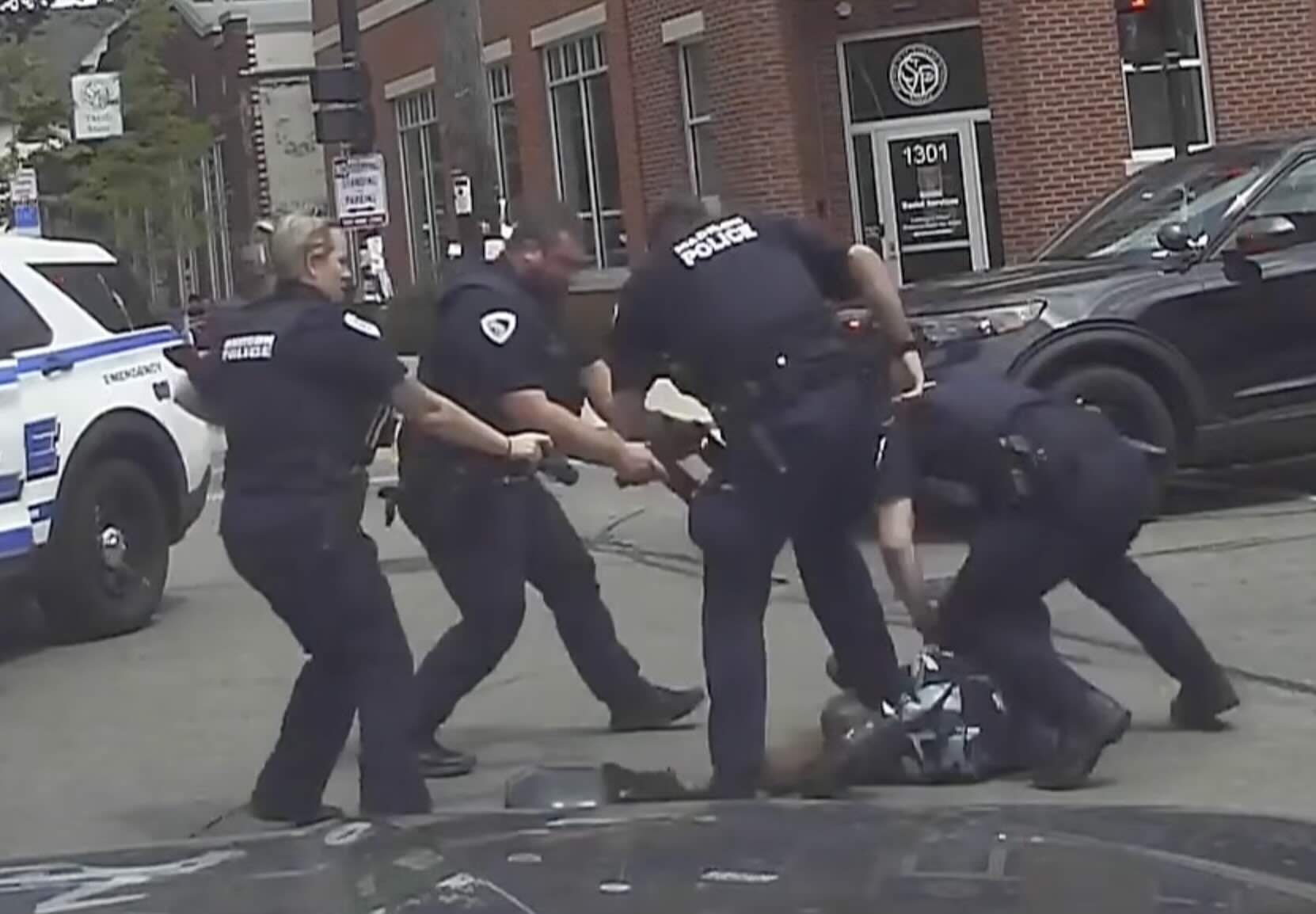
Baitinger-Peterson aims his firearm in a downward trajectory at Ruiz, who is already on the ground. Seconds later he fires three point-blank shots—two into Ruiz's torso and one into his head.
- No confirmed crime: Officers were responding to unverified reports of someone looking into cars. No victim was harmed, no property was confirmed stolen, and no weapon was reported before officers intercepted Ruiz.
- Four officers, one man: Four "trained" officers surrounded and physically grappled with Ruiz. They had the numbers and proximity to disarm or contain him without lethal force.
- The Taser and the fall: Video shows Ruiz stumbling and going down after the Taser deployment. Prosecutors claim the device did not achieve neuromuscular incapacitation; the visual sequence demonstrates it clearly did.
- The step back: Frame-by-frame analysis shows Baitinger-Peterson getting off his knees and stepping back before drawing his weapon—contradicting the claim that he was trapped underneath Ruiz.
- The third shot: The medical examiner found Ruiz was shot twice in the torso and once in the head. Crump called the final round a "kill shot" fired while Ruiz was already incapacitated on the ground.
The Prosecutor's Rationale
District Attorney Ozanne acknowledged the physical struggle shown on video but argued that having hands on a suspect is not the same as having control over a lethal weapon. Under Wisconsin self-defense law and the U.S. Supreme Court's Graham v. Connor standard, prosecutors do not evaluate whether deadly force was actually necessary in hindsight—they evaluate whether the officer reasonably believed he or another person was in imminent danger of death or great bodily harm at that exact split second.
Because Baitinger-Peterson had already sustained cuts to both hands and Ruiz still held the knife, Ozanne concluded that a criminal defense attorney could easily raise reasonable doubt about whether the officer genuinely feared being stabbed—even after stepping back. "I conclude it was reasonable for the officer to use deadly force when this person resisted officers, produced a knife and was not affected by multiple Taser deployments," Ozanne said at the November 19 press conference.
Madison Police Chief John Patterson acknowledged the uncertainty surrounding the Taser deployment, telling reporters, "I still don't know exactly what happened with the Taser." That uncertainty—combined with the fact that Madison police officers do not wear body cameras—means there is no close-up, first-person angle showing the exact grip officers had on Ruiz's right hand in those final milliseconds.
A Pattern of Disparity
The Ruiz shooting is not an isolated incident. It is the third time since 2012 that Madison police have shot and killed someone in the same near-east-side neighborhood. The most prominent prior case was the 2015 fatal shooting of Tony Robinson, a 19-year-old unarmed Black man killed by a Madison officer just blocks away—a case in which District Attorney Ismael Ozanne also declined to file charges.
Civil rights advocates and local activists have repeatedly contrasted fatal encounters involving Black residents with routine police reports in Dane County where white men armed with knives, machetes, or firearms—sometimes during mental health crises or domestic standoffs—are successfully talked down, Tased, or tackled and arrested without lethal force. To them, the video of Ruiz's final moments is not just a single tragedy but a window into a two-tiered system of policing.
What Happens Next
Because Ozanne declined to file charges or convene a grand jury, the state criminal path is closed. The dispute over what the video proves will now move to other arenas. Crump and the Ruiz family are preparing a federal civil rights lawsuit under Section 1983, where the burden of proof is lower—"preponderance of the evidence" rather than "beyond a reasonable doubt"—and a civil jury, rather than a single prosecutor, will watch the footage at regular speed and in slow motion to decide whether shooting a man already on the ground violated his constitutional rights.
Madison's Office of the Independent Monitor has also launched a separate administrative review of the officers' tactics, de-escalation, and adherence to department policy—standards that are stricter than criminal law and can still result in discipline or termination. Meanwhile, in response to public outcry over the lack of police footage, Mayor Satya Rhodes-Conway announced plans to fund police body cameras in the upcoming city budget.
Immediately following the July shooting, protesters established an encampment at the Williamson Street intersection that lasted until early August, when city crews and police cleared the site and arrested 22 people. Following the November 19 charging decision, demonstrators returned to the intersection and held vigils demanding justice for Ruiz. Dozens stood in the same crosswalk where the video shows Ruiz falling, where the Taser crackled, and where three shots ended his life over a call about looking into cars.
For the family and their legal team, the fight is no longer about whether a crime was committed in the eyes of a local prosecutor. It is about whether a jury of everyday citizens, watching the same footage that has circulated on social media and news broadcasts, will see what they see: a man on the ground, an officer stepping back, and three shots fired downward at close range.
No Ads. By Us. For Us.
This article was made possible by readers like you. We hope it inspired you to support Emerald Book, so we can continue producing content like this.
We will never show you ads, sell your data, or require a subscription to consume our content. Your gift helps us keep the truth accessible.
Click the Support button to give a gift of any amount today.
Thank you for making this work possible.