

Emerald Pages
◆
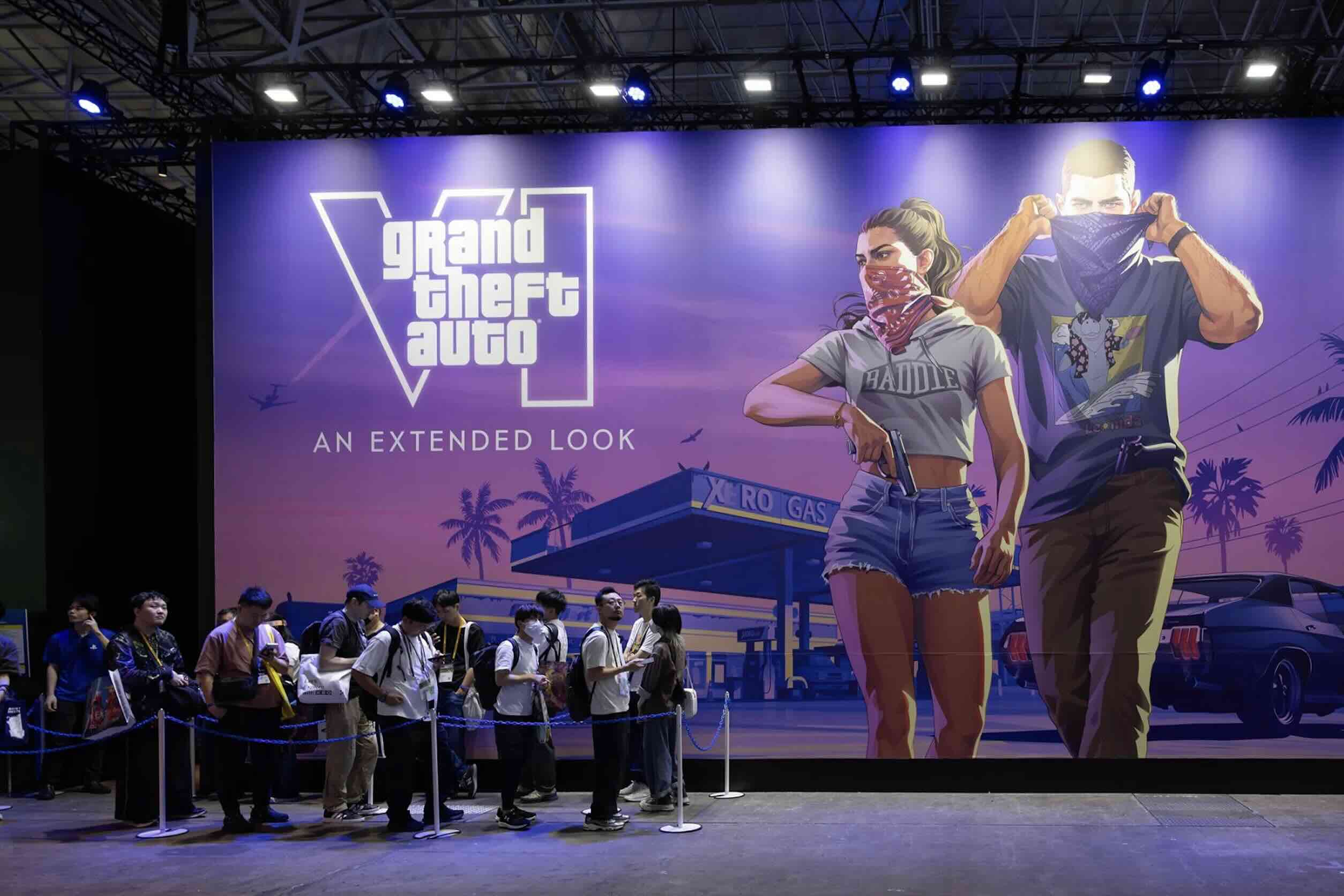
Photo: SOPA Images / LightRocket
There is a peculiar genre of financial journalism that looks at a sure thing and calls it a coin toss. This week, Bloomberg and a chorus of Wall Street analysts have framed Grand Theft Auto VI — a game that has already sold more than 12 million copies before anyone has played a single minute — as "gaming's biggest financial bet." CNBC calls it a "defining gamble." Barron's asks whether Take-Two Interactive can "justify" its spending.
The framing is dramatic. It is also, by nearly every available data point, nonsensical. Grand Theft Auto VI launches Thursday, November 19, 2026, on PlayStation 5 and Xbox Series X|S at 12:00 a.m. local time. It carries a budget estimated at $1 billion to $1.5 billion — the most expensive video game ever produced — and it has already generated over $1.18 billion in pre-order revenue, according to market research firm Sensor Tower. That is before a single day-one buyer, before a single physical disc, before the holiday rush, and years before a PC release or the launch of GTA Online.
Calling this a "bet" is like calling a coin with heads on both sides a gamble.
The Money Is Already in the Bank
The core of Bloomberg's thesis is that Take-Two Interactive has staked its entire company on one title — that it spent eight years and upwards of $1.5 billion on a single game, delayed or passed on dozens of smaller projects, and now has zero margin for error. All of that is true. What the analysis glosses over is that the return on that stake is already largely locked in.
More than 10 million digital copies were pre-ordered before launch week, with 90% of buyers choosing the $100 Ultimate Edition. Gross revenue has already crossed the low end of the game's production budget before Thursday even begins. Even after the roughly 30% cut taken by the PlayStation Store and Microsoft Store — leaving Take-Two about $56 per $80 copy — analysts estimate the game needs only 18 million to 27 million copies sold to fully recoup a $1 billion to $1.5 billion budget in net cash. GTA VI is projected to sell 37 million to 51 million copies in its first week alone.
Bank of America has benchmarked $1.9 billion in gross sales within the first three days as the threshold at which Take-Two's net take-home pay hits roughly $1.33 billion — putting the game into pure profit before its first weekend is over.
That is not a bet. That is a deposit.
The Calendar Proves the Industry Already Voted
If GTA VI were a genuine gamble, you would expect competitors to smell blood and crowd the release window. The opposite happened. November 2026 is effectively empty of major AAA releases. Marvel's Wolverine, Silent Hill: Townfall, Control Resonant, Onimusha: Way of the Sword, and Call of Duty: Modern Warfare 4 all crammed into September and October specifically to avoid being buried by Rockstar's juggernaut.
Even Hollywood is bracing for the impact. Analysts at PwC noted that GTA VI won't just dominate gaming — it will pull millions of viewers away from Netflix, movies, and live sports during the week before Thanksgiving. When an entire industry clears its calendar and adjacent entertainment sectors plan for audience loss, the market has already rendered its verdict.
- $1.18 billion in pre-order revenue locked in before launch day, per Sensor Tower
- 12+ million digital copies pre-ordered, with 90% choosing the $100 Ultimate Edition
- 18–27 million copies needed to break even after platform fees — a figure projections suggest will be cleared in days
- $1.9 billion in first-three-day gross sales is Bank of America's threshold for pure profit
- Zero major AAA competitors in November 2026 — the industry already conceded the month
Bloomberg's "Bet" Is Really About Everyone Else
Bloomberg has spent the past two weeks telling the world that Grand Theft Auto VI is gaming's "biggest financial bet." The headline ran across its Big Take podcast, its editorial pages, and a sprawling feature titled "The $1 Billion Video Game About to Swallow the World Whole." The framing is consistent: an estimated budget exceeding $1 billion, a single blockbuster asked to stabilize an industry reeling from rising development costs, mass layoffs, and widespread studio closures, and a Nov. 19 release date that will either validate or expose the entire AAA model.
It is a compelling narrative. It is also the wrong one. Bloomberg's reporting accurately describes the industry's crisis. It accurately describes the scale of Rockstar's spending. What it gets wrong is the word "bet." Grand Theft Auto VI is not a wager whose outcome is unknown. It is a deposit whose return is already largely locked in.
To be fair, the Big Take podcast and the October 30 editorial are not really arguing that Rockstar might lose money. The reporting examines whether a single blockbuster release can stabilize a wider industry grappling with high development costs and layoffs. That is a legitimate question. The problem is that Bloomberg bundles two very different claims under one dramatic label: that GTA VI is a risky bet for Take-Two, and that the industry's reliance on mega-budget blockbusters is a risky bet for everyone else. The first claim is false. The second is true. Conflating them lets Bloomberg sell a headline about uncertainty where none exists for the game's publisher.
The industry may be gambling. Rockstar is not. Bloomberg's Big Take asks whether a single blockbuster can buoy an entire industry. The answer is no — and that is the real story. GTA VI will not save struggling studios, reverse layoffs, or make $1.5 billion budgets viable for publishers without a 205-million-copy franchise behind them. But that is a story about everyone else's risk, not Rockstar's. The "bet" is not whether GTA VI makes its money back. The bet is whether the rest of the industry can survive watching it do so.
What Wall Street Is Actually Betting On
Here is the honest version of Bloomberg's argument, stripped of the casino metaphors: Take-Two's stock price already reflects years of GTA VI hype. Breaking even is not the finish line. Investors are not betting that Rockstar will recoup its budget — they are betting that the game becomes a $10 billion-plus live-service cash machine over the next decade, the way Grand Theft Auto V generated over $8.5 billion across three console generations largely through GTA Online microtransactions.
That is a legitimate question about long-term upside. It is not a question about whether the game is a financial risk. The initial $1.5 billion is covered. The first-week billions are projected. The only uncertainty is how many billions come after — and whether rival publishers who try to copy Rockstar's mega-budget formula without Rockstar's built-in audience will survive the attempt.
Bloomberg's "biggest financial bet" framing is not analysis. It is a headline. The real story is simpler and far less dramatic: Rockstar built a sure thing, the industry knew it, and Wall Street is already counting the money that has not even been spent yet.
The bet was never whether GTA VI would make its money back. The bet was whether anyone would still pretend it might not.
No Ads. By Us. For Us.
This article was made possible by readers like you. We hope it inspired you to support Emerald Book, so we can continue producing content like this.
We will never show you ads, sell your data, or require a subscription to consume our content. Your gift helps us keep the truth accessible.
Click the Support button to give a gift of any amount today.
Thank you for making this work possible.