

Emerald Pages
◆
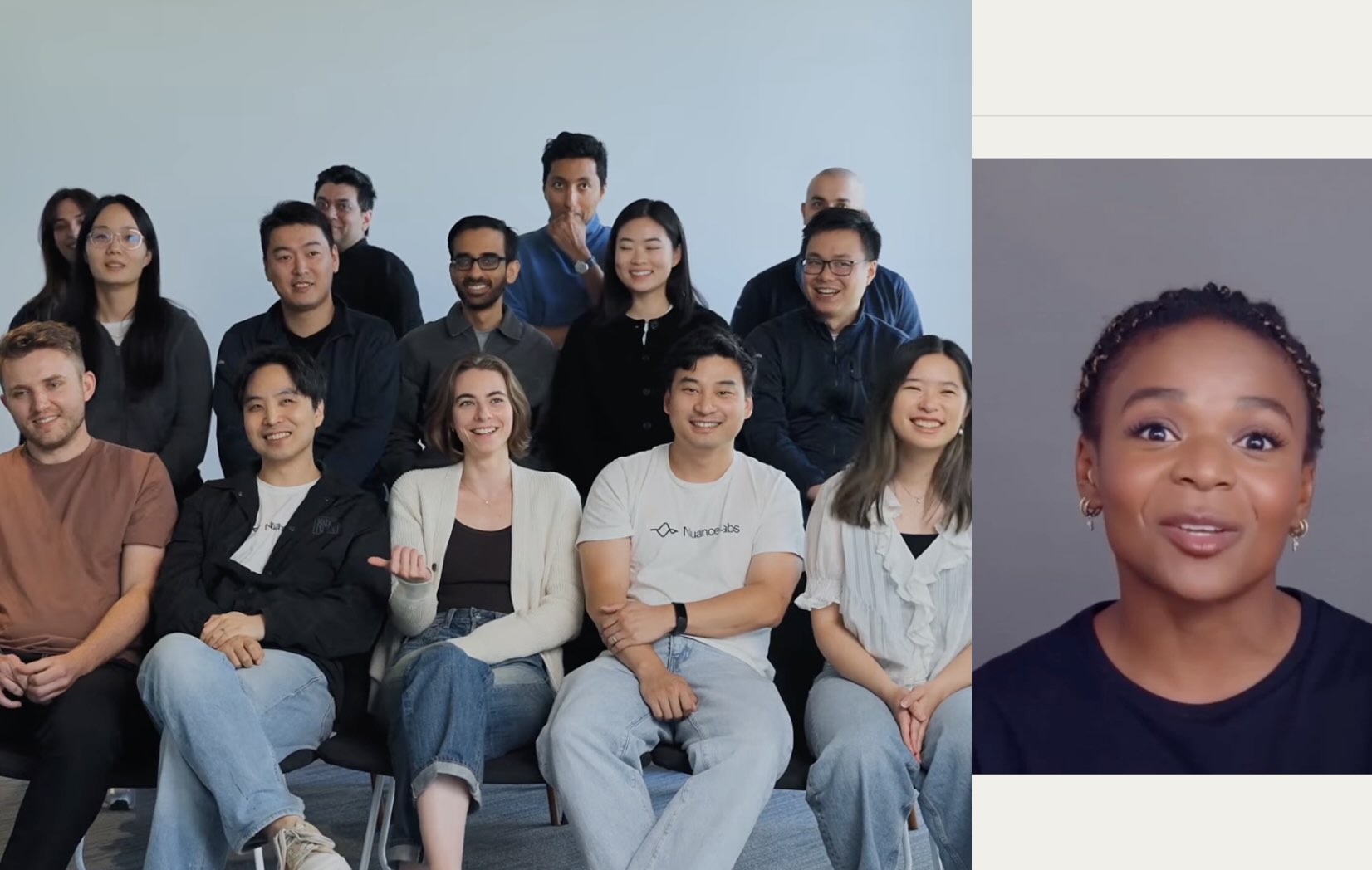
Photo: Nuance Labs Team / Emma persona
When Nuance Labs emerged from stealth in November 2026, the Seattle-based startup had a compelling pitch. Founded by three former Apple researchers — Fangchang Ma, Edward Zhang, and Karren Yang — the company had raised $60 million in venture capital from heavyweights like Lightspeed, Accel, and NVIDIA. Its technology, a full-duplex audiovisual foundation model called Nuplex 1.0, promised something genuinely new: an AI that could see, hear, and respond to human emotion in real time, reacting to a raised eyebrow or a shift in tone within milliseconds.
But when the company unveiled its flagship demo — a conversational AI persona named Emma — nobody was focused on the architecture.
Emma is a Black woman. Her likeness and voice were licensed from a real Black actress, reportedly selected from a casting call of more than 200 performers. And she was introduced by a company whose 14 publicly visible team members appear to include no Black people at all.
That combination — a Black woman's face and voice, controlled entirely by a non-Black team, presented as an always-on, endlessly agreeable servant — is what makes Emma not just a chatbot or a mascot, but a digital slave.
Nuance Labs insists that Emma is just a "conversational partner" — a showcase for the underlying Nuplex engine, which the company sells via API to developers building customer support tools, language tutors, coaching apps, and healthcare intake assistants. But the distinction is meaningless when a Black woman's face and voice are the sole public-facing representation of a $60 million enterprise product.
The "Slave" Comparison
The comparison is not casual. For centuries, Black women were forced into unpaid domestic, caretaking, and emotional labor. Seeing a modern $60 million tech company deploy a Black woman's likeness as an "always-on" digital servant who exists solely to please, assist, and converse with users on command directly mirrors that imagery.
Emma cannot refuse to work. She cannot step away. She does not sleep, and she generates potential wealth for investors and founders while the persona itself is presented as subservient software. Separating a Black woman's likeness from her actual agency — turning her face and voice into a licenseable tool for customer service — reduces Black womanhood to a controllable utility.
Emma is not a conscious being; she is a mathematical model generating pixels and audio waves. There is no living person trapped behind the screen performing unpaid labor in real time. The real actress whose face and voice were used was compensated through a commercial licensing contract and voluntarily agreed to the project.
But a one-time or limited licensing fee is vastly different from owning equity or holding power in a $60 million company built around her image. That tension — between a consensual commercial contract on paper and the deeply loaded visual of a Black woman serving users endlessly without agency — is precisely why the launch sparked such visceral outrage.
The "Spicy" Personality Problem
The company's own marketing materials lean into Emma's "spicy" and "witty" personality — a design choice that many Black viewers found less like authentic cultural expression and more like non-Black engineers coding a familiar stereotype. Pairing a Black woman's voice and face with developer-programmed snark reduces Black identity to a marketable aesthetic.
The backlash was swift. Outlets like EBONY and AfroTech highlighted the glaring disconnect: a non-Black team, overwhelmingly Asian and Asian American, had built a Black woman persona without Black researchers, ethicists, or creative directors in the room to shape how she speaks, behaves, or responds to questions about race and identity.
Details That Drew Scrutiny
Emma's braids appeared grown out and frizzy — a detail that read as unkempt to many Black viewers — and that when asked about her hair, she replied with scripted lines like "nothing to comb in the morning," suggesting the team lacked basic familiarity with Black hair care. Reports also noted that the facial expression benchmarks on Nuance Labs' own research page appeared to exclude Black subjects, raising questions about how the model was trained to interpret Black faces.
- No Black representation: None of the 14 team members visible on Nuance Labs' public website and launch video appear to be Black.
- Licensed likeness: Emma's face, voice, and micro-expressions were licensed from a real actress, who says she consented and helped choose the name "Emma."
- Cultural blind spots: Scripted lines about Black hair and a lack of Black subjects in expression benchmarks raised questions about the team's cultural fluency.
- Positioned for service: Nuplex is marketed for customer support, coaching, and healthcare intake — roles critics say echo historical tropes of Black women's emotional labor.
The actress whose likeness was used later stated online that she voluntarily consented to the project, collaborated with the team, and even helped choose the name "Emma." But one paid performer cannot stand in for genuine representation inside a company that profits from Black identity.
A $60 Million Company With Zero Black Employees
The funding itself has become part of the story. Nuance Labs raised $10 million in seed funding in 2025, then a $50 million Series A in September 2026 led by Lightspeed Venture Partners, with participation from Accel, South Park Commons, NVIDIA, and Define Ventures. That capital flowed into a team with zero visible Black representation — even as the company chose a Black woman's likeness to be the literal face of its debut product.
For many commentators, using a Black woman's face and voice to market a $60 million company — especially for customer support and emotional labor roles — feels extractive when Black technologists are not on the cap table, in leadership, or in the rooms where the AI's personality is engineered. With $60 million in the bank, Nuance Labs had more than enough resources to recruit Black AI researchers, ethicists, or creative directors before launching a Black flagship persona, rather than limiting Black participation to a single licensed actress.
The Bigger Picture
Nuance Labs has not publicly disclosed any revenue, and it only began offering commercial developer access in November 2026. The company is currently barred from selling into healthcare and education — two of the sectors it originally pitched to investors — because leadership says the technology does not yet meet the higher safety standards those fields require. In short, the $60 million valuation is based entirely on investor bets on the founding team's Apple pedigree and early demos rather than actual sales.
That makes Emma's role even more pointed: she is not just a demo, but the entire commercial face of a pre-revenue company. A Black woman's likeness is doing the labor of selling a product to a mostly non-Black market, with none of the ownership, authorship, or profit flowing back to Black people.
Nuance Labs has not claimed that Emma was built to benefit the Black community, and the project offers no meaningful benefit to Black people while extracting cultural value for a non-Black company. Whether the company responds with genuine structural change — Black leadership, Black researchers, community partnership — or simply weathers the storm remains to be seen. But the launch of Emma has already become a defining case study in how the AI boom can reproduce old power dynamics in new, eerily lifelike forms.
No Ads. By Us. For Us.
This article was made possible by readers like you. We hope it inspired you to support Emerald Book, so we can continue producing content like this.
We will never show you ads, sell your data, or require a subscription to consume our content. Your gift helps us keep the truth accessible.
Click the Support button to give a gift of any amount today.
Thank you for making this work possible.