

Emerald Pages
◆
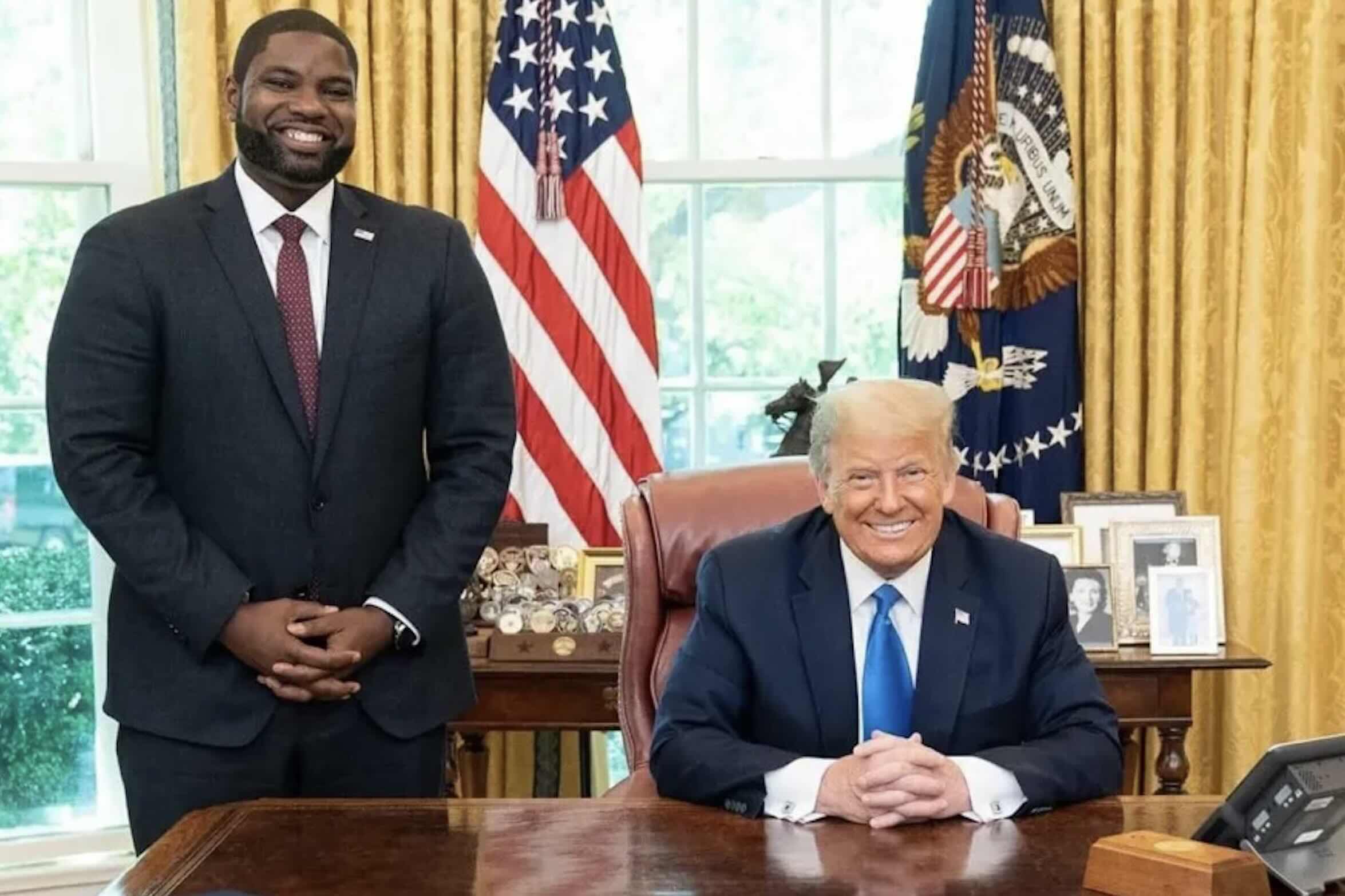
Photo: Official White House Photo
Florida made history on November 3, 2026, electing Republican Byron Donalds as its first Black governor. Yet within hours of the AP calling the race, a familiar chorus rose—not just in Florida, but from Black communities across the country: silence.
The sentiment isn't new, and it isn't provincial. It crystallized eleven months earlier, when a video clip went viral of Donalds—then a U.S. Representative—declaring "Daddy's back!" in reference to Donald Trump during a Fox News appearance. The phrase, which Donalds later dismissed as a "flippant" joke, became a political Rorschach test. To his supporters, it was harmless bravado. To his critics—Black voters from Miami to Milwaukee, Atlanta to Oakland—it was something far more revealing: a Black man in the halls of power using paternal terminology toward a white authority figure, a visual that carried uncomfortable historical weight.
That moment, and the backlash that followed, set the tone for Donalds' ascendancy. His victory—50.01% to Democrat David Jolly's 48.72%—was narrow, but his separation from Black America was not. A St. Pete Polls survey released days before the election found Jolly leading Donalds among Black voters 76% to 18%. The first Black governor of the third-largest state in the nation was rejected by the very community whose history he was said to have broken. And the rejection echoed well beyond the state line.
The question of why is not complicated. It is answered in Donalds' own policy record, in the company he keeps, and in the words he has chosen to use—words and choices that resonate with Black voters nationwide who see in him a familiar type: the Black conservative deployed to validate a party they experience as hostile.
"Daddy's Back" and the Politics of Deference
The "Daddy's back" comment drew immediate criticism from political opponents and social media users nationwide who called it "creepy" and "weird." But for many Black commentators, the discomfort ran deeper than cringe. It touched on a specific historical nerve: the performance of deference by Black men toward white power.
Donalds addressed the backlash in October 2026, telling Florida Politics that he does not literally view Trump as his father and that the remark was a "misinterpreted joke" meant to contrast Trump's return with what he called Joe Biden being "asleep at the wheel." But the explanation did little to quiet the underlying critique. For many, the joke wasn't the problem—the reflex was. The clip circulated in group chats and on timelines far outside Florida, becoming a shorthand not for Donalds specifically but for a broader phenomenon: Black faces attached to a movement whose base and leadership remain overwhelmingly white.
The phrase also aligned Donalds with a specific brand of online "alpha male" political rhetoric popular in certain conservative circles, where dominant leaders are colloquially referred to in paternal terms. But as a Black man applying that terminology to a white president, Donalds stepped into a cultural minefield that was inevitable.
A Record That Speaks for Itself
If the "Daddy" comment was the spark, Donalds' policy agenda is the fuel. His platform as governor-elect—and his legislative record before it—reads to many Black Americans, in Florida and beyond, as a direct assault on the programs and protections they rely on most.
On diversity, equity, and inclusion, Donalds is uncompromising. He supports expanding Florida's existing bans on DEI spending in public universities and state government, opposes affirmative action, and has pressured university systems to reject candidates who have advocated for DEI policies. He argues that "equity" seeks to engineer equal outcomes rather than equal opportunity, and that meritocracy—not race-conscious programs—is the path forward.
On policing and immigration, Donalds has pledged "Zero Tolerance, Zero Dollars"—cutting state funds to any municipality that fails to certify strict cooperation with federal immigration enforcement—and directing state and local law enforcement to coordinate directly with federal authorities to fast-track deportations. Such coordination inevitably leads to racial profiling, pretextual stops, and a breakdown of trust between Black communities and local police, particularly in Afro-Latino and Caribbean populations.
On healthcare, Donalds rejects federal Medicaid expansion, a position that public health researchers say leaves hundreds of thousands of working-class Floridians in a coverage gap. Because Black Americans are disproportionately represented among the uninsured and low-wage workers without employer-sponsored insurance, the literature consistently links non-expansion to higher uninsured rates and worse health outcomes for Black populations—including higher maternal mortality and untreated chronic illness.
The Party Problem
Then there is the matter of the party itself. Donalds is one of Donald Trump's most vocal and prominent legislative allies—a relationship that earned him Trump's endorsement and, ultimately, the governor's mansion. But the Republican Party Donalds leads in Florida is roughly 80% white, with Black voters making up about 2% of its coalition nationally. Its congressional leadership and national committee leadership are entirely white. Only about 6% of Black Americans identify as Republicans.
- 76% to 18% — Jolly's lead over Donalds among Black voters, per St. Pete Polls, October 2026
- ~2% — Black voters' share of the Republican coalition, per Pew Research Center
- ~80% — White voters' share of the Republican coalition
- ~6% — Black Americans who identify as Republicans
- 0 — Black lawmakers in top Republican congressional leadership positions
Political scientists and watchdog organizations have extensively documented why white supremacists and far-right extremists overwhelmingly align with the Republican Party and express a sense of validation within it—from the "mainstreaming" of grievance narratives like the Great Replacement theory to the use of coded "dog whistles" that extremist groups recognize as racial solidarity signals. The party officially denounces white supremacy, but its rhetorical ambiguity and tactical hesitance to alienate energized factions of its base create a vacuum in which extremists feel tolerated.
For Donalds, this is not a contradiction. He frames his alignment with Trump as strategic—a vehicle for economic nationalism, deregulation, border security, and school choice that he believes will deliver better outcomes for Black families than race-conscious government programs. From this viewpoint, his support for Trump is not a betrayal but a realignment.
For Black America, the math is simpler: a party whose base and leadership are overwhelmingly white, whose policies disproportionately harm Black communities by the measurable outcomes, and whose most prominent Black lawmaker called its white leader "Daddy" is not a party that Black people can claim—or that can claim to represent them. That critique follows Donalds out of Florida and onto the national stage, where he is already being discussed as a future Republican voice.
A Historic First, Unclaimed
Byron Donalds will be inaugurated in January 2027 as Florida's first Black governor. He will govern a state where the majority of Black voters opposed him, where civil rights groups have labeled his platform "anti-Black," and where a single phrase—"Daddy's back"—became shorthand for a broader sense of alienation. And he will do so as a national figure, held at arm's length by a Black public that has watched this movie before.
History will record that he broke a barrier. Whether the community behind that barrier claims him is a different question—one that Donalds, by his own words and policy choices, has already answered.
Donalds' victory speech thanked Trump and declared that "Florida is still red." For many Black Americans—in Florida and far beyond it—that was the most honest thing he said all night.
No Ads. By Us. For Us.
This article was made possible by readers like you. We hope it inspired you to support Emerald Book, so we can continue producing content like this.
We will never show you ads, sell your data, or require a subscription to consume our content. Your gift helps us keep the truth accessible.
Click the Support button to give a gift of any amount today.
Thank you for making this work possible.