

Emerald Pages
◆
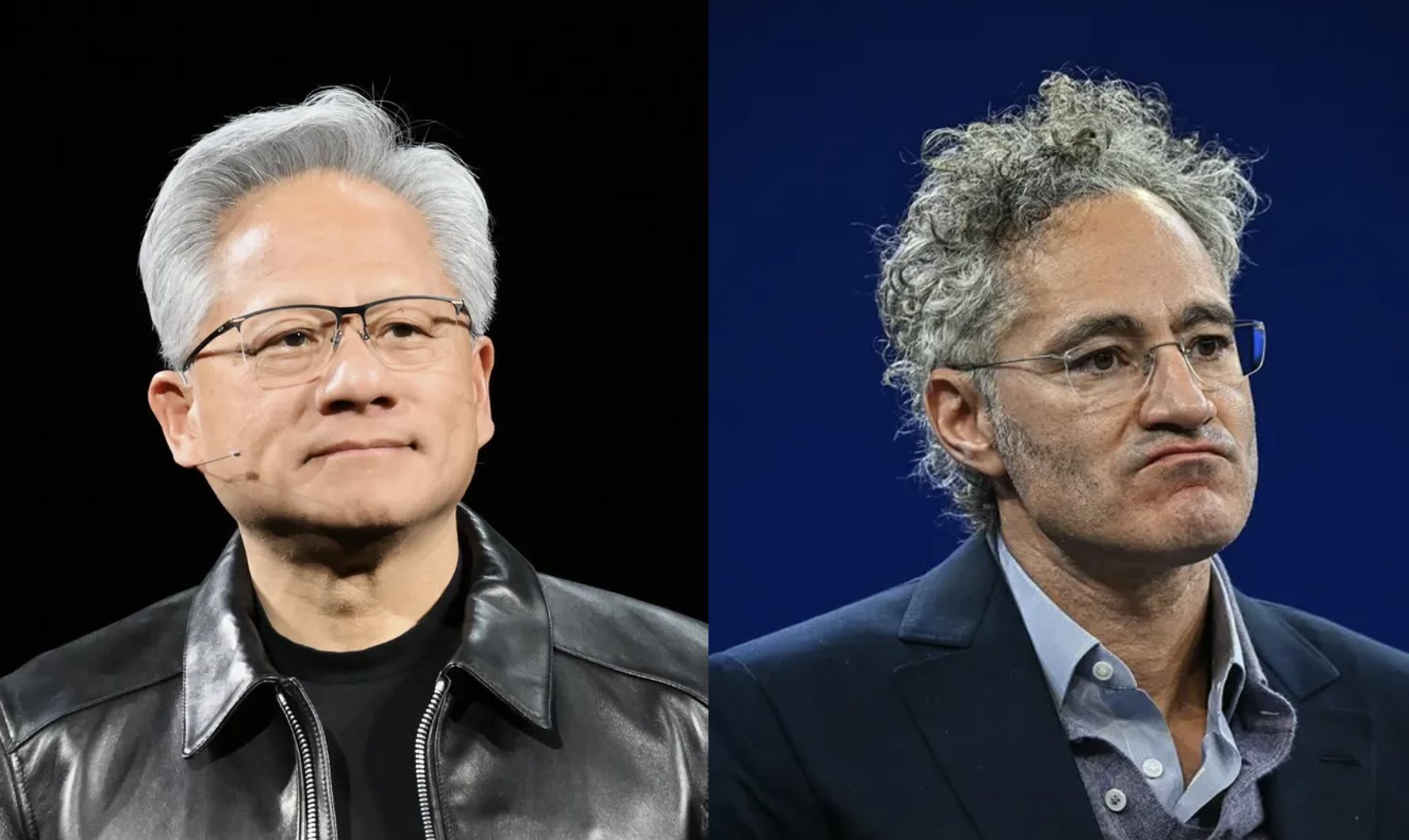
Nvidia CEO Jensen Huang (left) and Palantir CEO Alexander Karp | Photo: Emerald Book Image
The machinery of AI finance is no longer just about chips and data centers. It is about insurance — and the people buying it are getting nervous.
Over the past twelve months, the market for credit default swaps (CDS) tied to a small basket of AI-exposed companies has exploded from a niche corner of derivatives trading into one of Wall Street's most active credit markets. Weekly trading volume has surged from roughly $1–2 billion earlier this year to $8–10 billion a week, according to data compiled by Morgan Stanley and Goldman Sachs. Year-to-date single-name CDS volume for the top ten AI hyperscalers and chipmakers has hit a record $140 billion — up 691% from $17.7 billion over the same period last year.
That is not retail speculation. That is institutional risk management at scale. And the people doing it are, increasingly, the same lenders who financed the AI buildout in the first place.
Offloading Risk to Keep Lending
The clearest example of lender hedging comes from Barclays PLC. The bank has been approaching insurance companies and hedge funds to buy default protection on more than $10 billion in loans it issued to fund AI infrastructure — data centers, GPU clusters, and the specialized "neo-cloud" providers that lease compute capacity to AI developers.
This is not a fire sale. Barclays is not selling the loans themselves. Instead, it is using a Significant Risk Transfer (SRT) — a synthetic hedge where the bank pays an insurance syndicate a regular premium in exchange for the syndicate absorbing the first 10–15% of losses if the underlying AI borrowers default. Because the risk is legally transferred, regulators allow Barclays to free up capital and keep lending.
- The premium: Barclays pays an ongoing fee to insurers, effectively buying a put option on its own loan book.
- The risk: Insurance syndicates absorb first-loss exposure on $10 billion+ in AI infrastructure debt.
- The goal: Free up regulatory capital so Barclays can issue another $10 billion in AI loans — keeping the lending machine running.
Barclays is not alone. Morgan Stanley and Goldman Sachs are serving as market makers — underwriting multi-billion dollar debt deals for AI infrastructure while simultaneously structuring the default swaps that let investors bet against those same deals. The banks are, in effect, selling insurance on the risks they helped create.
Hedge Funds Shorting the Bubble
On the other side of the trade, macro hedge funds are using CDS as a direct short on AI debt. Unlike the Barclays model — where the bank owns the underlying loans — speculative players do not need to hold any AI bonds to buy protection. They are buying CDS on a "macro basket" of tech giants (Oracle, Alphabet, Amazon, Meta, Microsoft, Palantir) and chipmakers (Nvidia, Broadcom, AMD), betting that credit spreads will widen if AI spending slows.
The economics are straightforward. If insuring Alphabet's debt costs 40 basis points, a hedge fund pays $40,000 a year to insure $10 million in exposure. If the AI narrative cracks and Alphabet's credit rating drops, that insurance could spike to 200 basis points or more — allowing the fund to sell the contract at a massive profit without a default ever occurring. If a company actually defaults, the payout is even larger.
This is the same synthetic-short playbook Michael Burry and others used to bet against subprime mortgages in 2007. Burry himself has reportedly moved up his AI bubble timeline, swapping standard short positions for leveraged June and September 2027 put options against Nvidia, Micron, and Oracle.
Circular Financing and Opaque Risk
What makes the current hedging wave more than just prudent risk management is the underlying structure of AI finance itself. The Bank for International Settlements (BIS) has explicitly warned that the AI sector is characterized by "circular financing" — over 55% of all funding into AI firms comes from other AI firms, and 46.4% of that deal value involves an investor who is also a supplier or customer of the target company.
In plain terms: a hyperscaler invests $5 billion in an AI startup. The startup immediately hands that cash back to the hyperscaler to buy chips or lease cloud capacity. The hyperscaler reports blockbuster revenue. No outside customer bought anything. The revenue is real on the income statement, but it is funded by debt and venture capital rather than sustainable enterprise demand.
This opacity is compounded by the use of Special Purpose Vehicles (SPVs) and private credit funds. Much of the AI infrastructure debt is held off-balance-sheet by parent companies, arranged privately by firms like Blackstone, Apollo, and Ares, and packaged into portfolios sold to life insurance funds and pension systems chasing yield. Regulators cannot easily measure how many leveraged layers sit on top of a single set of GPUs — or what those chips will be worth if the AI compute market cools.
The Danger
There is one important structural difference from 2008. Much of the core AI debt is tied to mega-cap hyperscalers — Microsoft, Alphabet, Meta — that hold hundreds of billions in genuine free cash flow. Those balance sheets can absorb shocks that subprime borrowers could not. The systemic risk is concentrated in the layer beneath: the unproven neo-cloud providers, GPU aggregators, and data center developers funded by private credit and secured against depreciating silicon.
That silicon is the first problem. Chips do not hold value like houses — they depreciate fast, and each generation makes the last one cheaper and less rentable. Several hyperscalers have already quietly stretched depreciation schedules from three years to five or six to prop up earnings. If compute prices fall, the repossessed collateral behind hundreds of billions in private credit is worth a fraction of the loan.
The second problem is who sold the insurance. A CDS is only as good as its seller, and with $140 billion in volume concentrated in about ten names, much of the protection now sits with private credit funds, specialty insurers, and leveraged ETFs rather than deep-capitalized dealers. In a real credit event everyone collects at once — and the same slowdown that triggers defaults impairs the funds that sold the protection.
The third is where the risk landed. Life insurers and annuity funds have absorbed nearly $850 billion in private tech credit chasing yield. Those are policyholder reserves and retirement income, held in assets too opaque to mark or easily sell. If the AI credit layer cracks, the loss surfaces in ordinary people's accounts — slowly, because nobody can price it. That is the dynamic that turned subprime into a systemic crisis.
And the hedges themselves add leverage. Barclays' SRT frees capital so the bank can lend more into the same buildout — every dollar of risk transferred is a dollar of new capacity. Institution by institution the system looks safer; in aggregate it becomes more fragile.
That is precisely why the CDS market has exploded. Institutional investors are not necessarily betting on a hyperscaler default. They are hedging against the possibility that the private credit layer cracks — and that the circular financing loop, once one link breaks, unravels faster than anyone can model.
The lenders built the AI boom on debt. Now they are buying insurance against the boom they financed. Whether that insurance works depends on whether the people selling it can actually pay out when the music stops.
No Ads. By Us. For Us.
This article was made possible by readers like you. We hope it inspired you to support Emerald Book, so we can continue producing content like this.
We will never show you ads, sell your data, or require a subscription to consume our content. Your gift helps us keep the truth accessible.
Click the Support button to give a gift of any amount today.
Thank you for making this work possible.