

Emerald Pages
◆
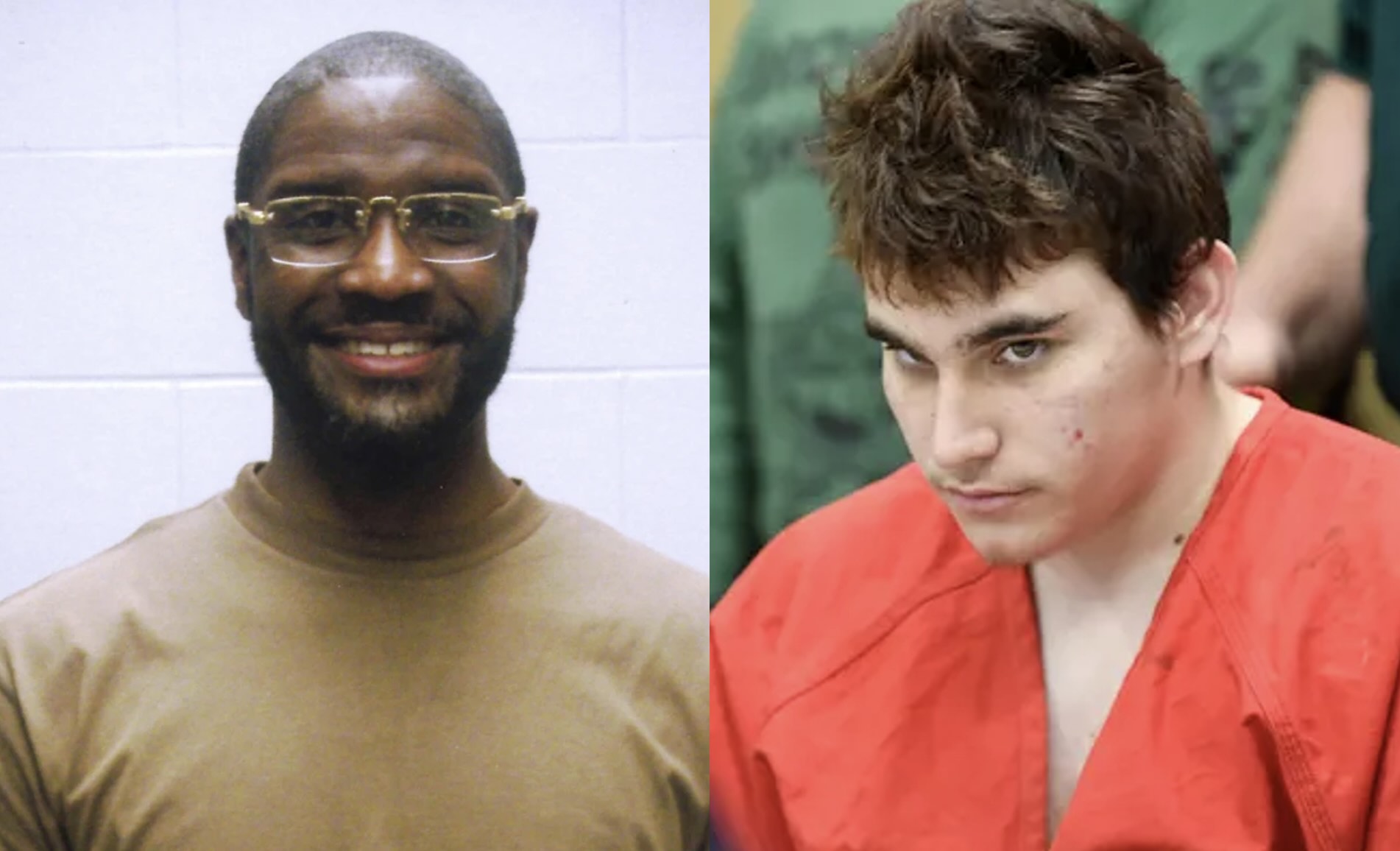
Brandon Bernard (Wrongfully executed by the Federal Government, 2020, left) and Nikolas Cruz (right), the perpetrator of the February 14, 2018, Marjory Stoneman Douglas High School, killing 17 people. | Photo: Emerald Book Image
On April 20, 1999, two teenagers walked into Columbine High School and killed thirteen people before turning their weapons on themselves. In the twenty-seven years since, the United States has endured Sandy Hook, Parkland, Uvalde, and hundreds of other school shootings. Not one perpetrator of those massacres has been executed. Meanwhile, in the same period, Black men and children have been put to death in cases where recanted testimony, hidden evidence, or posthumous DNA testing later pointed to innocence.
The numbers are stark and they sit side by side in the public record. Since 1999, zero school shooters have been executed. Since 1999, multiple Black people have been executed despite deep, documented doubts about their guilt—Ledell Lee in Arkansas, Troy Davis in Georgia, Domineque Ray and Nathaniel Woods in Alabama, Brandon Bernard by the federal government — as well as Black children: George Stinney Jr. at fourteen, Alexander McClay Williams at sixteen. The question is not whether this disparity exists. It is why a system that calls itself just has produced it so consistently, and for so long.
Legal scholars and civil rights organizations point to a consistent structural pattern: the American capital punishment system does not scale punishment to the horror of a crime. It scales it to the resources of the defense, the scrutiny of the media, and the race of the defendant. Each of those factors, in the modern era, happens to protect the most notorious killers and destroy the most vulnerable defendants.
The Scrutiny Shield
When a mass shooting occurs, the case becomes a national event. Courts are under enormous pressure to conduct a flawless constitutional process, and defendants are provided heavily funded, elite capital defense teams. Those teams spend years assembling mitigating evidence—neurological damage, severe trauma, fetal alcohol spectrum disorder, untreated psychosis. The Parkland shooter's defense team used exactly this strategy in 2022, convincing three jurors to vote for life without parole. Under Florida's unanimity requirement at the time, that was enough to spare him. The system bent over backward to understand him. It almost always does when the defendant is white and the cameras are on.
By contrast, the Black men and children executed in disputed cases were convicted in low-profile cases that received little or no national coverage. They were represented by overworked, underfunded court-appointed attorneys who lacked the time and money to hire experts, challenge coerced informants, or commission independent DNA testing. By the time independent investigators uncovered evidence of innocence, strict procedural deadlines often barred the courts from acting. The state did not need a flawless case. It only needed a defendant who could not afford a better one.
- Ledell Lee (Arkansas, 2017): Posthumous DNA testing in 2021 revealed the DNA of an unknown man on the murder weapon.
- Troy Davis (Georgia, 2011): Convicted on eyewitness testimony alone; 7 of 9 key witnesses later recanted, some alleging police coercion.
- Domineque Ray (Alabama, 2019): Convicted solely on the testimony of a co-defendant with severe mental illness who received a spared sentence.
- Nathaniel Woods (Alabama, 2020): Executed as an accomplice while his co-defendant confessed to being the sole gunman.
- Brandon Bernard (Federal, 2020): Five surviving jurors later said his defense lawyers had abandoned him; the prosecutor acknowledged possible racial bias.
- George Stinney Jr. (South Carolina, 1944): Executed at fourteen after a trial that lasted less than three hours; conviction vacated in 2014.
- Alexander McClay Williams (Pennsylvania, 1931): Executed at sixteen; conviction thrown out in 2022 after review showed his confession was forced.
The Certainty Paradox
For school shooters captured alive, absolute certainty of guilt produces a strange inversion. Because identity is never in question—the perpetrator is on camera, arrested at the scene, or leaves a digital trail—the trial skips the guilt phase and becomes a contest over mental health and upbringing. The very horror of the act becomes evidence of a broken mind, and a single holdout juror is enough to secure life without parole. Meanwhile, the disputed cases that end in execution are precisely the ones where the evidence was thin and the defense was weak—and where the defendant was Black.
The state has never executed a white teenage school shooter but it has executed Black children. George Stinney Jr. was fourteen when South Carolina put him in the electric chair in 1944, convicted by an all-white jury in a trial that lasted less than three hours. Alexander McClay Williams was sixteen when Pennsylvania executed him in 1931; a judge threw out his conviction in 2022 after finding his confession had been coerced. These are not ancient aberrations. They are the through-line. The same system that could not bring itself to execute a white teenager who massacred children in Parkland once strapped a Black child to a chair for a crime he did not commit.
That white teenager is Nikolas Cruz. On February 14, 2018, he walked into Marjory Stoneman Douglas High School in Parkland, Florida, and killed seventeen people—fourteen students and three staff members—wounding seventeen more. He is the deadliest school shooter in American history who is still alive. He was captured, he confessed, and he was sentenced to thirty-four consecutive life terms without parole. The system found a way to explain him.
Over 100 Black Death Penalty Exonerations
The asymmetry is not proof of intent in any single case. It is the aggregate outcome of a system that treats undeniable mass guilt with exhaustive constitutional caution while pushing disputed individual guilt through an underfunded, racially skewed process. The Death Penalty Information Center notes that since 1973, more than 200 people have been exonerated from U.S. death rows—roughly one for every eight executions—and over half of those exonerees are Black. The modern record suggests the error rate does not stop at the prison gate. It stops at the grave.
This is what racial bias looks like when it is institutionalized: not a burning cross, but a docket. Not a slur, but a plea deal. Not a lynch mob, but a jury of twelve who could not see a Black child as a child. The justice system does not need to announce its racism. It only needs to keep working exactly as it always has—protecting the white and the wealthy, and killing Black people for crimes they did not commit.
Until the machinery of capital punishment is examined as a whole—who gets elite counsel, whose victims command attention, whose guilt is presumed—the paradox will hold. The most certain killers will live, and the most doubted defendants will die. That is not justice. It is a confession, written in the language of procedure.
No Ads. By Us. For Us.
This article was made possible by readers like you. We hope it inspired you to support Emerald Book, so we can continue producing content like this.
We will never show you ads, sell your data, or require a subscription to consume our content. Your gift helps us keep the truth accessible.
Click the Support button to give a gift of any amount today.
Thank you for making this work possible.