

Emerald Pages
◆
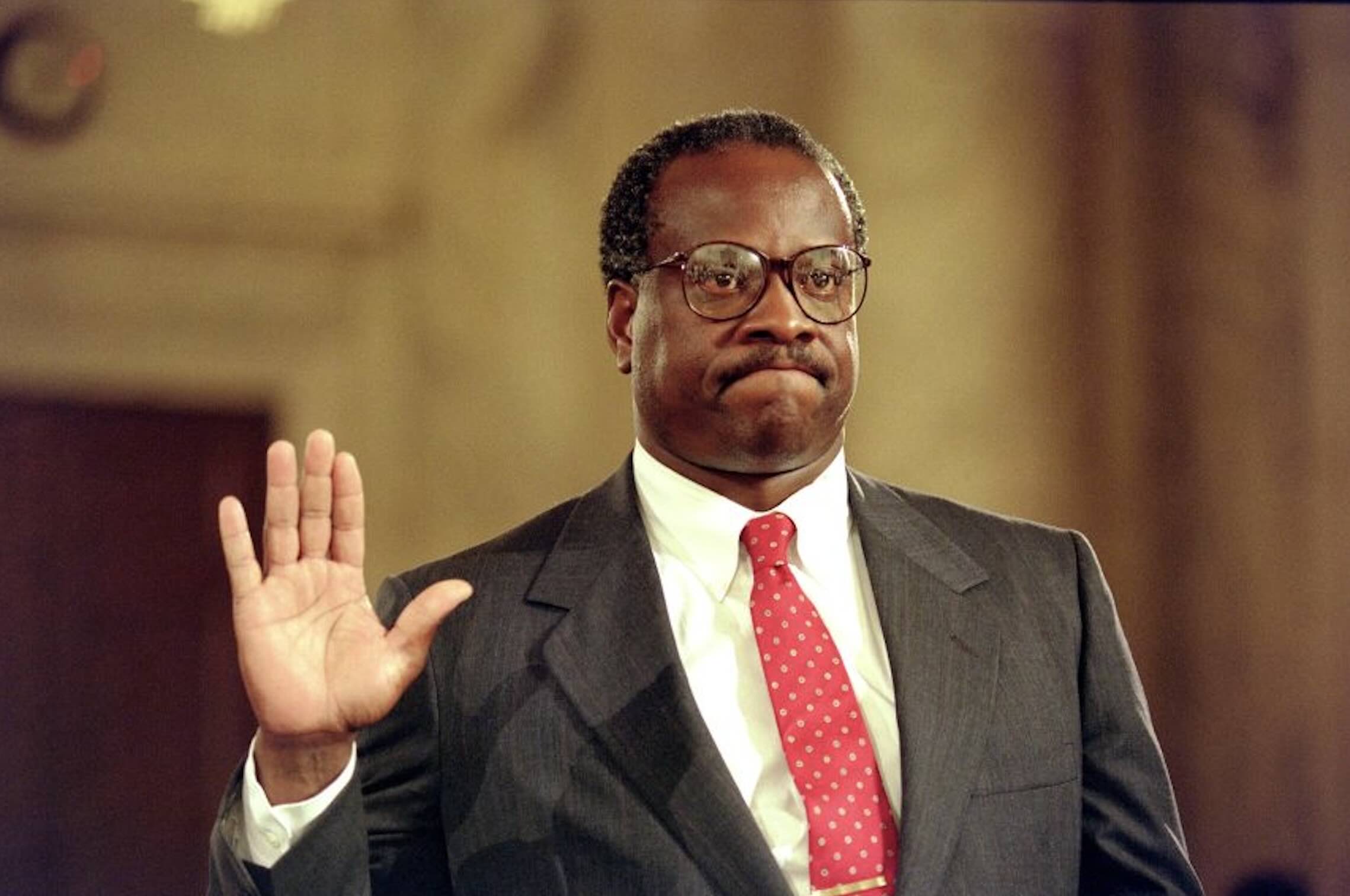
US Supreme Court Justice Clarence Thomas being sworn in, 1991. | Photo: Getty Images
When the University of Texas at Austin announced that Supreme Court Justice Clarence Thomas would co-teach an undergraduate seminar on civil rights in spring 2027, the institution framed it as a prestigious opportunity. The course, "Equality and the New Birth of Freedom," would be a one-credit-hour discussion seminar through the School of Civic Leadership, limited to just 17 of the 65 students who applied. Justice Thomas would come to campus for one week in February, teaching for two hours each morning.
For the university, it is a coup—a sitting Supreme Court justice, the longest-serving member of the current Court, teaching undergraduates for the first time. For civil rights education, it is something else entirely: the appointment of a jurist who has spent his entire career dismantling the legal architecture of civil rights to lead a course on the very subject he has spent decades eviscerating.
A Career Defined by Dismantling Remedies
To understand why this appointment is so jarring, one must examine what Justice Thomas has actually done in the realm of civil rights. His record is not one of ambiguity or nuance—it is a consistent, decades-long project of narrowing, limiting, and eliminating the legal tools that marginalized communities have relied upon to combat discrimination.
- Affirmative Action: Thomas authored the majority opinion in 2023 that struck down race-conscious admissions policies at Harvard and the University of North Carolina, effectively eliminating a primary tool used to integrate elite institutions for nearly half a century.
- Voting Rights: He has consistently voted to weaken the Voting Rights Act of 1965, arguing that the Court has overstepped its bounds in policing state-level voting procedures. In Shelby County v. Holder, he joined the majority in gutting the Act's preclearance requirement—a provision that had prevented thousands of discriminatory voting changes.
- Disparate Impact: Thomas rejects the concept that a law or policy can be unconstitutional simply because it produces unequal racial outcomes. In his view, only explicit, intentional discrimination—proven by a specific actor with specific malice—can violate the Equal Protection Clause. This effectively strips the law of any remedy for systemic harm.
- Federal Oversight: His opinions consistently favor a strict originalist interpretation that dismantles the legal frameworks used by the federal government to protect marginalized groups.
For anyone who defines civil rights by the availability of protective remedies—the ability to sue for discrimination, the enforcement of voting protections, the use of affirmative action to redress historical exclusion—Thomas's record represents not just a limitation of civil rights, but their literal deconstruction.
The Paradox of Teaching What You've Undone
The course itself is structured around historical texts from figures like Frederick Douglass, Martin Luther King Jr., Abraham Lincoln, Malcolm X, Booker T. Washington, and W.E.B. DuBois. According to the course description, students will "explore how these foundational concepts influence current Supreme Court decisions." The School of Civic Leadership, which hosts the course, was established in 2023 with significant backing from conservative state lawmakers and has an explicit goal of promoting "intellectual diversity" on a campus they argued was ideologically one-sided.
But there is a fundamental contradiction at the heart of this arrangement. The civil rights movement—the very subject of the course—was built on the premise that the law can and must be used to remedy systemic injustice. The movement's victories, from Brown v. Board of Education to the Voting Rights Act, came from courts and legislatures intervening to dismantle structures of racial hierarchy. Thomas's entire jurisprudence is built on the opposite premise: that the law should be colorblind, that courts should not engineer racial outcomes, and that government intervention to address group-level disparities is itself a form of unconstitutional racial categorization.
To have Thomas teach this course is not to expose students to a diversity of viewpoints on civil rights. It is to have the leading opponent of the civil rights legal tradition define the terms of the debate. It is like asking someone who has spent their career demolishing hospitals to teach a course on public health.
The "Expertise" Defense
The university's defense of the appointment rests on a particular definition of expertise. As the longest-serving member of the Supreme Court, Thomas has spent over three decades shaping the nation's legal landscape. He has written major opinions and dissents on the 14th Amendment, voting rights, and affirmative action. Whether one agrees or disagrees with his rulings, his interpretations are the current law of the land. From this perspective, a sitting justice is an expert on constitutional law by virtue of their role in interpreting it.
But this defense conflates power with wisdom, and authority with expertise. A person can be an expert on how a system works while being fundamentally hostile to the system's purpose. A jurist can be an expert on the legal mechanisms of civil rights while believing those mechanisms should be eliminated. Thomas is not an expert on civil rights in the way that a civil rights lawyer, scholar, or organizer is an expert. He is an expert on the dismantling of civil rights—a distinction the university's framing obscures.
The course is also structured to minimize Thomas's actual involvement. It is primarily facilitated and graded by Justin Dyer, the dean of the School of Civic Leadership. Thomas will appear for just one week, teaching for two hours each morning. This is not a full-semester course taught by Thomas—it is a cameo appearance by a controversial figure, packaged as a prestigious academic opportunity.
What Students Will Actually Learn
The 17 students admitted to this seminar will be exposed to Thomas's particular interpretation of civil rights—one that centers on individual self-reliance, a colorblind Constitution, and a deep skepticism of government intervention. They will read Frederick Douglass and Booker T. Washington through the lens of Thomas's own philosophy, which emphasizes personal responsibility over structural redress. They will explore how Thomas believes the 14th Amendment was intended to establish a completely colorblind society—a view that ignores the Amendment's own legislative history and the realities of systemic inequality.
What they will not learn—or will learn only as a foil to Thomas's views—is the mainstream civil rights tradition that produced the movement Thomas has spent his career opposing. They will not learn from a scholar who has litigated civil rights cases, organized communities, or studied the lived experience of discrimination. They will learn civil rights from the perspective of the jurist who has done more than any other sitting justice to limit its reach.
The Damage Is Not Abstract
Supporters of the course argue that its impact is minimal—17 students out of a university of over 50,000, a one-credit-hour seminar, a single week of teaching. But the symbolic impact is significant. The university is placing its institutional imprimatur on the idea that Clarence Thomas is a legitimate authority on civil rights. It is signaling to students, faculty, and the broader public that his jurisprudence—which has actively harmed marginalized communities—is a respectable, even prestigious, perspective on the very subject he has worked to undermine.
For the 17 students selected, the impact may be more direct. Many will go on to careers in law and public policy. They will carry with them the framework Thomas provides: a framework that treats colorblindness as the essence of civil rights, that dismisses systemic racism as a sociological footnote rather than a legal injury, and that views government intervention to address inequality as a constitutional violation. This is not education—it is indoctrination into a particular ideology, dressed up as a seminar on civil rights.
The question is not whether Clarence Thomas has the right to teach. He does. The question is not whether universities should invite controversial figures. They should. The question is whether a course on civil rights should be taught by someone who has spent his career dismantling the legal architecture of civil rights—and whether the university should present that choice as a prestigious academic opportunity rather than a deeply troubling contradiction.
UT Austin has answered that question by inviting Thomas to campus, by creating a course that centers his philosophy, and by limiting enrollment to a tiny group of students who will receive his particular version of civil rights education. The university has made its choice. The rest of us are left to ask: what does it mean when the institution that claims to teach civil rights hands the syllabus to the man who has spent his life taking them away?
The answer, unfortunately, is that it means the inversion is complete. The course is not about civil rights. It is about the jurisprudence that replaced them. And the university is calling it education.
No Ads. By Us. For Us.
This article was made possible by readers like you. We hope it inspired you to support Emerald Book, so we can continue producing content like this.
We will never show you ads, sell your data, or require a subscription to consume our content. Your gift helps us keep the truth accessible.
Click the Support button to give a gift of any amount today.
Thank you for making this work possible.