

Emerald Pages
◆
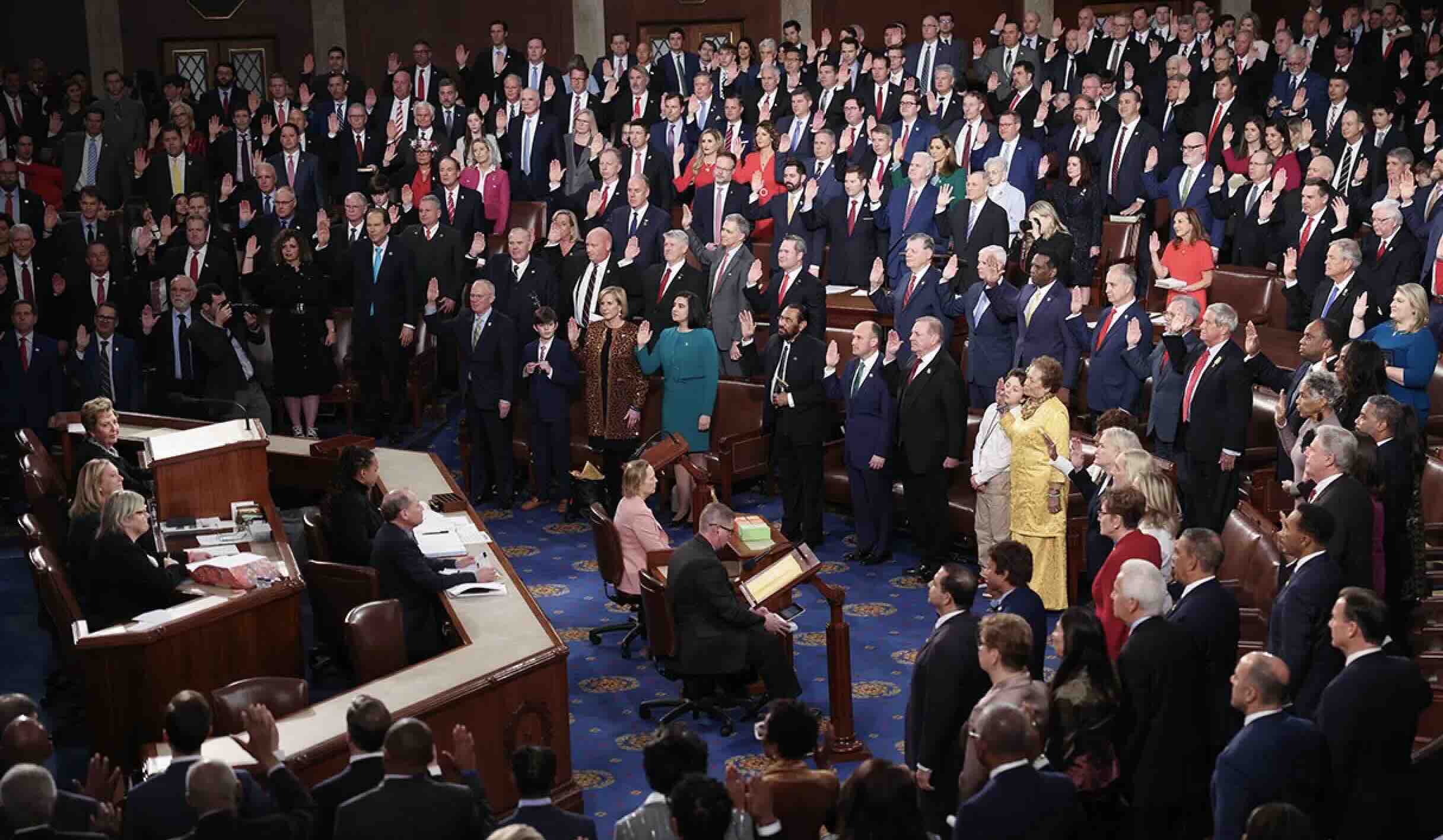
U.S. Representatives of the 119th Congress | Photo: Getty Images
The morning after the 2026 midterms, AIPAC's press office released a statement that read like a victory lap: over 234 pro-Israel Democratic and Republican candidates had won their races, with several more still too close to call. The New Arab and other outlets, meanwhile, were writing a different story—a string of high-profile defeats that suggested the lobby's grip was slipping. Both narratives were true. And both missed the point.
Because the real story of AIPAC's 2026 cycle isn't about how many candidates it endorsed or how many it lost. It's about the $168.5 million it deployed across the election, the unprecedented 518 of 539 members of Congress its network funded, and the mechanics—bundling, Super PACs, primary targeting—that let a small, intensely focused donor base outspend traditional party committees. AIPAC didn't win the 2026 elections in the way its critics fear. It won them in a way that's both more mundane and more revealing about American campaign finance.
The Numbers That Defined the Cycle
Federal filings through late September and post-election disclosures paint a detailed picture of AIPAC's financial footprint. The organization directed over $90 million from its members directly to candidates through its internal portal—a conduit system where individuals max out their legal contribution limits and AIPAC bundles the checks into a single, recognizable package for the campaign. Its traditional PAC contributed nearly $25 million in capped direct donations. And its Super PAC, the United Democracy Project (UDP), spent $53.5 million on independent expenditures—television, digital, and direct mail advertising—funded largely by a concentrated pool of high-net-worth donors.
Add it up, and you get $168.5 million. For context, that's more than many Senate candidates spend on their entire campaigns. And unlike the party committees that hoard their cash for the general election, AIPAC deployed much of its money early—during primaries, where turnout is low and a flood of advertising can decide the outcome.
The bipartisan math is what sets AIPAC apart. Most major political action committees are locked into one party—labor unions fund Democrats, fossil fuel executives fund Republicans. AIPAC operates as a single-issue organization, focused solely on U.S.-Israel relations, which allows it to recruit ultra-wealthy donors from both sides of the aisle. That dual network effectively doubles its fundraising pool and its reach.
The High-Profile Losses—and Why They Didn't Matter
The defeats were real, and they were expensive. Representative Haley Stevens of Michigan, AIPAC's top financial recipient of the cycle, pulled in over $30 million in pro-Israel backing—roughly 18% of the organization's entire tracking pool—and still lost her Democratic Senate primary to Abdul El-Sayed, a vocal critic of unconditional U.S. military aid to Israel. Pro-Israel entities then pivoted to Republican Mike Rogers in the general election, with UDP spending an additional $9 million. El-Sayed won that race too, overcoming a combined $31 million to $42 million in opposing AIPAC-aligned expenditures.
In Maine, Senator Susan Collins—the powerful Republican chair of the Appropriations Committee—was the single largest target for bundled individual contributions from AIPAC, which brought in over $3.3 million to support her reelection. She was unseated by Democrat Troy Jackson. J Street and other alternative advocacy groups pointed to these losses as evidence of a shifting landscape, a sign that unconditional aid to Israel was becoming a liability in congressional campaigns.
But here's the thing about a $168.5 million war chest: losing a few high-profile races doesn't mean you lost the cycle. It means you absorbed some losses and won everywhere else. AIPAC's 234 winning candidates span both parties and both chambers. Its network funded 518 of 539 tracked members of Congress. The losses made headlines. The wins made a Congress.
The Machine Behind the Money
Understanding how AIPAC turned a small, intensely motivated donor base into a nine-figure political force requires looking at the three streams that feed it.
- Grassroots bundling ($90 million): AIPAC's online portal lets individual members direct legally capped donations—up to $3,300 per candidate—straight to campaigns. AIPAC bundles thousands of these checks and delivers them as a single package, giving a network of regular citizens the same leverage as a billionaire while staying within campaign finance limits.
- The Super PAC ($53.5 million): The United Democracy Project accepts unlimited contributions from individuals and corporations, thanks to the Supreme Court's Citizens United decision. Its top donors are a concentrated group of hedge fund managers, tech executives, and real estate developers writing checks of $1 million to $5 million or more—including a $30 million transfer from AIPAC's own treasury.
- The traditional PAC ($25 million): Capped direct donations from AIPAC's membership, distributed across winning candidates from both parties.
The donor base skews heavily Jewish, even though AIPAC's broader membership of 6.5 million is majority non-Jewish—largely Evangelical Christians who support Israel through voter mobilization rather than personal political giving. The financial engine, by contrast, is powered by a small fraction of the roughly 7.5 million Jewish Americans, representing just 2.4% of the U.S. population. That fraction includes high-net-worth professionals for whom a $3,300 check is less than 1% of annual income, and for whom political giving is both a civic duty and a social expectation within tight-knit communal networks.
This is the "asymmetric intensity" that campaign finance analysts talk about. A small group that cares intensely about one issue will almost always outspend and out-influence a much larger group that cares about many issues. AIPAC has spent over half a century perfecting the organizational infrastructure to mobilize that intensity into a unified financial and lobbying block.
Putting AIPAC in Perspective
AIPAC's $168.5 million is enormous for a single-issue group, but it's not the largest pile of money in American politics. The Senate Leadership Fund, the premier Super PAC supporting Senate Republicans, raised and spent $558 million in 2026—supercharged by a $168 million individual infusion from Elon Musk. Senate Majority PAC, its Democratic counterpart, raised $354 million. Fairshake, the cryptocurrency lobby's Super PAC, entered the cycle with $193 million in cash from corporate treasuries like Ripple, Andreessen Horowitz, and Coinbase.
What makes AIPAC unique isn't the raw size of its war chest—it's how it deploys it. The party powerhouses hold their money for general elections and flood a handful of swing states with advertising. AIPAC goes into primaries, where it can shape the choices voters are given before the general election even begins. And it funds both parties, doubling its reach. The crypto lobby's Fairshake copied this playbook in 2026 with notable success, targeting anti-regulation candidates in both parties' primaries. But AIPAC has been doing it longer, and with a donor base that's more emotionally invested in the cause.
What the 2026 Cycle Actually Revealed
AIPAC's post-election announcement that it would stop making direct candidate endorsements through its traditional PAC, shifting its focus toward independent spending via its Super PAC, suggests the organization is adapting to a changing landscape. The high-profile losses in Michigan and Maine may have signaled that unconditional aid to Israel is becoming a harder sell in some Democratic primaries. But the broader math—234 wins, 518 members of Congress funded, $168.5 million deployed—tells a different story about the organization's reach.
The debate this spending has sparked is as old as the Citizens United decision itself. Supporters argue it allows citizens to pool resources for causes they care about, a form of collective political speech. Critics argue it gives outside groups outsized influence over who gets to run for office, and that the bundling and Super PAC mechanics allow a small, wealthy donor base to project power far beyond its demographic weight.
What's clear is that AIPAC didn't "appoint" anyone in 2026. American voters did that. But AIPAC spent $168.5 million to help determine which voters got which choices—and in a midterm cycle where control of Congress hung in the balance, that may be the most consequential form of influence there is.
The headlines will remember the defeats. The Congress will remember the money.
No Ads. By Us. For Us.
This article was made possible by readers like you. We hope it inspired you to support Emerald Book, so we can continue producing content like this.
We will never show you ads, sell your data, or require a subscription to consume our content. Your gift helps us keep the truth accessible.
Click the Support button to give a gift of any amount today.
Thank you for making this work possible.