

Emerald Pages
◆
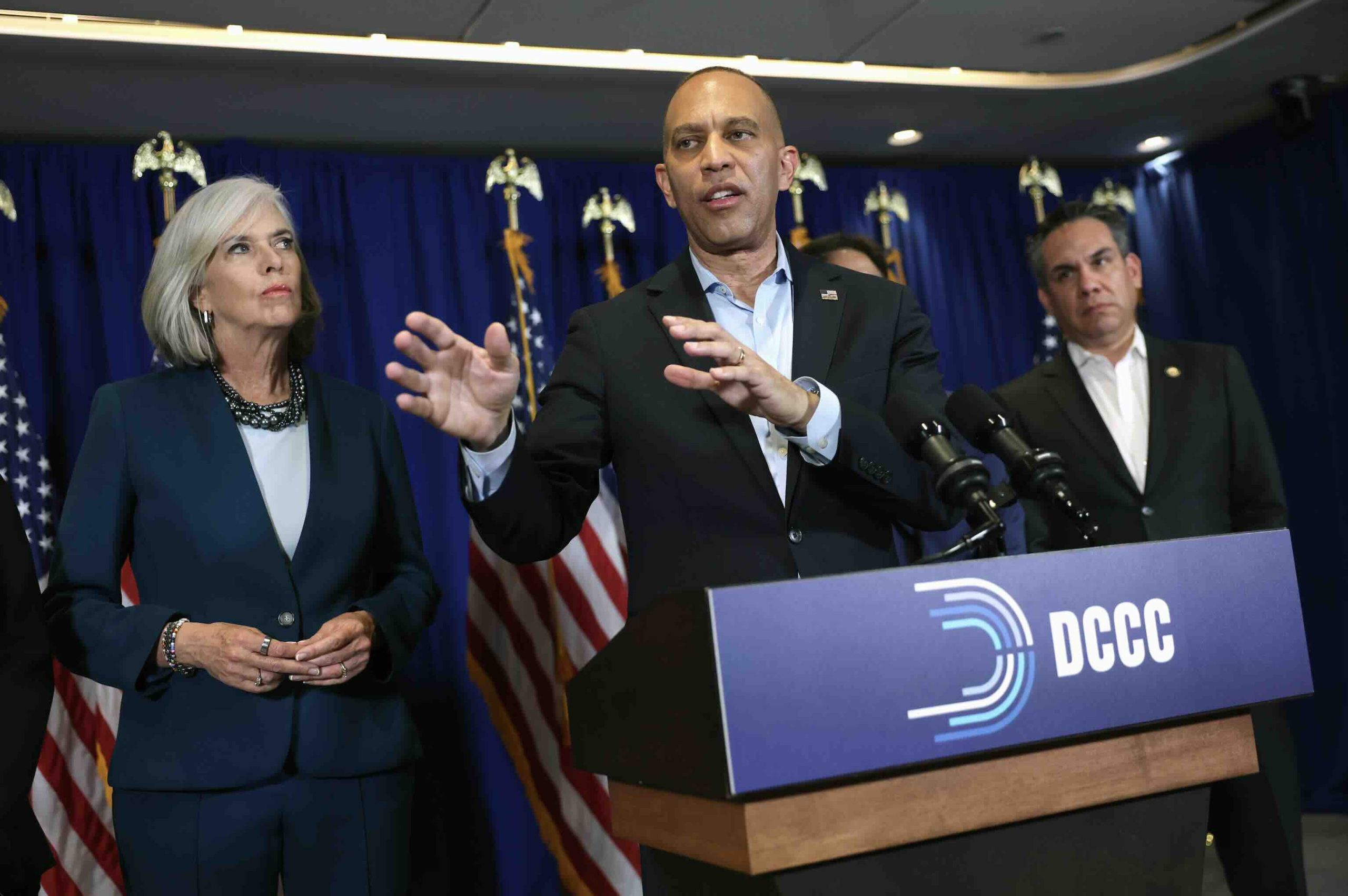
Photo: Getty Images
The morning after Democrats swept the 2026 midterms, incoming House Speaker Hakeem Jeffries took to MSNBC's Morning Joe with a carefully calibrated message: his party would not "get even" with Donald Trump. Democrats, he said, would focus on "affordability" — the cost of groceries, housing, healthcare, and education. "The American people don't want us to get even," Jeffries declared. "They want us to get things done on their behalf because life is way too expensive."
It was a reassuring pitch to moderate and swing-district voters. It was also only half the story. Behind the scenes, incoming committee chairs are preparing what amounts to a sweeping investigative apparatus aimed directly at the Trump administration — from the president's family business dealings to the Epstein files to the war with Iran. And the affordability agenda that Jeffries is publicly championing faces a fundamental obstacle that no amount of messaging can overcome: Trump's veto pen, and an economy that Congress cannot control.
"Lawyer Up": The Investigations Are Already Planned
On election night, Rep. Robert Garcia (D-Calif.) — poised to chair the House Oversight Committee — posted a two-word warning to Trump administration officials: "Lawyer up." He later clarified the committee's top four priorities: probing what he called "the Trump Crime Family," scrutinizing the administration's handling of the Epstein files, investigating DHS and ICE conduct, and examining corporate corruption tied to government contractors.
The Judiciary Committee, expected to be led by Rep. Jamie Raskin (D-Md.), is preparing what he described as a "gargantuan" slate of inquiries. These include allegations of weaponization at the DOJ and FBI, the firing of career prosecutors, and a probe into what Democrats call the "Pardon Industrial Complex" — alleged pay-to-play schemes involving the president's clemency powers.
Other panels are also lining up. The Armed Services and Foreign Relations committees plan deep reviews of Defense Secretary Pete Hegseth's role in the war with Iran. The Appropriations committees intend to challenge budget chief Russell Vought. The Homeland Security panel will examine cuts to the Cybersecurity and Infrastructure Security Agency.
On the Epstein matter specifically, Democrats allege an active administrative cover-up — claiming the DOJ omitted tens of thousands of records and improperly applied national security classifications to shield political figures. A 50-page staff report released by the Judiciary Committee, led by Raskin, outlines allegations involving Trump, featuring testimony from 11 women, including five who accuse him of sexual assault or rape during the 1990s.
None of this sounds like a party focused solely on affordability.
The Affordability Agenda: Popular, but Hobbled
Jeffries' public message is not insincere. Democrats genuinely plan to pass legislation on healthcare subsidies, tariffs, energy prices, and housing. Incoming leadership has promised a "First 100 Hours" agenda: restoring ACA subsidies that expired in 2025, reversing Medicaid cuts, repealing Trump's global tariffs, and pushing measures to crack down on institutional landlords.
The problem is that none of it can become law without President Trump's signature — and Trump's veto pen is a near-certainty. Democrats do not hold a two-thirds supermajority in either chamber to override a veto. The "100-hour agenda" serves a dual purpose: it gives Democrats a clear legislative benchmark to force Republicans and the White House to either negotiate on cost-saving measures or explicitly veto popular affordability bills heading into the 2028 presidential cycle.
- Democrats plan to restore enhanced ACA premium tax credits that expired under the previous Republican Congress.
- Leadership intends to repeal Trump's sweeping global tariffs, which economists say acted as a sales tax on consumers.
- The party wants votes to defund or end the eight-month-old war with Iran, blamed for surging gas prices.
- Housing proposals target Wall Street institutional landlords and expand low-income housing tax credits.
The Veto Bottleneck and the Limits of Legislative Power
Even if Democrats successfully pass their affordability package, the constitutional reality is unforgiving. Trump retains the veto power, and overriding it requires a two-thirds majority in both chambers — a threshold Democrats do not have. Launching hyper-aggressive investigations or impeachment proceedings on day one would also destroy any remaining chance of bipartisan legislative cooperation on economic relief.
There is a deeper problem, too. We are highly skeptical that any congressional agenda can lower consumer prices in the short term. Congress holds very little direct control over inflation, interest rates, or the immediate economic aftershocks of the Iran war. The Federal Reserve operates independently, and many experts anticipate further rate hikes to combat the 4.1% inflation spiked by the conflict — meaning borrowing costs, credit card debt, and mortgages will remain painfully high regardless of what Congress passes.
Prices are also "sticky." Even if Democrats successfully roll back Trump's tariffs, companies are unlikely to immediately lower prices on groceries and household goods. Historically, once consumers adjust to higher prices, corporations retain those margins to maximize shareholder profits rather than passing savings along.
Beyond Congress's Reach
The forces dictating household budgets are largely driven by factors no congressional majority can easily regulate away. The U.S. has underbuilt housing for decades, and zoning laws, building permits, and land-use regulations are controlled entirely by local city councils and county governments. An aging population is driving up demand for healthcare and prescription drugs. Corporate consolidation in industries ranging from meatpacking to airlines gives a handful of mega-corporations the market power to keep prices high. Climate change and extreme weather are driving up grocery bills and insurance premiums. And automation and labor shortages in nursing, childcare, and eldercare are creating permanent upward pressure on the cost of essential services.
The Iran war compounds all of it. The conflict triggered an Iranian blockade of the Strait of Hormuz, driving U.S. crude oil past $90 a barrel and sending national gas price averages near $4.00 a gallon — over $5.40 in states like California. The Congressional Budget Office reported the war has already cost the U.S. over $38 billion, racking up an additional $3 billion every month the conflict continues. Ongoing Middle East instability has also caused dramatic spikes in the price of fertilizer and diesel, directly escalating the baseline cost of farming and driving up grocery bills.
Democrats plan to introduce a War Powers resolution requiring Trump to either end the war or obtain formal congressional authorization to continue it, and to use the "power of the purse" to cut off funding for active offensive operations. But even if the fighting halts, the financial damage will linger. Global supply chains take months to stabilize, and countries that depleted their strategic petroleum reserves during the blockade will immediately begin buying oil to replenish them, keeping upward pressure on gas prices long after the shooting stops.
A Messaging Strategy, Not a Governing One
High-profile investigations inevitably consume the public's attention. If Democrats lead evening news broadcasts with subpoenas and administration scandals, it drowns out their messaging on economic accomplishments. Leaders like Jeffries fear this would make them look purely partisan to moderate swing voters rather than focused on everyday financial relief.
Pursuing immediate impeachment, for example, allows President Trump to frame himself to voters as the victim of a partisan "witch hunt." By focusing publicly on "accountability and the rule of law" rather than "revenge," leadership aims to insulate themselves from this criticism. Meanwhile, the committees quietly do the digging — using their independent subpoena powers to investigate corruption allegations, crypto conflicts, and cabinet appointees.
The institutional reality is that Congress is built to multitask. Jeffries and leadership will spend their first 100 hours forcing floor votes on kitchen-table bills regarding tariffs, healthcare subsidies, and housing costs. At the same exact time, separate committees will use their independent subpoena powers to investigate the administration. By publicly emphasizing affordability while letting committees quietly do the digging, leadership hopes to satisfy both the voters demanding economic relief and the base demanding accountability.
But there is a catch. Progressive factions and grassroots supporters want the new Democratic majorities to aggressively investigate the Trump administration. Failing to do so alienates the party's most loyal supporters. And the affordability promise, however genuine, may not survive the veto pen or the global economic forces that no Speaker can control.
Ultimately, while political parties campaign heavily on promises to "fix the economy" to win elections, their actual legislative powers are mostly marginal. A congressional majority can tweak tax brackets or protect certain subsidies, but they simply do not have a dial in the Capitol that can lower prices or instantly reverse global economic trends. The forces dictating your monthly budget are largely driven by global climate patterns, corporate boardrooms, local zoning boards, and sweeping demographic changes that no congressional majority can easily regulate away.
Jeffries may genuinely want to focus on affordability. But the party he leads is preparing for a fight, and the economy he promises to fix is not his to control.
No Ads. By Us. For Us.
This article was made possible by readers like you. We hope it inspired you to support Emerald Book, so we can continue producing content like this.
We will never show you ads, sell your data, or require a subscription to consume our content. Your gift helps us keep the truth accessible.
Click the Support button to give a gift of any amount today.
Thank you for making this work possible.