

Emerald Pages
◆
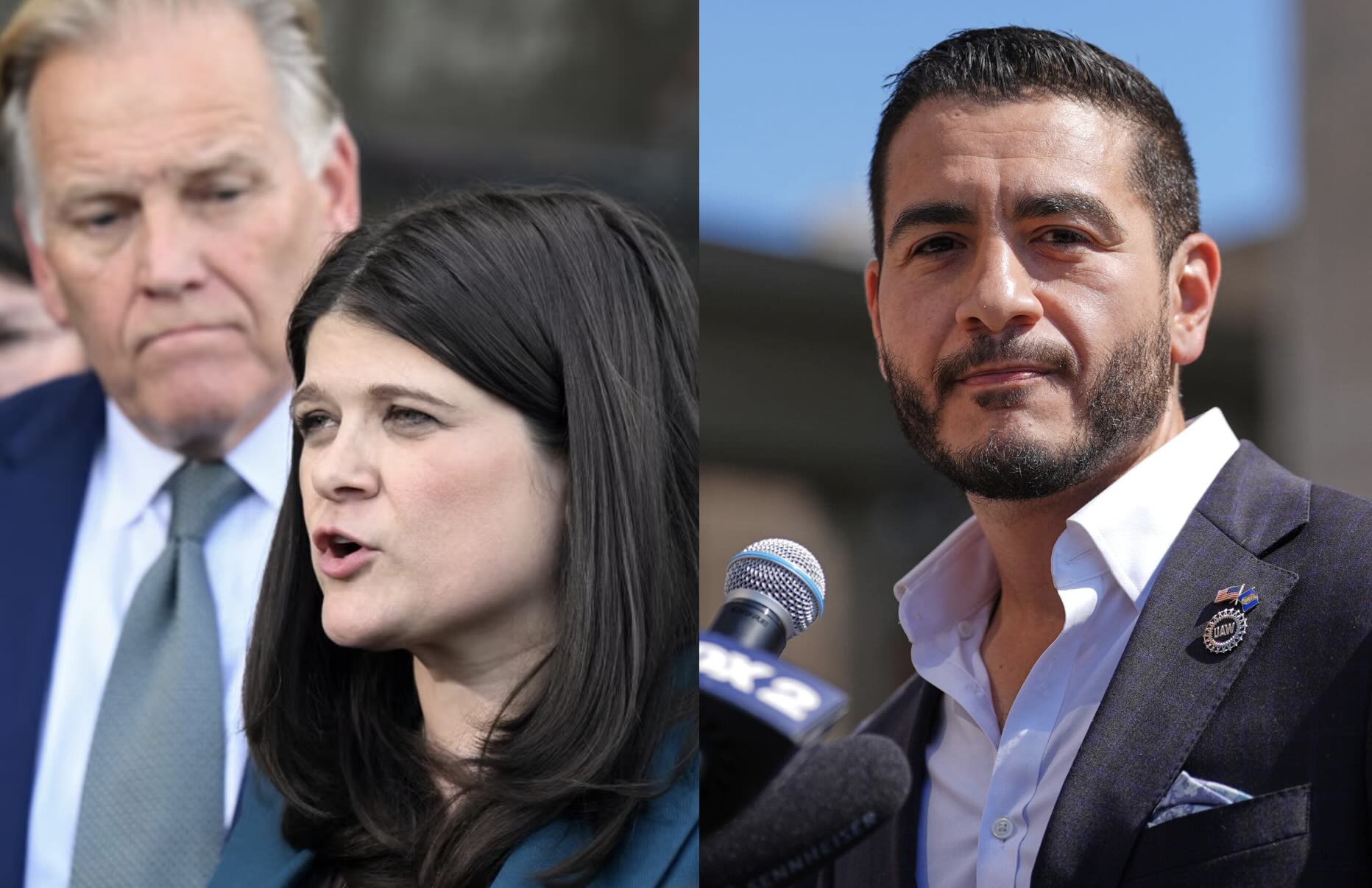
Haley Stevens (left) and Abdul El-Sayed (right) | Photo: Emerald Book Image
For decades, the American Israel Public Affairs Committee operated as a quiet, bipartisan force in Washington—a lobbying group whose influence was felt but rarely seen. That era is over.
In 2026, AIPAC and its affiliated super PAC, the United Democracy Project (UDP), have become the single largest outside spenders in Democratic primaries, pouring tens of millions of dollars into races across the country to support candidates who align with their foreign policy priorities. The strategy has worked—AIPAC-backed Democrats won primary after primary. But in Michigan, the strategy didn't just defeat a progressive challenger. It fractured the party itself.
On Sunday, November 1, 2026—less than 48 hours before Election Day—Democratic Representative Haley Stevens stood alongside Republican Mike Rogers at Perfecting Church in Detroit and endorsed him for the U.S. Senate. The move shocked political observers across the spectrum: Stevens, a centrist Democrat with deep ties to party leadership, had just abandoned her own party's nominee, progressive Abdul El-Sayed, in one of the most critical Senate races in the country.
The Money Behind the Moderate
The endorsement didn't emerge from nowhere. It was the culmination of a primary battle that had been shaped—some say distorted—by unprecedented outside spending. According to Federal Election Commission tracking data, AIPAC and its affiliated committees have directed over $15.8 million to support Haley Stevens across her career, including more than $11 million during the 2026 election cycle alone.
The breakdown reveals two distinct channels of influence:
- Direct and earmarked contributions: $1,427,974 given directly to Stevens' campaign committee, including bundled individual donations routed through the AIPAC portal and direct PAC contributions.
- Independent expenditures: $14,444,056 spent by the United Democracy Project on television ads, mailers, and digital campaigns—money that by law cannot be coordinated with Stevens' staff but which fundamentally reshaped the race.
- 2026 primary surge: During the August Democratic primary, UDP deployed roughly $10.5 million specifically to boost Stevens and oppose El-Sayed, giving her side an estimated 12-to-1 television ad spending advantage in the final weeks.
When accounting for funds spent strictly to attack her opponents—alongside contributions from allied pro-Israel groups like DMFI PAC and NORPAC—some election trackers calculate the broader pro-Israel network directed upwards of $30 million to $35 million to influence her races. It represents the largest single-race investment in AIPAC's history.
The Primary That Broke the Party
The August primary between Stevens and El-Sayed was never just a contest between two candidates. It was a proxy war for the soul of the Democratic Party—and the money made that explicit.
El-Sayed, 41, built a grassroots campaign statewide on a message of universal healthcare, getting money out of politics, and a foreign policy that conditioned U.S. military aid on human rights. He repeatedly criticized Stevens' reliance on AIPAC funding, arguing that candidates requiring multi-million-dollar outside spending were detached from local interests.
Stevens, for her part, ran as a pragmatic centrist—a Democrat backed by Senate Leader Chuck Schumer and the party's national infrastructure, viewed as the safest bet to keep Michigan's open Senate seat in Democratic hands. But the scale of AIPAC's spending complicated that narrative, fueling progressive accusations that her primary allegiance lay with her largest donors rather than the standard party platform.
The immediate catalyst for the rupture came in the final days of the general election campaign. A progressive group ran an advertisement linking U.S. military aid to Israel with high grocery prices at home—an ad Stevens characterized as antisemitic. She publicly demanded that El-Sayed condemn it. When his campaign instead uninvited her from a scheduled Democratic unity event, Stevens took it as a final rejection.
"Abdul made very clear that I was not welcome in his campaign," Stevens said in her endorsement video. "And he's right. And that's why I am endorsing Mike Rogers."
The Fallout: A Party Excommunicates Its Own
The backlash was swift and absolute. Senate Democratic Leader Chuck Schumer, who had actively backed Stevens during the primary, called her decision a "despicable betrayal." Representative Nancy Pelosi stated that Stevens had "dangerously betrayed Michigan families."
Michigan Democratic Party Chair Curtis Hertel took the extraordinary step of announcing that Stevens is no longer a member of the state party and will be permanently barred from renewing her membership. Her own long-term congressional staff—including her Chief of Staff—resigned en masse on the day of the announcement and issued a statement re-endorsing El-Sayed.
Meanwhile, Republican leadership celebrated. Donald Trump praised Stevens as "brave" during a campaign rally, and the GOP's messaging apparatus seized on the defection as evidence of Democratic dysfunction.
For his part, El-Sayed dismissed the endorsement with pointed indifference. "At the end of the day, I actually don't think about Haley Stevens," he told reporters, insisting his campaign remained focused on "lowering the cost of gas and groceries, passing Medicare for All, and getting corporate money out of politics."
The Contradiction at the Heart of the Endorsement
What makes Stevens' decision so striking is not just that she crossed party lines—it's that she crossed them for a candidate whose domestic policy positions she had previously declared absolute "red lines."
During her time in Congress, Stevens built a record as a mainstream Democrat: pro-choice, pro-labor, supportive of LGBTQ+ rights, and critical of Donald Trump's policies. Mike Rogers, by contrast, holds traditional conservative stances on abortion access and LGBTQ+ rights. Stevens' own website contains extensive material criticizing Trump's agenda. When pressed on CNN about how she could support Rogers—whom she had previously condemned as a "rubber stamp" for MAGA—Stevens did not directly explain how she squared those policy differences.
Critics across the political spectrum have called the move bizarre: a politician sacrificing her entire domestic platform for a single foreign policy stance. But that decision reflects a deeper reality about how AIPAC's financial influence has reshaped the incentive structure for moderate Democrats. When a single issue—and a single donor network—can determine whether a candidate survives a primary, that issue inevitably becomes paramount.
A Microcosm of a National Divide
The Michigan implosion is not an isolated incident. It is the most visible manifestation of a fault line that has been widening within the Democratic Party for years.
On one side are establishment Democrats and pro-Israel advocates who argue that support for Israel has historically been a bipartisan cornerstone of U.S. foreign policy, championed by mainstream leaders including President Joe Biden. From their perspective, AIPAC-backed Democrats simply reflect the views of millions of American voters who support a robust U.S.-Israel alliance—and their domestic voting records align closely with the mainstream Democratic platform on judicial nominations, reproductive rights, climate change, and labor rights.
On the other side are progressives who argue that AIPAC's super PAC spending is distorting Democratic primaries, defeating progressive candidates, and pulling the party's center of gravity to the right on foreign policy. They point out that AIPAC also heavily funds and endorses hundreds of Republicans, and they cite Stevens' defection as evidence that these alliances can ultimately supersede traditional party loyalty.
The scale of the spending makes the debate difficult to ignore. In Michigan alone, AIPAC's investment in a single Senate primary exceeded the total spending of many statewide campaigns. Across the country, the group has become a dominant force in Democratic primaries—funding moderates, defeating progressives, and reshaping the ideological composition of the party's congressional caucus.
What Happens Next
With Election Day just hours away, the immediate question is how Stevens' endorsement will affect the Senate race. El-Sayed's campaign says the controversy has inadvertently energized his support base, and progressive groups are using the defection to mobilize voters. Rogers' campaign, meanwhile, is hoping the endorsement lends him credibility with moderate Democrats and independents.
But the longer-term question is what the Michigan episode means for the Democratic Party's future. If a lifelong Democrat backed by party leadership can be pushed to endorse a Republican over a single foreign policy dispute—and if the state party responds by permanently excommunicating her—what does that say about the party's ability to hold together its increasingly fractious coalition?
The answer may depend on whether Democrats can find a way to debate Israel policy without treating it as a loyalty test—and whether the party's donor class and its grassroots can ever reconcile their competing visions for American foreign policy.
For now, the Michigan Senate race has become a national test case: not just for who wins a seat, but for whether a party can survive the divisions that money—and a single, outsized foreign policy issue—have created.
No Ads. By Us. For Us.
This article was made possible by readers like you. We hope it inspired you to support Emerald Book, so we can continue producing content like this.
We will never show you ads, sell your data, or require a subscription to consume our content. Your gift helps us keep the truth accessible.
Click the Support button to give a gift of any amount today.
Thank you for making this work possible.