

Emerald Pages
◆
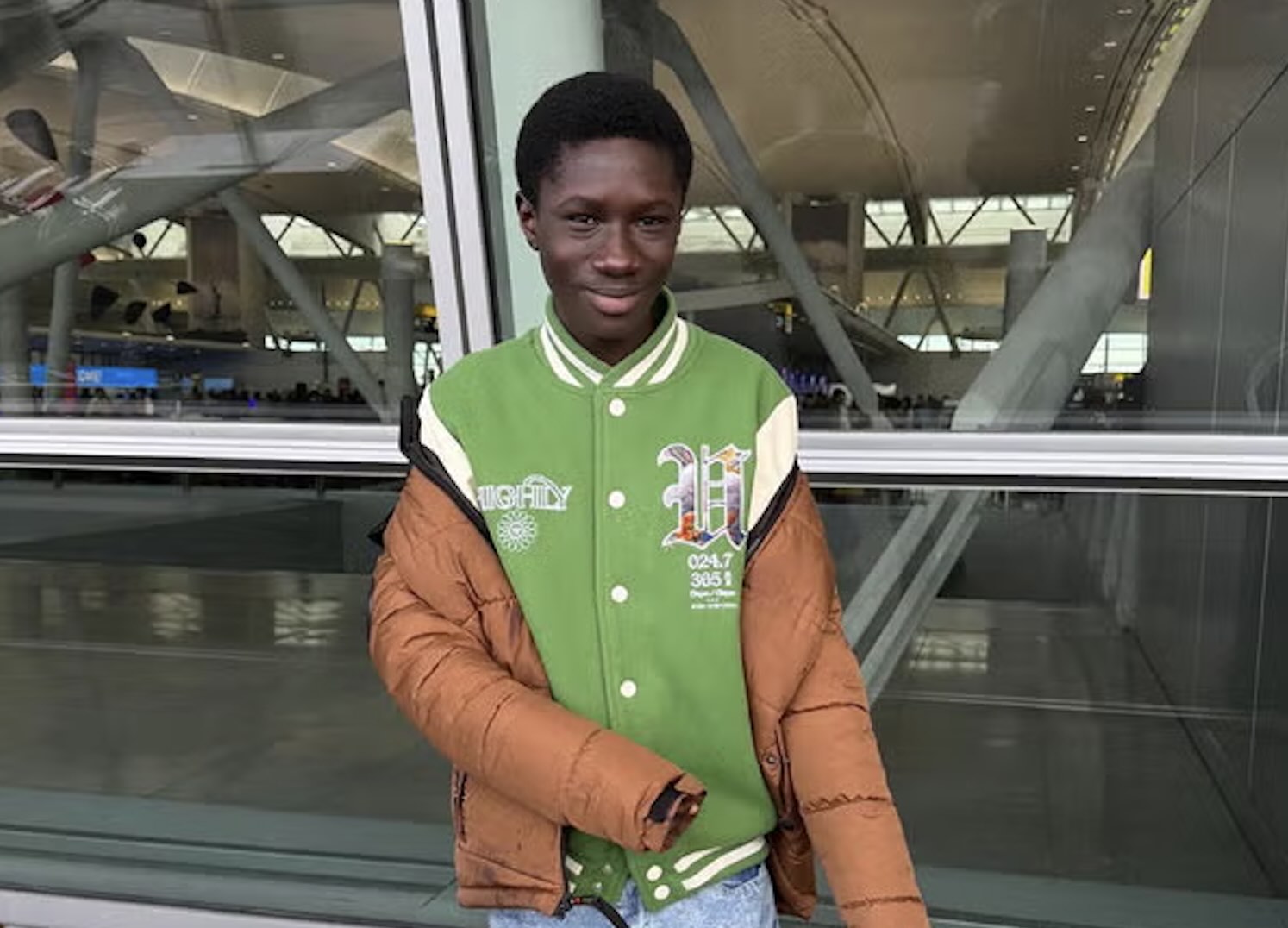
Javits Frimpong Photo: GoFundme
The phone call came from New York to Kumasi, Ghana, and it carried the worst news a mother can receive. Doris Adu Gyamfi learned that her 15-year-old son, Javits Frimpong, had been chased through the streets of the Claremont neighborhood in the Bronx and shot once in the abdomen. He had been in America for exactly one year, one month, and one day. He was pronounced dead at St. Barnabas Hospital shortly after 9:30 a.m. on Thursday, October 29, 2026.
Surveillance footage captured the terror of his final moments. Javits, wearing his backpack and walking to DreamYard Preparatory School, is seen running for his life. Behind him, an individual dressed entirely in black gives chase. Across the street, two more figures in black sweatsuits and blue surgical masks flee the scene. Javits runs about a block after being struck, then collapses. The three suspects disappear into the 100-plus acres of Crotona Park, where the dense tree cover and lack of security cameras swallowed them whole. To date, no arrests have been made.
His father, Thomas Frimpong, believes he knows why. Just three days before the shooting, the school principal had called to say that two students had been suspended for bullying Javits. The father says his son was innocent—merely defending himself. The NYPD has not officially confirmed a motive, but investigators are focusing on the school bullying connection. The suspects, described as teenagers between 16 and 18 years old, remain at large.
But the deeper tragedy lies in what the Frimpong family could not have known when they made the agonizing decision to send their son to America. They were entering a nation with approximately 500 million civilian firearms in circulation—more guns than people. According to the Small Arms Survey, the United States has an estimated 120.5 firearms for every 100 residents. Yemen ranks a distant second with roughly 53 guns per 100 people. No other high-income nation comes remotely close.
A Nationwide Crisis
The scale of American gun violence is not confined to cities like the Bronx. Firearm deaths are a nationwide phenomenon, and the culture of gun proliferation is ubiquitous across the country. Public health data published in journals like JAMA reveals that overall firearm death rates in rural counties actually exceed urban rates by up to 40%. The difference lies only in the type of tragedy: urban centers are driven predominantly by gun homicides, while suburban and rural areas see higher rates of gun suicides and high-casualty mass shootings. The harm is everywhere.
In communities across America, gifting a child a firearm is viewed as a traditional rite of passage. This is not limited to small-caliber hunting rifles. It includes military-style semi-automatic weapons. In Georgia, a father gave his 14-year-old son an AR-15-style rifle as a Christmas gift—months after the boy had been questioned by police over threats to shoot up a school. The teenager used that weapon to kill four people at Apalachee High School. His father was later sentenced to 15 years in prison. And the gun industry has gone further: one manufacturer released the JR-15, a scaled-down AR-15 marketed explicitly for children, with the tagline that it "looks, feels, and operates just like Mom and Dad's gun." Federal law sets no minimum age for long-gun possession, and many states permit parents to gift rifles to minors. This is not a benign tradition; it is part of the problem. It normalizes the presence of deadly weapons in the hands of children and reinforces a culture in which firearms are treated as ordinary household items rather than instruments of lethal violence.
This abundance has fostered a multibillion-dollar domestic industry and a highly visible social infrastructure—ranging from massive conventions and specialized media to widespread recreational shooting sports—that exists nowhere else in the developed world. Approximately 30% of American adults report personally owning a gun, but the massive statistical surplus is largely driven by avid collectors and enthusiasts who own multiple firearms. The sheer volume of hundreds of millions of guns ensures that gun presence is a fundamental, nationwide framework of American life. It is a culture that produces harm on a scale unmatched by any other developed nation.
Ghana: A World Where Guns Are Rare
In Ghana, where Javits spent his entire childhood, private firearm ownership is exceedingly rare and strictly regulated by the state. Civilian gun ownership requires extensive background checks, permits, and registration. The country has a homicide rate of approximately 1.7 per 100,000 people—a fraction of the United States' rate of 6.4 per 100,000. For Ghanaian families, disputes that arise among teenagers are typically settled through words, family mediation, or school intervention. The introduction of a firearm into a schoolyard conflict is virtually unheard of.
When Javits arrived in New York in October 2025 to reunite with his father, he stepped into a completely different reality. The Bronx, like many under-resourced urban neighborhoods, experiences rates of gun violence that would be considered a public health emergency in any other developed nation. In 2026 alone, the NYPD has seized over 4,500 illegal guns across New York City, including 900 in the Bronx. These weapons flow into the borough through a pipeline fed by states with permissive gun laws, where straw purchases and theft divert legal firearms into the hands of teenagers.
Community leaders within the West African diaspora say the shock is profound. Families research economic opportunities, educational systems, and housing costs before migrating. They do not research gun violence statistics, because the possibility that their child could be shot on the way to school is simply not part of the calculus. The America they imagined—a land of safety, wealth, and supreme stability—is, in reality, a nation where the sheer volume of hundreds of millions of firearms ensures that when localized conflicts do happen, they carry a lethal severity virtually unseen in the rest of the developed world.
The Information Gap
General statistics about "American gun violence" do not give newcomers a clear picture of localized risks. Because firearm violence in the United States is heavily concentrated in specific, under-resourced neighborhoods, newly arrived families who settle in these areas due to affordable housing options often discover the localized reality of street violence only after they arrive.
An immigrant's awareness depends heavily on their country of origin and their reasons for migrating. Individuals fleeing active conflict zones or regions with high levels of cartel or political violence are often acutely aware of gun violence, though they may expect a higher standard of systemic protection upon reaching the United States. But for families from stable, low-crime nations like Ghana, the reality of American gun culture remains abstract until it becomes personal. The Frimpong family learned this lesson in the most devastating way possible.
Javits's short life in America was defined by promise. Neighbors and teachers at DreamYard Preparatory School described him as quiet, clever, and focused. His father said his son mostly kept to himself and did not spend much time outside the home. He was using his first year in America to focus on his education. His dream was to become a doctor. The father, speaking through tears at a vigil, said simply: "My son was precious, very clever."
A Community Demands Justice
The killing has sparked outrage across the Bronx and the West African diaspora. Vigils have been held demanding justice. Family friends held a rally over the weekend pleading with the public for tips and urging the responsible individuals to turn themselves in. Bronx District Attorney Darcel Clark held a press conference directly appealing to school families for anyone with concrete information to come forward. The NYPD is asking anyone with information to contact Crime Stoppers at 1-800-577-TIPS.
The case has also drawn international attention. Following a call between New York City Mayor Zohran Mamdani and President Trump, an emergency visa was fast-tracked for Javits's mother, who remains in Ghana. She is traveling from Kumasi to Accra to begin processing the paperwork so she can come to New York to attend her son's funeral and say goodbye in person. Ghanaian Foreign Affairs Minister Samuel Okudzeto Ablakwa confirmed that the government is coordinating with U.S. authorities to assist her. Mamdani stated: "The murder of a child is a pain no parent should have to endure, let alone from thousands of miles away."
- Approximately 500 million civilian firearms are in circulation in the United States—more than the entire population
- The U.S. has a gun homicide rate 25 times higher than other high-income nations
- Rural firearm death rates exceed urban rates by up to 40%, driven by suicides and mass shootings
- New York City seized over 4,500 illegal guns in 2026 alone, including 900 in the Bronx
- Ghana's homicide rate is 1.7 per 100,000—the U.S. rate is 6.4 per 100,000
Javits's death has forced a highly visible conversation among education officials, parents, and community advocates about the rising rates of school harassment and how easily minor schoolyard conflicts escalate into lethal gun violence due to the availability of illegal firearms. But the problem is not confined to any single city, demographic, or geographic area. Gun violence is a nationwide crisis, woven into the fabric of American life, affecting urban, suburban, and rural communities alike. The culture that produces it is ubiquitous, and its harm is universal.
A 15-year-old boy came to America to become a doctor. He was chased down and shot in the stomach on his way to school. He ran a block before he collapsed. His mother is still trying to get a visa to bury him. The three teenagers who killed him are still out there, somewhere in the Bronx. And the gun that ended his life is just one of hundreds of millions, in a country that long ago decided it could live with the consequences.
No Ads. By Us. For Us.
This article was made possible by readers like you. We hope it inspired you to support Emerald Book, so we can continue producing content like this.
We will never show you ads, sell your data, or require a subscription to consume our content. Your gift helps us keep the truth accessible.
Click the Support button to give a gift of any amount today.
Thank you for making this work possible.