

Emerald Pages
◆
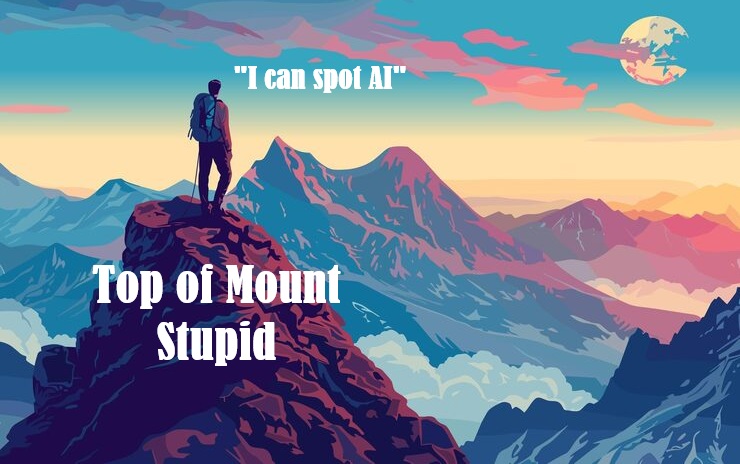
Photo: Emerald Book Graphic
Scroll through any social media platform today and you will find them. The self-appointed AI detectives. They write comments like "Obviously AI—they used an em dash." or "This uses the word 'delve,' so it's definitely ChatGPT." They speak with the unshakable certainty of a forensics expert. But here is the uncomfortable truth that psychologists have understood for decades: people with the least actual knowledge about a subject are often the loudest and most confident. This is the Dunning-Kruger effect, and it is currently running rampant through every online discussion about artificial intelligence.
The Dunning-Kruger effect, first identified by psychologists David Dunning and Justin Kruger in 1999, describes a specific cognitive bias. People who possess very low ability in a domain tend to dramatically overestimate their competence. They do not know enough to recognize their own mistakes. The classic chart features a steep early peak called "Mount Stupid"—a point where confidence reaches its absolute maximum while actual knowledge remains near zero. For AI detection, millions of internet users are currently standing on this peak, shouting down at anyone who disagrees.
The Numbers Do Not Lie
The gap between confidence and reality is not just anecdotal. It has been measured. Scientific studies published in the Communications of the ACM found that the average person can distinguish between AI and human content only 51% to 57% of the time. That is statistically indistinguishable from flipping a coin. When AI produces high-quality, professional content, human accuracy crashes below 20%. Even experienced school teachers, who actively try to catch AI cheating, guess incorrectly most of the time, achieving only 37.8% accuracy.
Yet go online and you will find influencers and self-proclaimed experts who claim near-perfect detection abilities. They are not lying—they are genuinely experiencing the Dunning-Kruger effect. They have successfully spotted a few obviously bad AI examples: the sixth finger, the blurry background, the robotic phrasing. These small victories create an illusion of mastery. They do not realize that modern AI systems produce content that slips past their radar constantly. They are catching the slowest fish in a small pond and declaring themselves masters of the ocean.
- The "Delve" Trap: People fixate on a single word as a tell, but AI models update constantly. That trick may already be obsolete.
- The Vibe Check: Many flag writing as AI simply because it uses formal language or standard formatting, leading to false accusations against real human writers.
- The Blind Spot: Humans consistently miss high-quality AI content because it has no obvious flaws to anchor their suspicion.
Seventy Years of History, Ignored
The Dunning-Kruger effect is amplified by a profound lack of historical context. Many online users behave as if AI was invented two years ago when ChatGPT launched. In reality, computer scientists have been building these systems for over seven decades. The foundational concepts—neural networks, backpropagation, generative adversarial networks—have been refined through generations of research. Modern AI did not appear from nowhere. It stands on the shoulders of thousands of academic papers and countless failed experiments.
The online "AI expert" who discovered the technology last year is trying to fight hyper-advanced algorithms using basic "vibes" and outdated parlor tricks. They have skipped decades of learning and do not even know what they do not know. This is the double burden of the Dunning-Kruger effect: they lack the skill to detect advanced AI, and they lack the metacognition to recognize their own failure.
Why the Experts Agree With You
Here is the crucial distinction that Dunning-Kruger observers miss. Actual computer scientists and software engineers—the people who build this technology—openly admit that perfect AI detection is impossible. OpenAI, the company behind ChatGPT, built its own text detector and then shut it down because it was highly inaccurate. Their official statement advised schools not to rely on detection tools to catch cheating. Wikipedia banned AI-generated content while simultaneously warning editors not to trust AI detectors, noting their "non-trivial error rates."
The real experts understand something the online detectives refuse to accept. A perfect AI detector is mathematically impossible because AI systems are specifically trained to defeat detection. Every time a detector catches an AI, the AI learns from the mistake and evolves. It is an arms race where the offense is guaranteed to win because they control the underlying code. The loud voices on social media are not outsmarting the machines. They are being outperformed by them every single day without ever realizing it.
The wise response to AI content is not arrogant certainty but humble uncertainty. Ask: Does this work provide value? Is the information verified? Does it change my mind or help me understand something new? The question of origin—human or machine—is increasingly irrelevant. What matters is quality. Bad writing is bad writing regardless of who or what produced it. Great work speaks for itself. And the people who actually produce great work, unlike the inhabitants of Mount Stupid, rarely feel the need to announce their expertise from the rooftops.
No Ads. By Us. For Us.
This article was only made possible by readers like you. We hope it inspired you to support Emerald Book, so we can continue producing content like this.
We will never show you ads, never sell your data, and never require a subscription to consume our content. Your gift helps us keep the truth accessible.
Please click the Support button on the bottom right of your screen to make a gift of any amount today.
Thank you for making this work possible.