

Emerald Pages
◆
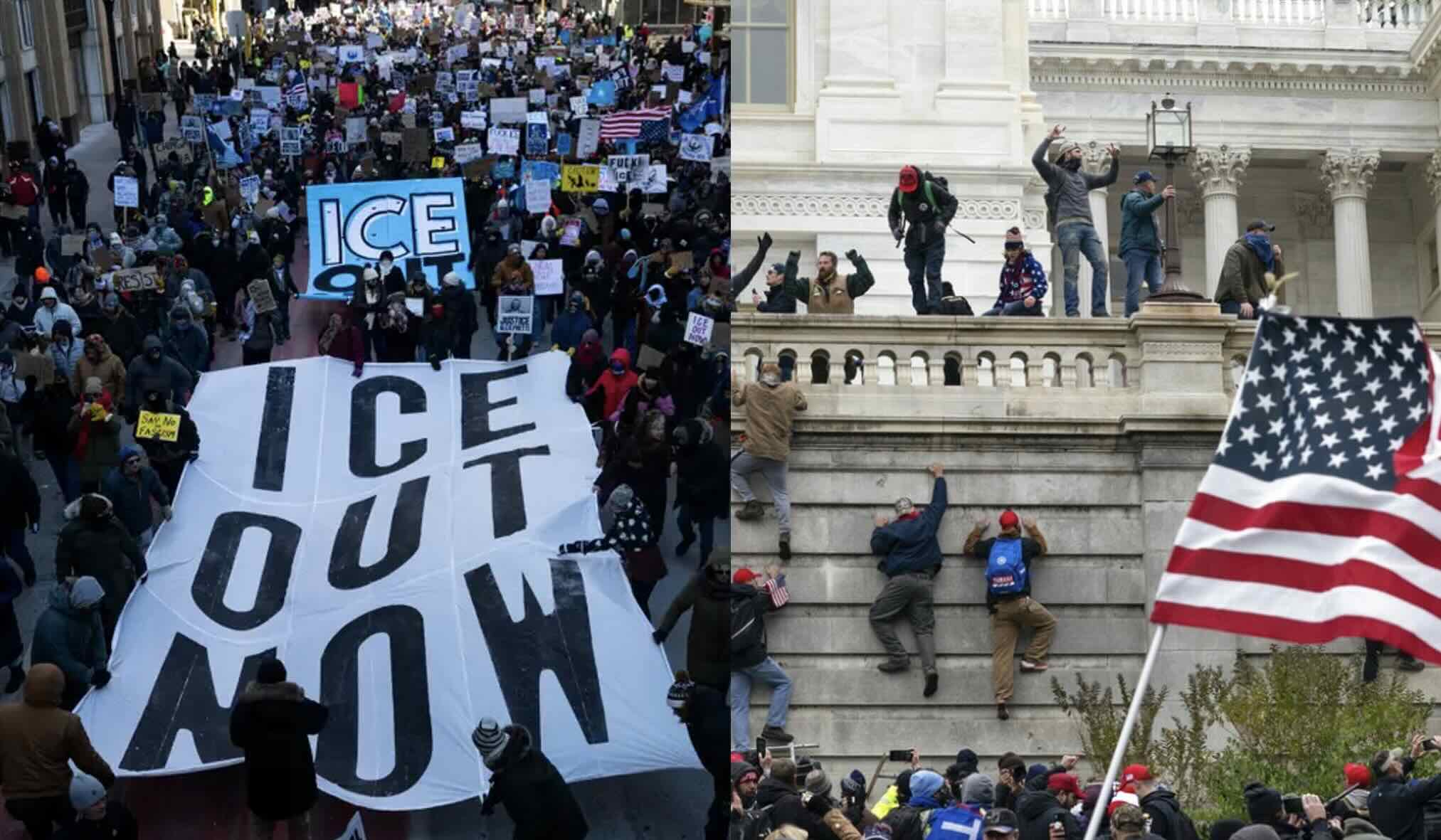
Photo: Stephen Maturen/Getty Images | AP Photo/Jose Luis Magana
In June 2026, eight anti-ICE protesters were sentenced to prison terms ranging from 30 to 100 years for their role in a demonstration outside the Prairieland ICE detention center in Texas. The harshest sentence — 100 years — went to Benjamin Song, who shot and wounded a police officer during the protest. But the sentences didn't stop there. Others who never fired a weapon, who were not even present when the shooting occurred, received decades behind bars. A man who simply moved a box of political pamphlets for his wife after her arrest was given 30 years. The Justice Department prosecuted the group as an "Antifa terror cell" following a 2025 presidential declaration labeling Antifa a domestic terrorist organization. A federal judge applied a rarely used "terrorism enhancement" rule and stacked the sentences consecutively, turning what would have been shorter terms into life-altering punishments.
Just 18 months earlier, on January 20, 2025, President Donald Trump signed a sweeping blanket presidential pardon that set free roughly 1,500 people involved in the January 6, 2021, attack on the U.S. Capitol. Among those pardoned were individuals convicted of violent assaults against police officers — including David Dempsey, who used crutches, flagpoles, and his feet to stomp on officers' heads. Enrique Tarrio, the Proud Boys leader who was convicted of seditious conspiracy for organizing the breach while in a hotel room in Baltimore, had his 22-year sentence erased. The pardon was "full, complete, and unconditional," wiping away convictions for those who had attacked the seat of American democracy in an attempt to overturn a presidential election.
The contrast between these two cases is not an accident of the legal system. It is a direct reflection of how the United States defines political violence — not by the severity of the act, but by who commits it and who holds the power to label it. Those who stormed the Capitol are called patriots by the administration that freed them. Those who protested an immigration detention center are called terrorists by the administration that imprisoned them for life. The difference is not the violence. It is power.
A View From the Black Community: The U.S. Government Has Always Been Fascist
For many white Americans, the events of recent years — the January 6 insurrection, the pardoning of its participants, the aggressive prosecution of left-wing protesters — have been a shocking revelation. The realization that the U.S. government will protect those who align with power while crushing those who challenge it has shaken the faith of millions. But for Black Americans, this is not a revelation. It is a confirmation of what they have always known.
From the perspective of Black people in America, the U.S. government has always been fascist. The definition of fascism — authoritarian nationalism, the suppression of political opposition, the use of state power to crush dissent, the protection of the powerful at the expense of the powerless — describes the American experience for Black people from the very beginning. Slavery was state-sanctioned fascism. Black people were legally classified as three-fifths of a person. The government enforced a system of chattel slavery that treated human beings as property. When slavery ended, Jim Crow laws replaced it — a system of state-enforced racial segregation and oppression that lasted for nearly a century.
Lynchings were public spectacles of state-sanctioned terror. Between 1882 and 1968, nearly 4,500 Black people were lynched in the United States. The government did not stop these murders — in many cases, it participated in them or looked the other way. When Black people attempted to vote, they were met with poll taxes, literacy tests, violence, and murder. The government systematically suppressed Black political participation for generations. When Black people tried to build wealth, the government engaged in redlining — the systematic denial of mortgages and loans to Black neighborhoods, trapping generations in poverty. The legacy of redlining continues to this day, with Black families having significantly less wealth than white families.
When Black people protested this oppression — during the Civil Rights Movement, during the Black Power Movement, during the uprisings of the 1960s — the government responded with violence. The FBI's COINTELPRO program targeted Black activists, including Martin Luther King Jr., with surveillance, harassment, and assassination. The government infiltrated Black organizations, framed activists, and murdered leaders like Fred Hampton. The state used every tool at its disposal to crush Black dissent. This is not an exaggeration — it is documented history.
Now, white Americans are seeing the same government that has always oppressed Black people turn its attention to them. The terrorism enhancement used against the anti-ICE protesters is the same tool that has been used against Black activists for decades. The mass surveillance, the aggressive prosecution, the politicized use of law enforcement — these are not new. They are the continuation of a pattern that has existed since the founding of the country. For Black Americans, the current moment is not a surprise. It is the inevitable outcome of a government that has always prioritized power over justice.
What Is Antifa? And Why Is the U.S. Government Targeting Anti-Fascists?
The word "Antifa" is short for "anti-fascist." It is not an organization with a central hierarchy or leadership structure, but rather a loosely affiliated network of activists who oppose fascism, white supremacy, and authoritarianism. Antifa activists have historically been at the forefront of counter-protests against neo-Nazi groups, Ku Klux Klan rallies, and far-right extremism. Their tactics have included doxing, property damage, and physical confrontation with fascist groups. In many countries, anti-fascist resistance is seen as a necessary defense against the rise of authoritarian movements.
But in the United States, the federal government has taken a different approach. In 2025, a presidential executive order officially designated Antifa as a domestic terrorist organization. This designation allows the Department of Justice to prosecute anyone associated with Antifa under terrorism statutes, including the "material support of terrorism" law. The irony is staggering: the U.S. government is now using terrorism laws to punish people whose core ideology is opposition to fascism. This is a dangerous inversion of values — the government is treating anti-fascists as enemies of the state while pardoning those who attempted to overthrow a democratically elected government.
Is the U.S. Government Leaning Toward Fascism?
The question many are now asking is whether the United States government itself is moving in a fascist direction. Fascism, as defined by historians and political scientists, is characterized by authoritarian nationalism, the suppression of political opposition, the use of state power to crush dissent, and the glorification of a strong, charismatic leader. When the U.S. government labels anti-fascists as terrorists while pardoning those who attacked the Capitol to keep a particular leader in power, it raises uncomfortable questions about which side of that equation the government is on.
Critics point to several warning signs. First, the executive order designating Antifa as a terrorist organization was issued unilaterally by the president, without congressional oversight or due process. Second, the terrorism enhancement used in the Texas case was applied to people who were not even present at the shooting, effectively punishing political association rather than individual action. Third, the blanket pardon of January 6 defendants — including those convicted of violent assaults on police — signals that violence is acceptable when it serves the administration's political goals.
Civil liberties groups warn that the U.S. is entering dangerous territory. When the government defines its political opponents as terrorists, uses the full weight of the law to crush dissent, and pardons those who use violence in its defense, it is adopting the very tactics that define authoritarian regimes. The fact that those being punished are anti-fascists — people who explicitly oppose the kind of authoritarianism that is now being used against them — adds a layer of irony that is both tragic and deeply troubling.
The Texas Anti-ICE Prosecution: Maximum Terrorism Penalties
The Prairieland demonstration took place outside an ICE detention center in Alvarado, Texas. Protesters threw fireworks and vandalized cars. The event escalated when Benjamin Song shot and wounded a police officer. Song received the maximum sentence of 100 years. But the prosecution did not stop with the shooter. The Department of Justice prosecuted the group as an "Antifa terror cell" under a 2025 presidential declaration that designated Antifa a domestic terrorist organization. The judge applied a "terrorism enhancement" rule that drastically increases penalties if an offense is meant to influence the government through intimidation. The sentences were then "stacked" consecutively rather than concurrently, turning what would have been shorter terms into 50-to-70-year sentences for defendants who had already left the scene before the shooting occurred.
Legal experts called the sentences "stunningly severe" and rare for political demonstrations. Civil liberties groups warned that the case set a dangerous precedent: the government could use terrorism laws against protest movements based on political affiliation, not violence. The statute used to charge them requires no relationship to a terrorist organization — it merely requires that the act be intended to influence government policy. This definition could apply to nearly any political protest that turns disruptive.
The January 6 Pardons: Absolute Executive Power
The January 6 attack on the U.S. Capitol involved approximately 140 police officers injured, multiple deaths, millions of dollars in damages, and an explicit attempt to disrupt the peaceful transfer of power. The maximum sentence handed down by the courts was 22 years for Enrique Tarrio, who was convicted of seditious conspiracy. The longest sentence for someone who actually committed physical violence was 20 years for David Dempsey, who prosecutors called "political violence personified." Yet despite the scale and severity of the attack, federal prosecutors largely avoided using the "terrorism enhancement" penalty. In the few cases where they asked for it, judges rejected it, calling it "overkill."
Then came the presidential pardon. On January 20, 2025, President Trump issued a blanket pardon to roughly 1,500 January 6 defendants. The pardon power under the U.S. Constitution is absolute — the president can wipe away any federal conviction for any reason, regardless of the crime's severity. Trump's executive order granted "full, complete, and unconditional" pardons to the rioters, including those convicted of violent acts against police. Their convictions were erased. Those still in prison were released. Those awaiting trial had their cases dismissed.
- Prairieland Nine (Anti-ICE protesters): Up to 100 years in prison. Prosecuted under terrorism laws. Sentences stacked consecutively. No executive intervention.
- January 6 Capitol rioters: Up to 22 years originally. No terrorism enhancement applied. Granted blanket presidential pardons. All convictions erased.
- Key difference: The anti-ICE protesters challenged a government system (ICE). The January 6 rioters aligned with the incoming administration's political goals.
- Historical context: For Black Americans, this is the same government that enslaved, lynched, redlined, and suppressed their votes for centuries.
The Impact on Public Trust
Whether people see this as a political division or an issue of oppressors versus the oppressed, the result is the same: a deep loss of trust in American justice. When two similar acts of violence lead to completely opposite results — freedom for one group and 100 years in prison for another — it leaves many convinced that the law is not fair, but is instead driven by power and politics. Civil rights groups are appealing the Texas sentences, arguing that the "terrorism enhancement" was applied unconstitutionally and that the stacking of sentences violated due process. Meanwhile, those who received pardons for January 6 are free, their convictions erased by executive order.
For Black Americans, however, the loss of trust in the justice system is not new. Studies have shown that Black Americans are disproportionately arrested, convicted, and sentenced to longer prison terms than white Americans for the same crimes. The criminal justice system has long been a tool of social control in Black communities. The current moment is not a rupture from that history — it is a continuation of it. The only difference is that now, more white Americans are beginning to see the system for what it is.
The contrast between these cases reveals a fundamental truth about the American legal system: justice is not always neutral. It is shaped by who holds power, who controls the narrative, and who gets to decide which political violence is labeled terrorism and which is labeled patriotism. When a president can pardon those who attacked the Capitol while a judge sentences protesters to 100 years in prison, it becomes clear that the system is not broken — it is working exactly as designed for those in power.
A Final Question: Whose Side Is the Government On?
The United States was founded on the principle of resisting authoritarian rule. The Declaration of Independence explicitly justifies rebellion against oppressive governments. The Constitution was designed to prevent the concentration of power. Yet today, the U.S. government is using anti-terrorism laws — originally designed to combat foreign threats like Al-Qaeda — against citizens who oppose fascism and the detention of immigrants. At the same time, it is granting pardons to those who attempted to overturn an election by force.
This is the defining contradiction of our time. The U.S. government is punishing anti-fascists while embracing those who used violence to keep a leader in power. If the government is willing to label anti-fascists as terrorists and pardons insurrectionists as patriots, then the question is no longer whether the U.S. is becoming fascist — it's whether it has already crossed that line.
For Black Americans, the answer has always been clear. The government that enslaved, lynched, redlined, and suppressed Black votes for centuries has never been on the side of justice. It has always been on the side of power. The current moment is simply a reminder of that truth. Now, white Americans are finally seeing the true colors of the government that Black people have always known. The question is what they will do with that knowledge.
No Ads. By Us. For Us.
This article was made possible by readers like you. We hope it inspired you to support Emerald Book, so we can continue producing content like this.
We will never show you ads, sell your data, or require a subscription to consume our content. Your gift helps us keep the truth accessible.
Click the Support button to give a gift of any amount today.
Thank you for making this work possible.