

Emerald Pages
◆
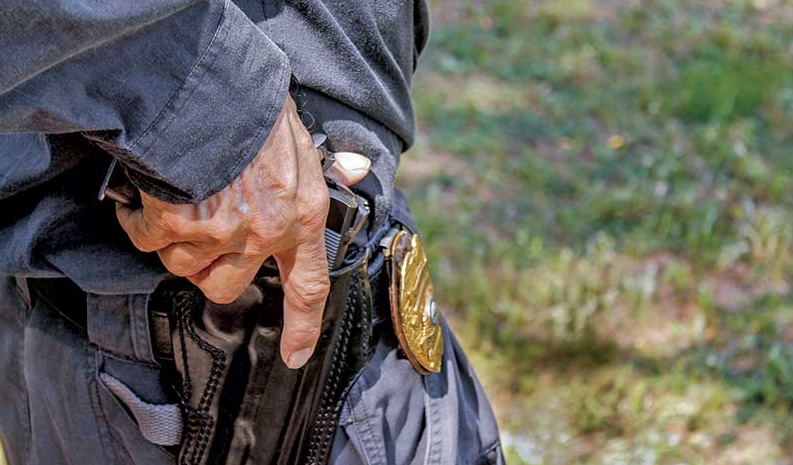
Photo: “Hand on a holstered gun” | American Handgunner
The average American police officer spends about 21 weeks in basic training. That is roughly 806 hours. By comparison, a licensed barber in many states trains for 1,000 to 1,500 hours. A commercial airline pilot logs 1,500 hours of flight time before they ever carry passengers. And yet we ask newly minted officers to master constitutional law, firearms, high-speed driving, crisis negotiation, and human psychology in less time than it takes to learn how to properly cut hair.
The problem goes far beyond mere quantity of hours, however. The content of American police training is deeply, structurally broken. According to data from the Bureau of Justice Statistics and policing think tanks like the Council on Criminal Justice, U.S. police academies dedicate an average of 80 hours to firearms training, 49 hours to defensive tactics and physical control, and 21 hours to driving. By contrast, they spend barely 10 hours on communication skills, 8 hours on de-escalation, and 8 hours on crisis intervention. In other words, the system spends three times as much time teaching officers how to shoot as it does teaching them how to talk.
The irony is that this training prioritizes the 3% of police work that involves violence, while neglecting the 97% of the job that involves talking to people, handling mental health crises, and solving neighborhood problems.
The Fear Factory: How Hypervigilance Becomes Paralysis
Many experts and former officers agree that police are trained to be afraid. While police academies call it "hypervigilance" or "tactical awareness," the actual methods used in training build a deep, constant sense of fear. Recruits are taught to view the world as a war zone and every citizen as a deadly threat.
From day one, instructors drill a terrifying message into recruits: anyone can kill you at any moment. Trainees are forced to watch real, horrific dashcam videos of officers being ambushed and killed during routine traffic stops. They are explicitly told, "You could die today, tomorrow, or next Friday." This constant focus on rare, extreme dangers makes officers terrified that every simple interaction might be their last.
The real-world consequences are devastating. When an officer approaches a car for a broken taillight, their brain is already screaming that the driver might have a gun. They are reacting to a threat that is merely possible, not actually probable. If the driver reaches quickly into their pocket for a wallet or a phone, the terrified officer is trained to instantly assume it is a weapon. What follows is often a cascade of screaming commands, drawn weapons, and physical force — all because a system trained an officer to see a nervous citizen as an enemy combatant.
The Deadly Intersection: Cowardice, Bias, and Black Children
Data and psychological research show that when you mix fear-based police training with racial bias, the results are disproportionately fatal for Black children. Public health studies confirm a stark racial gap. Research from Children's National Hospital and the journal Pediatrics found that Black children are six times more likely to be shot and killed by police than white children. Furthermore, a data analysis by The Associated Press showed that Black children make up over half of all instances where police handle kids with physical force, even though they represent only 15% of the child population.
When analyzing how flawed training connects directly to the deaths of children — especially Black children — experts point to three main systemic reasons.
- The "Adultification" of Black Children: Psychological studies, including research from the American Psychological Association, show that society — and police officers specifically — often do not view Black children as innocent. This is called adultification bias. Black boys as young as 10 years old are routinely perceived as older, larger, more aggressive, and more guilty than white children of the exactly same age. Because standard academies skip in-depth education on child brain development, officers fail to realize that a teenager's brain reacts differently to stress. When a child panics and runs, a cop's training tells them to treat it as criminal evasion rather than a kid just being scared.
- The Lethal Intersection of Cowardice and Bias: As established, police training drills an overwhelming fear of ambush into recruits, telling them that any split-second hesitation could mean their death. When an officer is hyper-afraid, their subconscious mind relies heavily on stereotypes to make fast decisions. Under stress, a biased brain is far more likely to misinterpret a completely harmless object — like a cell phone, a wallet, or a toy — as a deadly weapon if it is held by a Black child.
- The Tragedy of Tamir Rice: The real-world execution of this broken model is tragically illustrated by the 2014 killing of 12-year-old Tamir Rice in Cleveland. Tamir was playing with a toy pellet gun in a park. Instead of stopping at a safe distance to evaluate, the responding officers drove their squad car directly up to him on the grass. They instantly took away their own time and distance. Within just two seconds of pulling up, an officer opened fire. Official investigator reports later deemed the shooting "objectively reasonable" because the officer feared for his life. The system legally protected the officer's cowardness.
The Breaking Point: Kohen Wiley, 1 Year Old
The June 2026 killing of 1-year-old Kohen Wiley in Mississippi is a direct and horrifying example of how these training flaws play out in the real world. On June 14, 2026, police officers in Senatobia, Mississippi, responded to a nonviolent shoplifting call at a Walmart — reportedly over a box of diapers. When a vehicle tried to drive away from the scene, an officer drew his weapon and fired multiple shots into the car. One of those bullets struck and killed baby Kohen, who was sitting in his mother's arms in the front seat.
The details of this tragedy highlight every single failure of the modern policing model:
- Escalating a Minor Situation: Nearly half of all fatal police encounters begin with nonviolent incidents. Instead of using the Critical Decision-Making Model to step back and realize that a box of diapers is not worth human life, the officer reacted with immediate, lethal aggression.
- The Defensive "Vehicle as a Weapon" Reflex: The family's attorneys, including Ben Crump, note that the vehicle was backing up and trying to leave. However, the police department's initial justification was that the car was "heading toward" the officer. Officers are heavily trained to view a moving car as an immediate deadly weapon. Instead of simply stepping out of the way or letting the vehicle go — since they could easily track a shoplifter later by their license plate — the fear-based instinct told the officer to open fire on a moving car filled with people.
- Total Lack of Situational Awareness: Kohen's mother, Vellesiya Wiley, stated that she had the baby in her arms and was actively trying to tell the officers that a child was in the vehicle. Because the officer was operating in a state of high-adrenaline cowardness, his brain completely filtered out her words, his surroundings, and the presence of an innocent infant. He saw a "threat to compliance" and pulled the trigger.
The shooting has sparked massive protests and a national call for a boycott. The family is currently demanding that the Mississippi Bureau of Investigation release the bodycam and Walmart surveillance footage to show the public exactly what happened. When a 1-year-old Black child is killed over a box of diapers, it completely validates the argument that the current system does not train officers to value human life, de-escalate minor conflicts, or accurately assess risks before resorting to deadly force.
Quantity and Quality: A Double Failure
The brevity of police training is shocking when compared to almost any other skilled profession. But even the training they do receive is poorly designed. A 2026 study published in CrimRxiv highlighted the "transfer problem" in police training — the gap between how officers practice in the academy and how they perform under real-world pressure.
- The checklist problem: Academies treat training like a compliance checklist. Recruits shoot at paper targets that don't move or shoot back, in long, infrequent blocks. Under real pressure, their skills collapse because they haven't practiced under realistic conditions.
- The panic response: When people are poorly trained and gripped by fear, their bodies undergo severe physical changes: tunnel vision, racing heart, loss of fine motor skills. Without hundreds of hours of practice staying calm, officers panic — and panic looks like aggression.
- No national standard: The United States has over 17,500 independent police agencies and more than 800 different academies. Unlike the military or the medical profession, there is no single national standard for what a police officer must know, how long they must train, or how they are allowed to behave.
What this adds up to is a system that produces officers who are defensive before they ever step out of their patrol cars. Every aggressive action they take is usually driven by deep, trained-in cowardness. They believe that if they do not immediately dominate a situation with a loud, harsh voice and a rigid posture, they will lose control of it. To a citizen, this looks like an unprovoked power trip. To the officer, their brain tells them they are doing necessary "survival tactics" to keep from being ambushed.
The Way Forward: A Different Model Exists
The good news is that better training models exist, and they are already being implemented in some progressive U.S. cities and throughout much of Europe. The gold standard for how police should be trained replaces fear with critical thinking and communication.
In the Guardian Model, officers are taught that they are part of the community, not an occupying force. The primary job is protecting people and constitutional rights, not just hunting "bad guys." Officers are taught that their authority comes from the public's trust, not from the gun on their hip.
The Critical Decision-Making Model (CDM), used by organizations like the Police Executive Research Forum, teaches officers to collect information, assess tactical risk, and use time and distance — stepping back and slowing the situation down rather than rushing in and forcing a confrontation. And programs like Verbal Judo teach officers how to use words to deflect anger, lower tension, and guide a person toward cooperation.
Internationally, the contrast is stark. In Germany, police officers train for 2.5 to 3 years — with deep education in law, human rights, psychology, and extensive de-escalation training before they ever carry a gun on patrol. In the United Kingdom, training can take up to three years, with a heavy focus on "policing by consent," neighborhood relations, and communication — and most UK officers do not carry firearms at all.
When police are trained for years rather than months, they learn to rely on their brains, empathy, and problem-solving skills rather than rushing to use fear and force. They enter interactions already calm, equipped with hundreds of hours of practice staying level-headed, rather than already at a "Level 9" out of cowardness where a tiny spark pushes them to a "Level 10" physical response.
No Ads. By Us. For Us.
This article was made possible by readers like you. We hope it inspired you to support Emerald Book, so we can continue producing content like this.
We will never show you ads, sell your data, or require a subscription to consume our content. Your gift helps us keep the truth accessible.
Click the Support button to give a gift of any amount today.
Thank you for making this work possible.