

Emerald Pages
◆
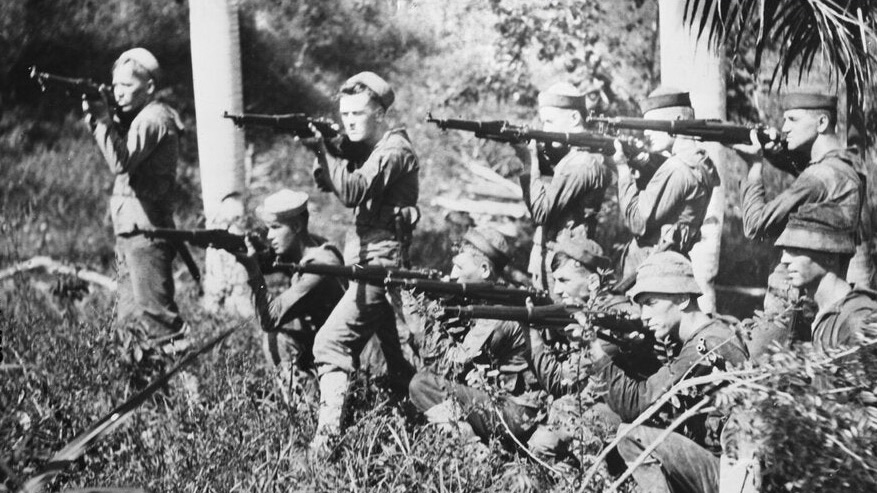
Photo: US Marines and sailors from the USS Washington ashore for the capture of Port-au-Prince, Haiti, 1915.(Source: Getty Images)
On December 17, 1914, U.S. Marines walked into the Banque Nationale de la République d'Haïti in Port-au-Prince. They weren't there to negotiate or protect. They were there to take. By the time they left, they had packed $500,000 worth of gold—today valued at roughly $96 million—into wooden crates, loaded them onto a wagon, and shipped them to a Wall Street vault controlled by National City Bank, now known as Citibank. It was, as the Haitian government immediately protested, a "flagrant invasion" of their sovereignty.
Yet this bank raid was just the opening act. Eight months later, the U.S. Marines officially invaded Haiti, beginning a 19-year military occupation that fundamentally dismantled the nation's independence. The gold was never returned, and the damage done to Haiti's financial and political systems would persist for generations. The story of how the United States systematically weakened Haiti is a masterclass in economic extraction, military coercion, and the rewriting of history to benefit corporate interests.
The seizure was a calculated move on behalf of Wall Street investors. National City Bank owned a major stake in Haiti's national bank and had aggressively lobbied the administration of President Woodrow Wilson to intervene. They wanted control over Haiti's custom houses—the country's main source of income—and feared political instability would lead to a default on debts. With World War I brewing, the U.S. was also deeply concerned about German influence in the Caribbean. The gold raid served as a double blow: it crippled Haiti's financial stability while weakening potential European competitors.
Rewriting History at Gunpoint
The theft of the gold was a precursor to a much larger project: the complete rewriting of Haiti's constitution. In 1917, the U.S. occupation forces presented a new constitution—largely drafted by Franklin D. Roosevelt, then Assistant Secretary of the Navy—that would allow foreign corporations to own Haitian land. This directly violated a law that had existed since Haiti's independence in 1804, designed to prevent the re-establishment of slavery and foreign control.
When the Haitian parliament refused to pass it, the U.S. responded with force. On June 19, 1917, Major Smedley Butler, a Marine later famous for exposing corporate war profiteering, marched armed troops into the legislative chambers. He locked the doors and officially dissolved the Haitian parliament. With the elected representatives gone, the U.S. military staged a rigged referendum in 1918. Marines stood guard at voting stations, and Haitians who voted "no" risked being beaten, jailed, or killed. The U.S. declared the new constitution passed with an absurd 99% approval rate.
The Mechanics of Extraction
The new constitution opened the door to a brutal system of forced labor known as the corvée. Marines forced thousands of Haitian peasants at gunpoint to build roads and infrastructure for foreign-owned plantations. Anyone who resisted faced severe violence. Meanwhile, the gold that was stolen in 1914 was used as the basis for fractional reserve banking, allowing National City Bank to issue millions in loans and expand its empire across Latin America.
- The Gold Value: The $500,000 stolen (24,190 troy ounces) would be worth over $96 million today at current gold prices. If invested in the stock market, it could have grown to over $20 billion.
- The 19-Year Occupation: U.S. Marines ruled Haiti with brute force from 1915 to 1934, controlling all finances and installing puppet leaders.
- The Debt Trap: Haiti was forced to take out massive loans from American banks to pay France's "independence debt," siphoning up to 80% of its budget to foreign creditors for decades.
The long-term damage was devastating. By destroying Haiti's agricultural self-sufficiency—forcing it to drop import taxes and flood the market with subsidized American rice—the U.S. turned the nation from a food producer into a dependent importer. This policy was later publicly apologized for by President Bill Clinton, who admitted it was a mistake that destroyed Haitian farmers to benefit American corporations.
A Century of Destabilization
The pattern didn't end with the Marines' departure in 1934. American financial officers controlled Haiti's budget until 1947 to ensure American banks were paid back first. During the Cold War, the U.S. funded the brutal Duvalier dictatorships, who murdered over 30,000 citizens, simply because they were anti-communist. In 1991 and again in 2004, the U.S. helped overthrow democratically elected President Jean-Bertrand Aristide, using CIA-linked forces and military coercion to remove a leader who dared to demand reparations from France.
This history brings us to a painful irony. Today, political rhetoric often refers to Haiti as a "shithole" and tells Haitians to "go back to their country." Yet the instability, poverty, and violence that define modern Haiti are not failures of the Haitian people. They are the results of deliberate, destructive policies imposed by foreign powers—policies that extracted wealth, destroyed agriculture, and installed dictators. The nation was crippled from the outside, then blamed for its own wounds.
No Ads. By Us. For Us.
This article was made possible by readers like you. We hope it inspired you to support Emerald Book, so we can continue producing content like this.
We will never show you ads, sell your data, or require a subscription to consume our content. Your gift helps us keep the truth accessible.
Click the Support button to give a gift of any amount today.
Thank you for making this work possible.