

Emerald Pages
◆
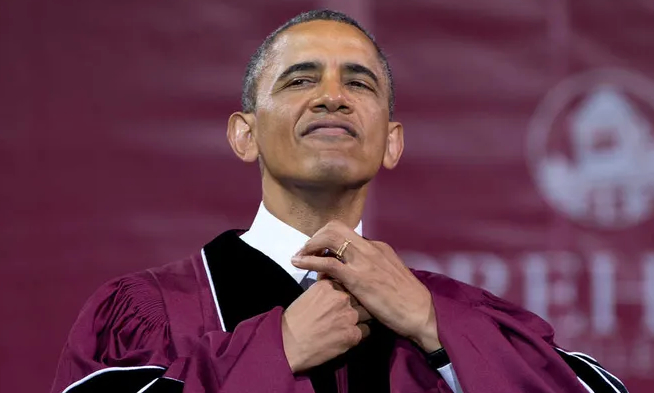
Photo: Amarillo Global-News
Former President Barack Obama has delivered a sharp and widely-discussed critique of Donald Trump, pointing out a stark contrast between the president's online bravado and his in-person demeanor. In a recent appearance on the All the Smoke podcast, Obama observed that while Trump frequently launches harsh public attacks on social media, he completely changes his tune when the two meet face-to-face. Obama's pointed remark—that Trump acts differently in person because "he knows better"—has reignited the conversation about the psychological dynamics between the two leaders.
Obama's comments were clear and direct. He explained that social media acts as a "shield," allowing people to say "crazy stuff" without immediate consequence. "He don't talk like that" in person, Obama said, implying that the aggressive rhetoric seen on Trump's social media accounts evaporates in the reality of a shared physical space. This contrast, Obama suggested, highlights a fundamental difference in how the two men operate: one is willing to deliver a roast to a person's face, while the other relies on the safety of a keyboard.
This is not the first time Obama has checked Trump, but the podcast comment has gone viral because it so perfectly encapsulates a pattern many have observed. The analogy to an "internet gangster" or a bully who only acts tough from a distance—a description coined by commentators and social media users, not Obama himself—has resonated widely. Obama himself previously made this point more famously at the 2011 White House Correspondents' Dinner, where he roasted Trump to his face while Trump sat in the audience, visibly uncomfortable. At that dinner, Obama did not hold back, mocking Trump's reality TV career and his baseless conspiracy theories about Obama's birth certificate.
A History of Public Takedowns
The 2011 dinner remains the most legendary example of Obama confronting Trump directly. However, Obama has continued to use public platforms to criticize Trump's behavior, often contrasting his own approach with Trump's. During the 2024 election cycle, Obama dropped his usual diplomatic filter, labeling Trump a "wannabe king" and a "wannabe dictator" at campaign rallies. He also publicly called a Trump-related social media post a "clown show," warning that such reckless behavior degrades political discourse.
- The 2011 Roast: Obama mocked Trump to his face at the White House Correspondents' Dinner over birtherism and reality TV.
- Political Rallies: In 2024, Obama called Trump a "wannabe dictator" and his behavior a "clown show."
- The Podcast Interview: Obama pointed out Trump's reliance on social media as a shield for insults he won't repeat in person.
The contrast could not be starker. When Obama has something to say to Trump, he has shown a willingness to say it directly, to his face, in front of the entire world. Trump, on the other hand, is known for "keyboard courage"—launching vicious attacks on social media but falling silent when forced into a formal, face-to-face setting. This was evident during the 2016 Oval Office meeting after Trump won the election, where Trump called Obama a "very good man," and at subsequent official events where both men maintained strict politeness.
The 'Keyboard Courage' Phenomenon
Obama's recent comments have shined a light on what observers see as a fundamental weakness. By using social media as a "shield," Trump can project an image of toughness without the risk of an immediate, real-world reaction. This behavior is often associated with "keyboard courage," where individuals say things behind a screen they would never dare say to someone's face. The irony and cowardice in this approach is palpable. The tough online persona does not match the diplomatic reality.
The White House responded to Obama's comments with a statement from spokeswoman Anna Kelly, who dismissed Obama as "one of the weakest and worst presidents in history." However, this defensive response did little to counter the central point Obama made: the behavior he described is a clear indicator of a discrepancy between online bravado and real-world behavior. By pointing out that Trump "knows better" than to talk that way in person, Obama exposed a dynamic that is telling and, ultimately, submissive.
No Ads. By Us. For Us.
This article was made possible by readers like you. We hope it inspired you to support Emerald Book, so we can continue producing content like this.
We will never show you ads, sell your data, or require a subscription to consume our content. Your gift helps us keep the truth accessible.
Click the Support button to give a gift of any amount today.
Thank you for making this work possible.