

Emerald Pages
◆
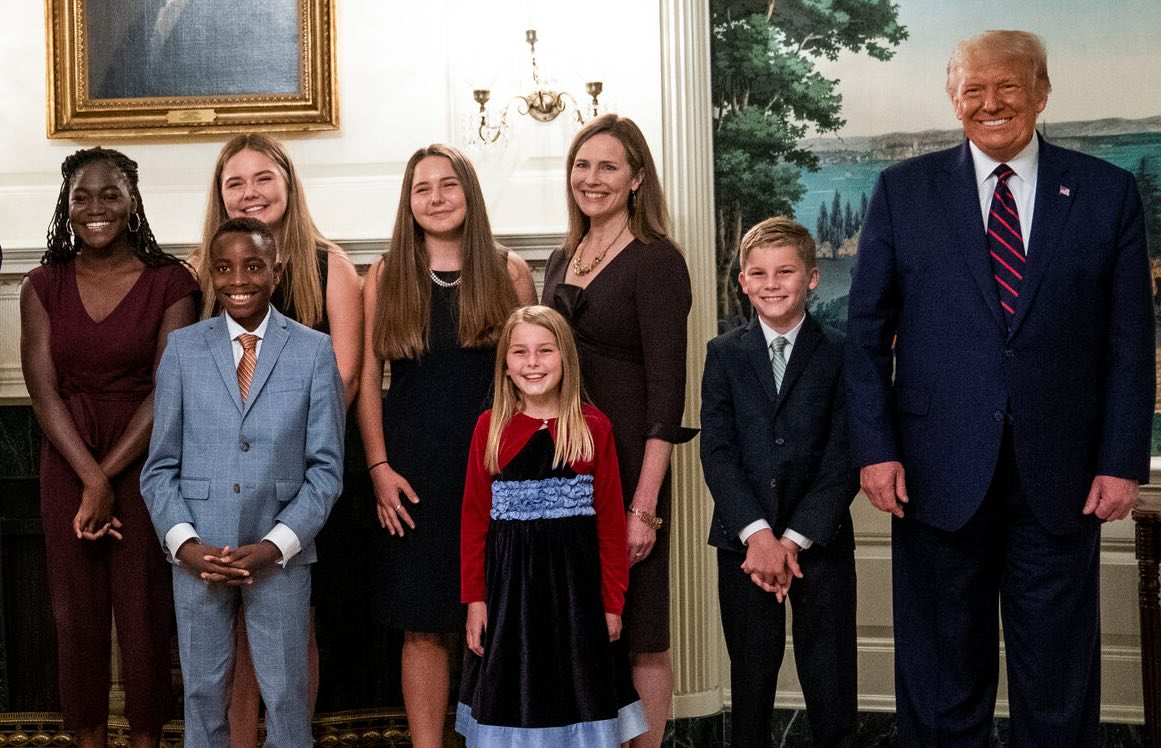
Photo: The New York Times
On June 25, 2026, the Supreme Court ruled 6–3 in Mullin v. Doe that the Trump administration could terminate Temporary Protected Status (TPS) for approximately 350,000 Haitian nationals—despite a mountain of public evidence, including the president's own widely publicized fabrications about Haitian immigrants, that suggested the policy was driven by racial animus. For the conservative majority, the case was a straightforward exercise in textualism: the official Department of Homeland Security policy was written in neutral language, and therefore the courts would not intervene.
But the ruling exposed something far more disturbing than strategic judicial restraint. It revealed a fundamental cluelessness about how modern racism actually operates. The conservative majority—including Justice Amy Coney Barrett—didn't choose to ignore the evidence because they were playing a legal game. They genuinely did not understand what they were looking at.
The irony is as painful as it is profound. Justice Barrett and her husband, Jesse, are the parents of two children adopted from Haiti. They are Black, Haitian immigrants who will navigate America as Black citizens. Yet in the courtroom, Justice Barrett adheres to a judicial philosophy that betrays a stunning lack of awareness about the reality her children will face daily: that modern discrimination rarely announces itself in explicit bureaucratic language. The Court's ruling doesn't just fail to protect her children's community—it proves she doesn't understand why they need protection in the first place.
The Legal Loophole: How Cluelessness Became Doctrine
In Mullin v. Doe, the plaintiffs presented extensive evidence of racial bias, including the president's campaign fabrications accusing Haitian immigrants of killing and eating household pets. The conservative majority, however, dismissed this evidence with surgical precision. Justice Samuel Alito, writing for the majority, held that offensive political rhetoric does not legally prove that the actual Department of Homeland Security policy was dictated by racial hatred.
- Separation of Rhetoric from Policy: The majority ruled that public comments do not automatically prove that an official policy was motivated by racial animus—as if the president's words exist in a vacuum.
- The 'Race-Neutral' Loophole: The administration provided a valid, non-racial rationale: a philosophical desire to wind down long-standing temporary programs. The court accepted this explanation on paper, ignoring the obvious context.
- An Impossible Burden of Proof: To strike down an executive action, plaintiffs must prove racial animus was a "motivating factor." The majority ruled the evidence didn't meet this threshold—a standard so high it essentially guarantees failure.
As the dissenting justices pointed out, this standard doesn't just create a loophole—it reveals a profound misunderstanding of how racism works in the 21st century. It tells politicians: You can be as openly prejudiced as you want in public, as long as your lawyers are smart enough to write the final policy using clean, race-neutral language. The majority doesn't see this as a problem because they genuinely believe racism is always overt, always explicit, and always documented in official memos.
The Personal Meets the Political
This is where Justice Barrett's personal life collides with her professional philosophy in a way that is deeply alarming. Barrett goes home to a family that includes two Black, Haitian children. Like any parent of Black children in the United States, she and her husband have undoubtedly had to navigate the realities of raising children who may face prejudice. But when she puts on her judicial robe, her legal philosophy—textualism and originalism—demands that she strip away that personal perspective.
This isn't cognitive dissonance—it's a failure of understanding. If a parent cannot see how modern racism operates on a political or societal level, how can they validate their children's lived experiences, help them navigate racial bias, or foster a healthy racial identity? Raising Black children in America requires a deep, active understanding of systemic racism, not a "colorblind" philosophy that requires explicit, written proof to acknowledge discrimination. Barrett's ruling suggests she lacks that understanding entirely.
The Supreme Court's Genuine Cluelessness
The Court's ruling in Mullin v. Doe is not merely a legal decision; it is a sociological statement. By refusing to connect the president's hostile rhetoric to the final agency actions, the conservative majority has demonstrated that they simply do not understand how racial discrimination works in modern America. This is not a strategic choice to remain "blind"—this is a genuine failure to grasp the mechanics of prejudice.
The majority's defense is that this blindness is a form of judicial discipline—that by forcing themselves to be blind to a politician's internal motives, they are preventing judges from becoming political actors. But the real-world cost is devastating. For the 350,000 Haitian TPS holders and their families, that abstract legal discipline means losing their legal status, their jobs, and their safety. And for Justice Barrett's own children, it means growing up in a country where the highest court in the land has decided that racial animus is legally invisible unless it is printed on official letterhead—because the justices genuinely don't know any better.
No Ads. By Us. For Us.
This article was made possible by readers like you. We hope it inspired you to support Emerald Book, so we can continue producing content like this.
We will never show you ads, sell your data, or require a subscription to consume our content. Your gift helps us keep the truth accessible.
Click the Support button to give a gift of any amount today.
Thank you for making this work possible.