

Emerald Pages
◆
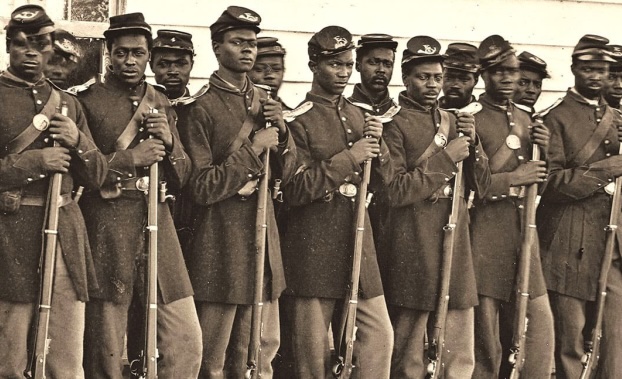
Photo: Black Civil War soldiers hold “grand review” in Harrisburg | November 1865
On June 19, 1865, Major General Gordon Granger stepped onto the balcony of the Ashton Villa in Galveston, Texas, and read aloud General Orders No. 3. The decree announced that all enslaved people in Texas were free — more than two and a half years after President Abraham Lincoln had signed the Emancipation Proclamation. But the story of Juneteenth is not a story of a gift delivered from a generous nation. It is a story of delayed justice, armed resistance, and a freedom that Black Americans seized with their own hands.
For generations, the dominant narrative has framed emancipation as a benevolent act bestowed by a white president and enforced by a white-led army. But that framing obscures the truth: freedom was not given. It was fought for, demanded, and won through the relentless resistance of enslaved people themselves — a resistance that began the moment the first enslaved African set foot on American soil and continues to this day.
Juneteenth is not a celebration of a proclamation. It is a celebration of survival, resilience, and an unbroken chain of resistance that stretches across more than 400 years. To understand the true story of Juneteenth, we must understand that the fight for freedom in America has been a near-constant war — and it is far from over.
The Truth About "Delayed Freedom"
One of the most common misconceptions about Juneteenth is that enslaved people in Texas simply didn't know they were free because "the news traveled slowly." This myth is not only false — it is deeply misleading. Enslaved people were not ignorant of world events. They had highly sophisticated communication networks, often called the "grapevine telegraph," that kept them informed about the progress of the Civil War, the Emancipation Proclamation, and the movements of Union troops.
The truth is far more brutal: enslaved people in Texas knew they were free in principle. But Texas was a Confederate stronghold, and there was no Union military presence to enforce that freedom. Slaveholders actively suppressed information about the Emancipation Proclamation, and anyone caught spreading the news faced severe punishment. The freedom declared in 1863 meant nothing without the military power to back it up.
And even then, Juneteenth did not end slavery in America. The Emancipation Proclamation only applied to Confederate states in rebellion. Slavery legally continued in loyal border states like Kentucky and Delaware — and did not end entirely until the 13th Amendment was ratified on December 18, 1865, a full six months after Granger's announcement in Galveston.
The Emancipation Proclamation Was a Military Strategy
President Lincoln did not issue the Emancipation Proclamation out of moral altruism. It was a calculated military measure to win a desperate war. By the summer of 1862, the Union was losing. Confederate armies had pushed deep into Northern territory, and European powers — Britain and France — were seriously considering recognizing the Confederacy as a legitimate nation.
Lincoln understood that transforming the war into a fight against slavery would change everything. The Emancipation Proclamation, issued on January 1, 1863, legally freed enslaved people only in states actively rebelling against the Union. Its primary goals were clear:
- Undermining the South: The proclamation encouraged more enslaved people to flee, further depleting the Confederacy's labor force.
- Blocking Foreign Aid: By explicitly tying the Union cause to abolition, Lincoln prevented anti-slavery European powers from politically recognizing or financially aiding the Confederacy.
- Enabling Black Military Service: The proclamation opened the door for Black men to enlist in the Union military — a move that would prove decisive.
Freedom Was Won, Not Given
The narrative of emancipation as a gift ignores the extraordinary agency of Black Americans in their own liberation. Long before Union troops arrived in Texas, enslaved people were actively freeing themselves — through escape, armed rebellion, and economic sabotage.
- Self-Emancipation: Hundreds of thousands of enslaved people freed themselves by fleeing plantations, slowing down work, and actively disrupting the Confederate war effort from within.
- The "General Strike": As Union armies marched into the South, enslaved laborers abandoned plantations by the hundreds of thousands. This mass flight stripped the Confederacy of its labor force and effectively crippled its wartime economy.
- The Contraband Decision: When escaping slaves reached Union lines, commanders like General Benjamin Butler refused to return them to Confederate owners, labeling them "contraband of war." This legal loophole forced the federal government to recognize that it could not fight the war without dismantling slavery.
- Military Service: Over 180,000 Black men served in the Union Army and 19,000 in the Navy — about 10% of the entire Union military force. Their combat service was a decisive factor in defeating the Confederacy and securing legal freedom.
Frederick Douglass understood this better than anyone. He fiercely pressured the Union military to enlist Black soldiers, arguing that the fight for freedom must be fought by those who had the most to gain. "Once let the black man get upon his person the brass letters U.S.," Douglass declared, "and there is no power on earth which can deny that he has earned the right to citizenship."
If Lincoln Hadn't Freed the Slaves: A Divided Continent
The decision to issue the Emancipation Proclamation was not just a moral turning point — it was the moment that determined whether the United States would survive as a single nation. Without emancipation, the United States as a singular country would have ceased to exist.
Historians who study "alternate history" point out that if the Union had not committed to freeing the slaves as a military strategy, the continent would have permanently fractured into at least two, and likely more, separate countries:
- The United States of America (The North): This country would have retained the industrial Northeast, the Midwest, and parts of the West. It would have been deeply bitter over its military defeat, highly militarized, and locked in a permanent "Cold War" style standoff with its southern neighbor.
- The Confederate States of America (The South): This would have been an explicit slave-holding empire stretching from Virginia to Texas. Its economy relied entirely on agriculture and plantation slavery. Because they couldn't expand slavery into the North, they would have likely launched wars of aggression to conquer Cuba, parts of Mexico, and Central America to build a massive slave-holding empire across the Caribbean basin.
- The Fragmented West: Without a unified federal government to secure territory, the Western frontier would have likely fractured further. The Republic of Texas might have broken away as its own independent nation again, while California and the Pacific Northwest may have formed a separate Pacific republic altogether.
A surviving Confederacy would also have faced severe global isolation. By 1865, almost every other major Western superpower — like Great Britain and France — had already outlawed slavery. The South would have eventually faced massive international embargoes and economic pressure to abolish the practice. Moreover, a nation built entirely on holding millions of people in chains through terror is fundamentally unstable. The Confederacy would have likely faced a continuous string of massive, armed Black insurrections and guerrilla warfare.
By weaponizing emancipation and recruiting Black troops, the Union didn't just end a horrific moral institution — they successfully prevented the complete balkanization and permanent collapse of North America.
America Would Not Exist Without Black People
To say "America wouldn't be America without Black people" is not a metaphor; it is a literal historical fact across every single layer of the nation's identity.
- Building the Physical Infrastructure: The U.S. Capitol Building and the White House were physically built using the labor of rented enslaved workers who quarried the stone, cut the timber, and laid the foundations. Enslaved labor crews laid thousands of miles of the southern railroad tracks that connected the continent.
- Financing the American Economy: By the mid-19th century, enslaved Black people produced roughly 60% of the world's cotton, which accounted for over half of all U.S. exports. The immense wealth generated by southern cotton financed the rise of Northern textile mills, fueled the growth of Wall Street banks, and built the American shipping industry. On the eve of the Civil War, the financial value of the 4 million enslaved Black people held in the United States was worth more than all the nation's railroads, factories, and banks combined.
- Intellectual and Agricultural Innovation: West Africans were targeted by slave traders specifically for their advanced knowledge of rice, indigo, and sugar cultivation. They introduced the complex tidal irrigation systems that made South Carolina one of the wealthiest colonies in the world. Later, free Black inventors like Lewis Latimer (who patented the carbon lightbulb filament) and Jan Matzeliger (who revolutionized the shoe industry) directly drove the American Industrial Revolution.
- The Definition of American Culture: Every single major genre of American music — rock and roll, jazz, blues, country, hip-hop, R&B, techno, and gospel — was created, innovated, and popularized by Black Americans. Without Black musical genius, the global soundtrack of the last century vanishes. The foundational flavors of American cuisine, from Southern barbecue and soul food to Cajun and Creole cooking, were created by Black chefs who blended West African traditions with local ingredients.
- The Blueprint for American Freedom: The original U.S. Constitution protected slavery and restricted power to wealthy white men. It was the 13th, 14th, and 15th Amendments — forced into existence by the Civil War and Black mobilization — that actually created a constitutional republic based on equal rights and universal citizenship. Every modern American social movement — including the women's suffrage movement, the labor movement, LGBTQ+ pride, and disability rights — directly copied the organizational blueprints, legal strategies, and protest music developed by Black freedom fighters.
Without Black people, the land mass would still be here, but the economy, the culture, the legal protections, and the very soul of what the world calls "America" would be entirely absent. Black people did not just help build America; they are the fundamental fabric of America.
A Constant, Unbroken Fight
The struggle for Black freedom in America is not a series of isolated events. It is an unbroken, multi-generational war for survival and human dignity. From the moment the first slave ship crossed the Atlantic, there has not been a single day in American history where Black people were not actively fighting for their freedom, safety, and rights.
The fight has shifted form over the centuries, but it has never stopped. Plantation resistance fueled the abolitionist movement. Black military service forced the end of legal slavery. Reconstruction battles established Black political power — only to be crushed by white backlash. Jim Crow defiance launched the Great Migration and the NAACP. The Civil Rights Movement dismantled legal segregation. And today, modern activism confronts systemic racism in all its evolving forms.
Why has the fight had to be constant? Because every time Black Americans achieved a breakthrough, the system evolved to suppress them again. When slavery ended, Jim Crow laws and sharecropping took its place. When legal segregation was defeated, mass incarceration and redlining emerged. The adversary kept changing form, and the fight had to adapt.
Common Misconceptions About the Struggle
The history of the Black freedom struggle is surrounded by deep myths that minimize Black agency, hide the financial motives of oppressors, and soften the violence of the past. These myths are not innocent errors — they are active erasures of a painful and ongoing truth.
- Myth: The Civil War was fought over "states' rights," not slavery.
Fact: This is a rewrite of history known as the "Lost Cause" narrative. The Mississippi Declaration of Secession stated plainly, "Our position is thoroughly identified with the institution of slavery — the greatest material interest of the world." - Myth: Rosa Parks was just a tired seamstress who randomly decided not to give up her seat.
Fact: Rosa Parks was a trained, veteran activist and the secretary of the local NAACP chapter. Her refusal was a calculated political act designed to launch a pre-organized economic boycott. - Myth: The fight for freedom mostly happened in the American South.
Fact: Segregation was completely national. Northern and Western cities relied on redlining, discriminatory housing covenants, and economic exclusion to trap Black communities in underfunded neighborhoods. - Myth: Juneteenth marks the official end of all slavery in America.
Fact: Slavery legally continued in loyal Union border states until the 13th Amendment was ratified on December 18, 1865.
The Fight Is Not Over
While the battleground has shifted from the open brutality of slave auctions and legal Jim Crow signs, the core struggle remains. Today, the fight is against systemic and institutional racism — systems that produce unequal outcomes for Black Americans, even without explicitly mentioning race in the law.
- The Criminal Justice System: Black Americans are incarcerated at roughly five times the rate of white Americans. Activists continue to fight against racially biased policing, mandatory minimum sentencing, and a cash bail system that disproportionately penalizes poverty.
- The Wealth Gap and Redlining: The average white family holds significantly more wealth than the average Black family. This is the compounding result of decades of historical "redlining" — where banks and the government systematically denied mortgages to Black buyers, preventing generations from building home equity.
- Voting Rights Suppression: Following the rollbacks of the Voting Rights Act, many states have passed laws that restrict early voting, close polling places in minority neighborhoods, and implement strict ID requirements. The fight for federal voting protections is as urgent now as it was in 1965.
- Maternal Health Disparities: Black women are three times more likely to die from pregnancy-related complications than white women, regardless of income or education level.
- Environmental Racism: Black and low-income communities are statistically far more likely to be located near toxic landfills, chemical plants, industrial polluters, and now AI data centers.
This is why Juneteenth is not just a celebration of a historical event. It is a reminder of an ongoing mission. It highlights the fact that freedom in America has always been delivered in stages, delayed by resistance, and won only through relentless pressure. The fight did not end in 1865, and it did not end in 1965. It continues today, in every courtroom, every classroom, and every community where Black Americans refuse to accept anything less than full and equal citizenship.
Juneteenth is a day to celebrate how far we have come — but it is also a day to recommit to the unfinished work of freedom. Because freedom is not a destination. It is a perimeter that must be constantly defended, generation after generation. And without the foundational labor, culture, and resistance of Black people, the entity known as "America" would not just be different — it simply would not exist in any meaningful way.
No Ads. By Us. For Us.
This article was made possible by readers like you. We hope it inspired you to support Emerald Book, so we can continue producing content like this.
We will never show you ads, sell your data, or require a subscription to consume our content. Your gift helps us keep the truth accessible.
Click the Support button to give a gift of any amount today.
Thank you for making this work possible.