

Emerald Pages
◆
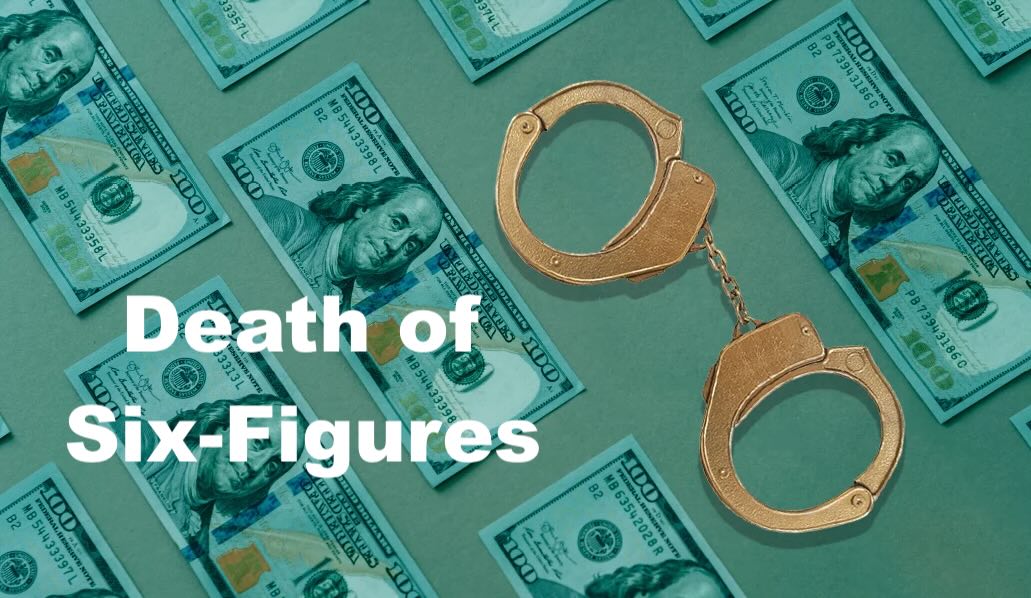
Photo: Emerald Book Image
For generations, earning a six-figure salary was the gold standard of American success—a clear marker that you had "made it." It meant financial security, a comfortable home, and the ability to afford life's luxuries without stress. However, a quiet but devastating shift has taken place. According to cumulative data from the Bureau of Labor Statistics Consumer Price Index (CPI), the 2026 economy has officially finalized the math: $100,000 today has nearly the exact same purchasing power as $50,000 did in the year 2000.
Over the last 26 years, overall consumer prices have increased by 93.39%. This means that a baseline middle-class salary from the turn of the millennium has essentially doubled in nominal dollars just to maintain the same standard of living. The shift is not just a matter of simple math; it represents a complete redefinition of what it means to be financially stable in America.
Why It Feels Worse Than the Math Suggests
While a general inflation calculator tracks a broad "basket of goods," major life necessities have outpaced standard CPI tracking. This creates an environment where a six-figure salary feels far more restrictive than a $50,000 salary did decades ago.
- Skyrocketing Car Prices: The average price of a new vehicle in 2000 hovered around $20,000, whereas it currently sits closer to $50,000. Car ownership has become a significantly heavier burden.
- Everyday Grocery Surges: Essential food items have expanded heavily. For instance, a standard carton of eggs cost roughly $0.98 in 2000 but scales closer to $3.59 today. These daily costs add up quickly.
- The $1 Million Retirement Shift: For generations, hitting a million-dollar net worth was the gold standard for financial freedom. Because $1 million in 2000 requires $1.93 million today to match purchasing power, the modern baseline retirement goal has moved closer to $2 million.
The $160,000 Reality Check
If the erosion of the $100,000 milestone feels jarring, consider what has happened to higher-income brackets. Earning $160,000 today gives you the exact same purchasing power that a $82,734 salary did in the year 2000. Alternatively, if you were earning an elite $160,000 salary back in 2000, you would require $309,424 today to maintain that exact same upper-class standard of living.
While $160,000 is objectively a high income—putting you in roughly the top 15% of individual earners nationwide—its economic identity has completely changed:
- The Old Identity (Year 2000): At the turn of the millennium, making $160,000 meant you were thoroughly rich. You could easily afford a luxury estate, multiple premium vehicles, private school tuition, and high-end vacations without a second thought.
- The Modern Identity (Today): Today, $160,000 has functionally become the new "comfortable upper-middle class." It provides excellent financial security, a reliable mortgage, robust retirement contributions, and the freedom to eat out without stress. However, in high-cost cities, it no longer buys a "luxury" lifestyle.
The Reality Check: Where the Money Goes
If you earn $160,000 today, your take-home cash feels significantly smaller due to modern structural expenses. The tax hit is substantial: a $160,000 single filer climbs heavily into the 22% and 24% federal tax brackets, meaning nearly a third of your paycheck vanishes to taxes before it even hits your bank account. The housing squeeze is equally brutal: in the year 2000, an $82,000 income easily secured a beautiful $250,000 home. Today, trying to buy that same home—now valued closer to $500,000—at modern mortgage interest rates will comfortably consume over $3,500 a month in housing costs alone.
The Timeline: When Did This Happen?
This shift did not happen overnight; it was a slow, 26-year crawl that officially crossed the finish line between 2024 and 2026. According to Bureau of Labor Statistics CPI tracking data, you can watch the precise moment the purchasing power of a year-2000 $50,000 salary disintegrated over the last few years:
- 2000: $50,000 (The ultimate baseline comfort standard).
- 2019: $74,450 (Slow, predictable 1.9% average annual inflation).
- 2022: $84,975 (The pandemic supply chain chaos kicks into overdrive).
- 2024: $91,032 (The peak of the global post-pandemic pricing spike).
- 2026 (Today): $96,695 (Effectively hitting the $100,000 psychological barrier).
If you feel like this reality suddenly slapped you in the face recently, your financial intuition is 100% correct. Between 2021 and 2023, the U.S. economy experienced a massive surge, hitting inflation peaks of 9.1%. Because of this compressed spike, more than 25% of the total inflation that occurred since the turn of the millennium happened in just a three-year window. That is why $100,000 suddenly felt incredibly restrictive practically overnight; your brain was forced to adjust to a decade's worth of typical currency devaluation in less than 36 months.
The Reclassification of Wealth
Because the line has officially been crossed, financial advisors are entirely redefining wealth metrics. The ultimate validation happened recently when economic analyses from firms like MoneyLion officially reclassified a $100,000 income into the "lower-middle class" tier across twelve different U.S. states (including Massachusetts, California, and New Jersey).
For nearly half a century, making $100,000 meant you had reached elite, upper-middle-class financial security. The recent data completely upends that rule of thumb, creating a heavy sense of money dysmorphia—a phenomenon where people earning historically high salaries still feel incredibly broke because their rent, healthcare, and basic groceries devour their income immediately.
What This Means For Your Wallet Right Now
This paradigm shift changes the practical, day-to-day rules of managing money, building a career, and planning for the future.
- The Death of the "Six-Figure" Milestone: Today, hitting $100,000 simply means you have achieved basic, baseline financial stability. It covers rent, a car payment, and groceries, but leaves very little room for luxury.
- Housing Requires Dual Incomes: With median home prices now over $420,000 (up from $119,600 in 2000), a single person making $100,000 will struggle to qualify for a mortgage in most major metro areas.
- Savings Targets Must Double: The old gold standard of saving $1 million for retirement is gone. To have the same lifestyle that $1 million provided in 2000, your new baseline retirement target must be at least $2 million.
- The New "Upper-Middle Class" is $160,000+: To afford a truly comfortable lifestyle with a premium home, luxury car, and robust savings, you now need to be earning well over $160,000—a figure that was once considered wealthy.
The new financial rules of thumb are clear: The new "Six Figures" is $200,000. Cash is a risk, as leaving large sums in a checking account means your wealth is actively shrinking. To keep up, workers attempted to aggressively switch companies to force the 15% to 20% salary jumps required to outrun this continuous devaluation. Those days are also over.
No Ads. By Us. For Us.
This article was made possible by readers like you. We hope it inspired you to support Emerald Book, so we can continue producing content like this.
We will never show you ads, sell your data, or require a subscription to consume our content. Your gift helps us keep the truth accessible.
Click the Support button to give a gift of any amount today.
Thank you for making this work possible.