

Emerald Pages
◆
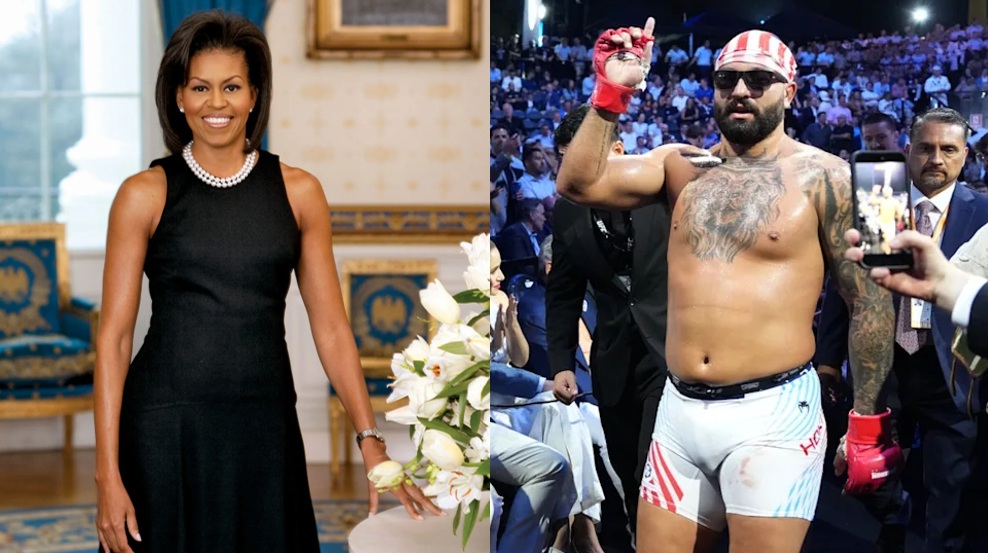
Photo: Emerald Book Image
It was supposed to be a moment of athletic triumph. On Sunday, June 14, 2026, inside an Octagon erected on the White House South Lawn for "UFC Freedom 250," heavyweight fighter Josh Hokit had just secured a second-round TKO victory over Derrick Lewis. The crowd was buzzing. The cameras were rolling. And then, without provocation, without context, without any mention of politics or the Obamas in the preceding interview, Hokit grabbed the microphone and delivered a message that was as inexplicable as it was revealing.
“And lastly — Michelle Obama is a man! Am I right, America?” he shouted, his voice echoing across the Ellipse. The comment was so sudden, so divorced from reality, that even commentator Joe Rogan froze, quickly pivoting to end the segment rather than engage with the slur. In the days that followed, while UFC CEO Dana White condemned the remark, the White House communications team notably declined to criticize it, with Steven Cheung noting only that Hokit "had a great win last night."
To the casual observer, the sequence of events might have seemed bizarre: a fighter, fresh off the biggest win of his career to insult a former First Lady who had nothing to do with the sport, the event, or even the current administration. But to those who study the history of racism in America, the "unprovoked" nature of Hokit’s attack was not an aberration. It was the thesis statement. The very lack of cause—no debate, no conflict, no threat—laid bare the inherent nature of racist aggression against Black people in this country.
The Invention of an Unprovoked Hierarchy
Racism, as sociologists and historians have documented, does not arise from experience. It is not a reaction to any objective action, behavior, or failing of the group it targets. Because race itself is a social construct—a fiction invented to justify economic exploitation and political dominance—the bias that flows from it is necessarily unprovoked. Black people did not create the concept of race; white Europeans did, in the 15th and 16th centuries, to rationalize the transatlantic slave trade. The prejudice came first. The justifications were invented later.
This is the deep, uncomfortable truth that the Hokit incident forces back into the light. There was no discussion of Michelle Obama’s policy positions. There was no debate about her public record. The fighter did not engage with anything she had said or done. Instead, he reached for one of the oldest, most degrading tropes in the white supremacist playbook: the dehumanization and masculinization of Black women. This specific form of bias, known as misogynoir, is designed to strip Black women of their femininity, dignity, and humanity. It is never earned. It is always projected.
- Historical Roots: The trope of the "unfeminine" or "aggressive" Black woman was invented during slavery to justify the brutal exploitation of Black female bodies in the field and the home.
- Modern Vessel: The "Michelle Obama is a man" conspiracy theory is a direct, 21st-century descendant of these 19th-century caricatures, repackaged for the internet age.
- The Unprovoked Nature: As seen in the June 14 broadcast, these attacks occur in neutral spaces (sporting events, book tours, children’s health initiatives) specifically because they are not about the target, but about the aggressor’s need to assert dominance.
No Consequences in a Culture That Excuses the Inexcusable
Perhaps the most damning evidence of the systemic nature of this unprovoked racism is the aftermath. Despite universal condemnation from sports journalists and civil rights leaders, the institutional response was telling. The UFC, while issuing a statement, has not announced a fine or suspension. The White House, hosting the event, refused to condemn the remark at all. And the fighter? He will fight again. He will keep his platform.
This pattern—unprovoked attack, momentary outrage, then silence—is as American as the Octagon itself. While federal law prohibits discrimination in housing and employment, the First Amendment protects most racist speech from government consequence. And in a hyper-polarized political environment, that shield becomes a sword. One political faction condemns the behavior; another faction rallies to the attacker’s defense, framing the bigotry as "anti-political correctness" or "free speech." The result is a culture where racist actors face no material risk, and their targets absorb the trauma alone.
The comparison to recent history is instructive. Just months before the UFC event, former President Donald Trump shared a video on Truth Social that used AI to depict Barack and Michelle Obama as monkeys. The racist imagery—dehumanizing the first Black president and first lady as primates—was met with a wave of outrage, but again, no consequence. The video remained online. The political base was energized. The attack served its purpose.
Josh Hokit did not wake up on June 14 intending to debate health policy or education reform. He woke up, won a fight, and chose—consciously, audibly, publicly—to express a racist belief. There was no reason. There was no provocation. There was only the inherent nature of a bias that has always existed as a self-justifying weapon, searching for a target.
To ask "why did he say that?" is to misunderstand the history of racism in America. It persists not because Black people provoke it, but because it serves a psychological and political function for those who wield it. It is a tool for dominance. And as long as there are no real consequences—as long as the White House declines to comment and the UFC declines to act—that tool will remain in the hands of anyone with a microphone and a grudge against a reality they refuse to accept.
The Octagon has been cleared from the South Lawn. The cameras have moved on. But the unprovoked slur remains, echoing not just across the Ellipse, but across four centuries of American life. It is a reminder that for Black people in this country, the attack never requires a reason—only the existence of a target.
No Ads. By Us. For Us.
This article was made possible by readers like you. We hope it inspired you to support Emerald Book, so we can continue producing content like this.
We will never show you ads, sell your data, or require a subscription to consume our content. Your gift helps us keep the truth accessible.
Click the Support button to give a gift of any amount today.
Thank you for making this work possible.